
Introduction
Navigating modern financial technology requires structured, empirical knowledge rather than speculative market hype. Millions of curious individuals explore digital tokens every single day, yet confusing technical terminology and complex software interfaces quickly overwhelm novice learners. Without a dependable educational framework, beginners frequently execute costly errors while managing initial transactions.
My early journey into blockchain technology involved an accidental chain mismatch that locked funds in limbo for hours. That stressful encounter proved that operational literacy, defensive key custody, and clear technical concepts matter infinitely more than chasing short-term price momentum. This comprehensive guide outlines the essential principles of distributed networks, personal custody, disciplined market mechanics, and modern Web3 systems.
What Is Cryptocurrency?
Cryptocurrency operates as sovereign digital money powered by advanced cryptographic algorithms and distributed computer networks. Unlike legacy fiat currencies issued by national central banks, digital tokens function without reliance on commercial banks, corporate payment processors, or administrative clearinghouses. These digital assets achieve complete operational independence by coordinating transaction verification across thousands of independent computing nodes worldwide.
- Mathematical Scarcity: Predetermined algorithmic issuance schedules eliminate arbitrary balance inflation and administrative currency debasement.
- Direct Peer-to-Peer Settlement: Global market participants send value directly to counterparties without waiting for banking approvals.
- Open Network Participation: Anyone with an active internet connection participates in open protocols without geographic discrimination.
When you study cryptocurrency for beginners, you quickly discover that mathematical verification completely replaces reliance on institutional gatekeepers.
Understanding Blockchain Technology
At its architectural core, blockchain technology functions as an append-only distributed ledger that thousands of independent computer nodes synchronize in real time. Whenever network participants initiate new transactions, distributed validators audit digital signatures and assemble those verified records into chronological data blocks. Each newly confirmed block links cryptographically to the preceding one, creating an unbreakable historical chain.
| Architectural Metric | Centralized Banking Rails | Decentralized Blockchain Networks |
| Operational Governance | Controlled by boardrooms and regulators | Governed by open mathematical consensus rules |
| Record Immutability | Subject to administrative edits and rollbacks | Cryptographically permanent and irreversible |
| System Transparency | Private, closed-door corporate ledgers | Transparent, universally verifiable ledger history |
| Network Uptime | Vulnerable to single-point server blackouts | Continuous, uninterrupted global operation |
Because the entire network replicates identical ledger records across thousands of independent machines, malicious actors cannot alter historical transactions without controlling an unachievable majority of total network computing power.
Bitcoin for Beginners: How Does Bitcoin Work?
Bitcoin delivered the first practical solution to the digital double-spending problem without employing a trusted central authority. The network runs on a battle-tested mathematical consensus system known as Proof of Work. Specialized computational computers called miners compete continuously to solve complex cryptographic puzzles, validating user transactions and minting new coins on a predictable, programmatic schedule.
Exploring Bitcoin for beginners reveals why leading financial analysts label this network digital gold. The underlying protocol establishes an unalterable limit of 21 million units, securing absolute mathematical scarcity. Whenever you broadcast a payment, miners verify your balance through unspent transaction outputs, settling your transfer permanently without exposing personal identity credentials.
What Is a Crypto Wallet?
A crypto wallet manages the cryptographic private keys that verify your ownership of digital assets on the distributed ledger. The blockchain ledger itself holds your token balances, while your personal wallet protects the digital signatures necessary to move them. Your public key serves as an account address that you can freely share, whereas your private key acts as your definitive, non-resettable master password.
- Software Hot Wallets: Browser extensions and mobile applications that provide rapid access for everyday decentralized finance transactions.
- Hardware Cold Wallets: Physical, air-gapped devices that store private keys completely offline away from internet-connected malware.
- Master Recovery Phrases: Standardized sequences of 12 to 24 words that restore your wallet access across any compatible software interface.
Retaining absolute personal custody of your private keys ensures total financial sovereignty over your digital wealth.
Crypto Security: Protecting Your Digital Assets
Practicing rigorous crypto security shields hard-earned capital against online predators, malicious smart contracts, and human procedural errors. Cybersecurity research confirms that user error, deceptive phishing campaigns, and compromised private keys cause the vast majority of personal crypto losses rather than protocol-level network failures.
Diligent security protocols transform everyday crypto operations into impenetrable personal fortifications.
Deploy the “Three-Layer Defensive Blueprint” across your operations:
- Cold Custody Storage: Keep the vast majority of long-term reserves on a dedicated physical hardware wallet.
- Physical Security Keys: Activate hardware security keys or authenticator apps rather than vulnerable SMS two-factor authentication.
- Burner Wallets: Use disposable wallet addresses when testing unknown applications to shield primary balances from harmful contracts.
Learning Crypto Trading for Beginners
Stepping into crypto trading for beginners requires mastering order book depth, execution dynamics, and market liquidity. Novice traders should always begin with spot market trading, where buyers purchase and take direct delivery of actual underlying digital tokens.
Avoid high-leverage derivative contracts while learning basic market structures. High leverage magnifies volatility, frequently liquidating novice accounts during standard market pullbacks. Focus attention on assessing trading volume, reading market capitalization, and deploying fundamental order types:
- Market Orders: Execute transactions immediately at the best available current market price.
- Limit Orders: Set a predetermined price threshold, executing trades only when market orders match targets.
- Stop-Loss Orders: Establish automated safety exits to protect capital against severe downward portfolio drawdowns.
Understanding Risk Management
Rigorous risk management separates enduring market navigators from speculators who deplete capital through emotional decisions. Capital preservation must always take priority over aggressive profit hunting in fast-moving markets. Without strict guidelines on position sizing, a few bad trades can eliminate months of steady gains.
Adopt the “Two Percent Exposure Rule” for all active market positions. Never risk more than two percent of total liquid accounts on any single trade setup. Set objective entry targets, profit milestones, and hard invalidation stop-losses before executing orders. Maintaining emotional discipline prevents chasing overextended price spikes or panicking during healthy market retracements.
How Does a Cryptocurrency Exchange Work?
A cryptocurrency exchange serves as a digital transaction venue where market participants convert traditional fiat currencies into digital assets or swap individual tokens. These platforms aggregate massive trading liquidity, matching buyers and sellers across real-time order books in milliseconds.
Centralized exchanges control custody, handle identity verification checks, and settle trades using high-speed internal databases. Decentralized exchanges rely entirely on self-executing smart contracts, letting users execute peer-to-peer asset swaps directly from non-custodial wallets. Before choosing a trading venue, examine fee structures, independent proof-of-reserve audits, withdrawal policies, and operational history.
What Is Decentralized Finance?
Decentralized finance reconstructs traditional financial instruments into transparent, permissionless software protocols running on distributed ledgers. Most of these applications operate on the Ethereum blockchain, utilizing programmable smart contracts to facilitate transactions without human loan managers, underwriters, or banking committees.
Consider a practical use case: a business owner requires short-term liquidity but refuses to liquidate long-term digital asset holdings. By locking tokens as collateral inside a verified lending protocol, they borrow stable assets within seconds. The underlying protocol manages loan parameters automatically, liquidating collateral only if values fall below agreed safety margins, entirely bypassing manual underwriting processes.
Web3 for Beginners
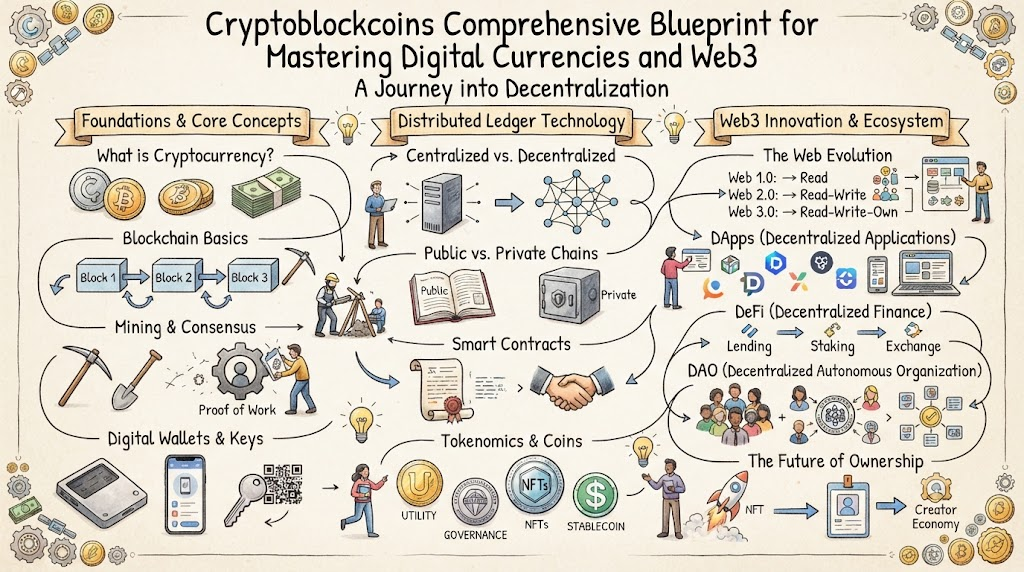
Studying Web3 for beginners reveals the progressive migration of the internet from centralized corporate platforms toward user-governed ecosystems. While early web architectures allowed users to consume static text and modern social platforms let people publish content, Web3 enables verifiable ownership of digital data, identity, and assets.
- Web1 Era (Read): Open, decentralized protocols hosting static, read-only information pages.
- Web2 Era (Read-Write): Centralized corporate platforms that monetize personal user data while dictating access rules.
- Web3 Era (Read-Write-Own): Open blockchain applications that grant participants direct sovereignty through cryptographic keys and tokenized governance.
Decentralized identities and open-source applications empower users to navigate digital spaces without corporate gatekeepers capturing platform value.
Common Cryptocurrency Mistakes Beginners Should Avoid
Unseasoned market participants consistently fall into predictable behavioral traps during rapid market expansions. Recognizing standard behavioral hazards early shields both sanity and portfolio balances:
- Chasing Parabolic Runs: Buying speculative tokens after massive price runs due to fear of missing out.
- Saving Keys Digitally: Storing seed phrases in cloud drives, smartphone note apps, or email folders.
- Signing Unvetted Approvals: Granting broad contract permissions on unverified websites without reviewing token transfer limits.
- Ignoring Network Fees: Transferring small token amounts during peak network congestion when execution costs skyrocket.
A Practical Learning Path for New Crypto Users
Developing lasting competence across digital asset ecosystems requires a phased progression. Follow this structured roadmap to build capabilities safely:
- Foundation Milestone: Master distributed ledger fundamentals, cryptographic hashing, and Bitcoin monetary economics.
- Custody Milestone: Acquire a non-custodial hardware wallet, write down mnemonic recovery phrases on physical media, and practice small test transfers.
- Execution Milestone: Fund exchange accounts, study order depth charts, and execute non-leveraged spot purchases.
- Ecosystem Milestone: Interact cautiously with decentralized lending pools and automated token exchanges using minimal capital allocations.
Why Crypto Education Matters
Comprehensive digital asset education remains essential because blockchain transactions settle with irreversible finality. If users transmit tokens to invalid recipient addresses or compromise private keys, no banking ombudsman can reverse transactions.
Solid technical knowledge gives individuals tools to evaluate blockchain projects objectively. Understanding protocol incentives allows spotting sustainable technology through empty marketing hype. Independent education stands as reliable defense against catastrophic mistakes in decentralized finance.
Explore Cryptocurrency Learning With CryptoBlockCoins
CryptoBlockCoins equips newcomers with clear, practical tutorials covering digital currencies, secure custody setups, and decentralized networks. The platform translates complicated cryptographic concepts into plain, accessible lessons studied at individual paces.
Whether users want to understand how the Ethereum blockchain runs decentralized applications, how to configure hardware keys, or how to avoid common trading pitfalls, CryptoBlockCoins delivers dependable instructional content. Secure self-custody habits, sensible risk guidelines, and objective research help navigate modern digital assets with total clarity.
Frequently Asked Questions About cryptoblockcoins
Which core concepts constitute the foundational curriculum across the portal?
Instructional modules systematically review distributed ledgers, non-custodial wallet management, market trading mechanics, token security protocols, and decentralized Web3 applications.
Does platform content supply customized financial or investment counseling?
Independent technical education forms the core of published resources, intentionally excluding financial, legal, or investment advice.
Can individuals without engineering backgrounds grasp these lessons easily?
Clear terminology breaks down advanced cryptographic principles into intuitive concepts tailored specifically for absolute beginners.
Do readers encounter subscription walls while accessing platform resources?
All educational articles and structural guides remain completely free to support independent reader research.
How do platform tutorials train users regarding hardware key protection?
Step-by-step walkthroughs demonstrate configuring offline devices, engraving recovery seed phrases onto steel plates, and shielding balances from digital surveillance.
Does instructional content cover active market trading strategies?
Guides detail spot order execution, order book analysis, trading volume metrics, and disciplined risk-management frameworks.
Which advanced technological sectors receive analysis across the site?
Articles examine autonomous smart contracts, liquidity pools, decentralized lending systems, and evolving Web3 infrastructure.
Can participants execute direct token trades on the platform?
The site operates exclusively as an educational knowledge repository and never provides brokerage services, asset custody, or exchange settlement.
How do educational guides contrast Bitcoin with Ethereum?
Materials present Bitcoin as an immutable store of value while explaining Ethereum as a programmable computational engine for decentralized applications.
Why must novice operators prioritize study before deploying capital?
Permanent transaction settlement on blockchain networks makes foundational technical education mandatory to prevent irreversible operational errors and balance losses.
Final Thoughts
Unlocking decentralized digital networks provides powerful pathways for personal financial independence and global digital coordination. Although initial technical hurdles demand patience, systematic study transforms complicated protocols into routine operational habits. Prioritize self-custody diligence, enforce strict risk parameters, and continue building competence through trusted educational channels before deploying financial capital.