Introduction
Space travel is one of the most demanding environments humans have ever experienced. Unlike life on Earth, spaceflight exposes astronauts to microgravity, radiation, isolation, unusual sleep schedules, and limited access to medical facilities.
The human body is designed to function under Earth’s gravity and environmental conditions. When astronauts enter space, several body systems have to adapt to a very different environment. Some effects may appear quickly, while others become more important during longer missions.
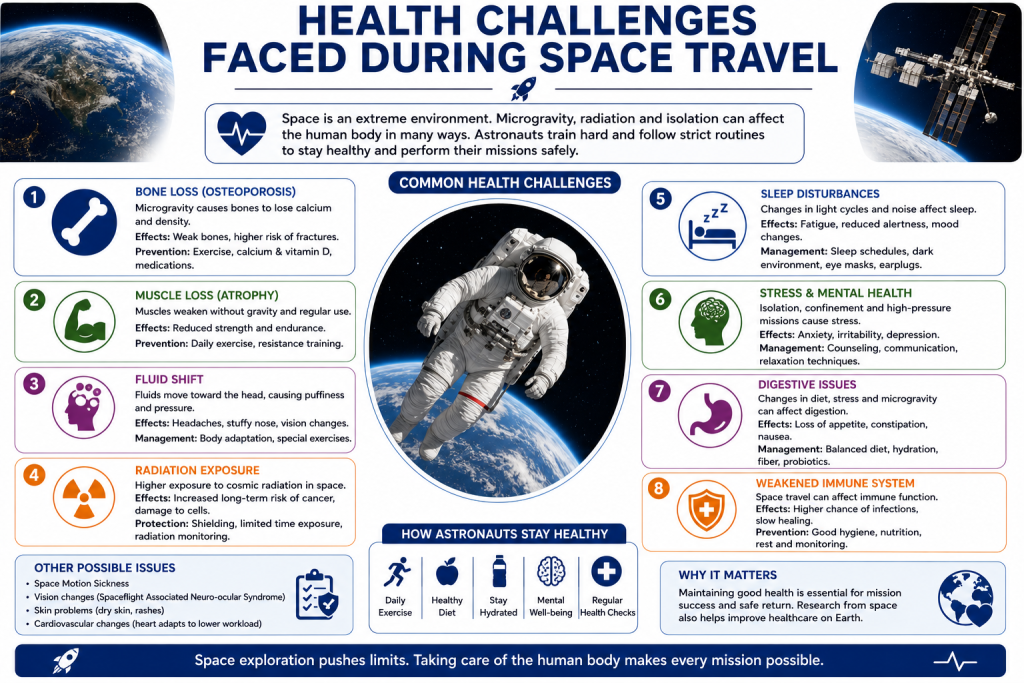
Common concerns can include motion sickness, muscle loss, bone loss, cardiovascular changes, vision-related effects, sleep disruption, psychological stress, immune changes, and radiation exposure.
Astronauts undergo extensive preparation and health monitoring before, during, and after missions to manage these challenges. Understanding space-related health risks is particularly important as future missions are expected to last longer and travel farther from Earth.
Understanding How Space Travel Affects the Human Body
The human body constantly responds to gravity. Muscles help maintain posture, bones support body weight, and the cardiovascular system works to circulate blood throughout the body against Earth’s gravitational pull.
In microgravity, many of these normal demands are reduced or changed.
Spaceflight can influence:
- Muscles and bones
- Balance and coordination
- Blood and fluid distribution
- Cardiovascular function
- Vision
- Sleep patterns
- Immune responses
- Psychological well-being
The effects are not identical for every astronaut. Individual health, mission duration, workload, spacecraft environment, and other factors can influence how a person responds to spaceflight.
Major Health Challenges Faced During Space Travel
Space Motion Sickness
Space motion sickness is one of the health challenges astronauts may experience during the early stages of spaceflight.
On Earth, the brain receives information about body movement from the eyes, inner ear, and other sensory systems. In microgravity, these signals can change, causing the brain to adapt to a different sense of movement and orientation.
Possible symptoms include:
- Nausea
- Vomiting
- Dizziness
- Headache
- Disorientation
- General discomfort
For many astronauts, the problem is associated with the adaptation period after entering space. Astronaut training and medical support help crews prepare for these effects.
Muscle Loss and Physical Deconditioning
Muscles are constantly working against gravity on Earth. In microgravity, the body does not need to support its weight in the same way.
As a result, extended spaceflight can contribute to muscle weakening and physical deconditioning.
Areas of concern can include muscles involved in:
- Standing
- Walking
- Maintaining posture
- Supporting body weight
Exercise is an important countermeasure during space missions. Astronauts use specially designed exercise equipment to provide physical loading despite the microgravity environment.
Physical conditioning before and after a mission is also important for maintaining and recovering physical capability.
Bone Loss
Bones also respond to mechanical loading.
On Earth, activities such as walking and standing place regular loads on the skeleton. In microgravity, this loading is greatly reduced, which can contribute to loss of bone mineral density during extended missions.
Bone health is important because reduced bone strength can create concerns during and after spaceflight.
Astronaut health programs therefore consider:
- Exercise
- Nutrition
- Medical monitoring
- Post-flight rehabilitation
Recovery after returning to Earth can take time, and astronauts may require continued monitoring and rehabilitation.
Cardiovascular Changes
The cardiovascular system also adapts to microgravity.
On Earth, gravity influences the distribution of blood and other body fluids. In microgravity, fluids can shift toward the upper part of the body.
This redistribution can contribute to changes in:
- Blood volume
- Heart function
- Blood pressure regulation
- Cardiovascular adaptation
After returning to Earth, the cardiovascular system must readjust to Earth’s gravity.
Some astronauts may experience difficulty standing or maintaining normal circulation immediately after landing. Rehabilitation and medical monitoring can support the readaptation process.
Fluid Shift and Facial Changes
One noticeable effect of microgravity is the movement of body fluids toward the upper body and head.
This fluid shift can contribute to:
- Facial puffiness
- Nasal congestion
- Changes in pressure around the head
- Changes in fluid distribution
These effects are part of the body’s adaptation to the space environment.
Scientists continue to study how fluid shifts may interact with other physiological changes during longer missions.
Vision and Eye-Related Changes
Some astronauts experience changes involving the eyes and visual system during spaceflight.
Researchers have identified spaceflight-associated neuro-ocular effects involving changes that can affect structures around the eyes and the visual system.
Possible concerns may include:
- Changes in vision
- Changes in the shape or structure of the eye
- Fluid-related effects
- Changes involving the optic structures
Not every astronaut experiences the same effects, and researchers continue to investigate why some individuals may be more susceptible than others.
Vision health is particularly important because astronauts rely heavily on visual information while operating equipment, conducting experiments, and performing mission tasks.
Radiation Exposure
Radiation is one of the major health concerns associated with space travel.
Earth’s atmosphere and magnetic field provide significant protection from certain types of space radiation. Astronauts outside this protective environment can encounter radiation from sources such as:
- Solar particle events
- Galactic cosmic radiation
- Other radiation environments encountered beyond low Earth orbit
Radiation exposure can damage cells and increase potential long-term health risks.
The issue becomes particularly important for future missions beyond Earth’s protective environment because astronauts may spend much longer periods exposed to space radiation.
Radiation protection is therefore an important part of spacecraft design, mission planning, and astronaut health research.
Sleep and Circadian Rhythm Problems
Sleep can be difficult during spaceflight.
Astronauts may experience unusual light-dark cycles, scheduled work periods, spacecraft noise, mission demands, and changes in their normal routines.
In low Earth orbit, the spacecraft can experience multiple sunrise and sunset periods during a single Earth day, making normal day-night cues more difficult to maintain.
Poor sleep can affect:
- Concentration
- Reaction time
- Memory
- Decision-making
- Mood
- Mission performance
Maintaining appropriate sleep schedules and environmental conditions is therefore an important part of crew health management.
Psychological Stress
Space travel is physically demanding, but it can also create psychological challenges.
Astronauts may spend extended periods in a confined environment with limited privacy and separation from family and friends.
Possible sources of stress include:
- Isolation
- Confinement
- High workload
- Emergency situations
- Limited personal space
- Separation from family
- Communication challenges
- Mission uncertainty
Team relationships are also important. Astronauts need to work closely with one another for extended periods, making communication, teamwork, and conflict management essential.
Psychological preparation and ongoing support can help crews manage these demands.
Immune System Changes
Spaceflight can affect the body’s immune system.
Researchers have observed changes in immune responses during spaceflight, although the exact mechanisms and long-term implications continue to be studied.
Changes in immune function can be relevant because astronauts operate in an environment where medical resources are more limited than on Earth.
Preventive healthcare, hygiene, health monitoring, and appropriate medical planning therefore remain important throughout a mission.
Infection and Illness Management
Managing illness in space is different from managing illness on Earth.
A spacecraft does not provide the same medical infrastructure as a hospital. Crew members may have access to medical supplies and trained support, but advanced treatment options can be limited.
Preventive measures can include:
- Medical screening
- Hygiene procedures
- Health monitoring
- Medical supplies
- Crew medical training
- Ground-based medical support
Preventing avoidable illness is especially important during missions where returning to Earth quickly may not be possible.
Skin and Wound-Healing Concerns
Skin health can also require attention during spaceflight.
Minor injuries that would be relatively simple to manage on Earth may require additional consideration when access to advanced medical facilities is limited.
Astronauts therefore receive medical training and follow procedures designed to reduce injury risks and manage health problems during missions.
Researchers also continue to investigate how spaceflight conditions may influence healing and other biological processes.
Dental Health
Dental problems can become particularly inconvenient during space missions.
A dental emergency on Earth can often be treated relatively quickly by visiting a dentist. During a space mission, that option may not be available.
For this reason, dental health is considered during astronaut medical preparation.
Preventive dental care before launch can help reduce the possibility of serious dental problems during a mission.
Gastrointestinal and Nutritional Challenges
Nutrition plays an important role in astronaut health.
Spaceflight can influence appetite, food preferences, meal schedules, and the way astronauts interact with food.
Astronauts need adequate nutrition to support:
- Muscle health
- Bone health
- Immune function
- Energy
- General physical performance
Mission food is carefully planned to provide appropriate nutrients while also meeting the practical requirements of storage, preparation, and consumption in space.
Hydration is also an important part of maintaining health and performance.
Comparison of Major Health Challenges in Space
| Health Challenge | Main Cause or Contributor | Possible Impact |
|---|---|---|
| Space motion sickness | Adaptation to microgravity | Nausea, dizziness, disorientation |
| Muscle loss | Reduced physical loading | Reduced strength and physical capacity |
| Bone loss | Reduced skeletal loading | Lower bone mineral density |
| Cardiovascular changes | Fluid redistribution and microgravity | Difficulty adapting to Earth’s gravity |
| Radiation exposure | Space radiation | Potential long-term health risks |
| Sleep disruption | Lighting, schedules, environment | Fatigue and reduced concentration |
| Psychological stress | Isolation and confinement | Mood and behavioral challenges |
| Vision-related changes | Fluid shifts and other factors | Possible visual or ocular changes |
| Immune changes | Spaceflight environment | Altered immune responses |
| Nutritional challenges | Mission environment and diet | Reduced energy or nutrient intake |
These effects can vary between astronauts. Not every crew member experiences every health challenge to the same degree.
Health Challenges During Short-Duration vs Long-Duration Missions
The duration of a space mission can influence the importance of different health concerns.
Short-Duration Space Missions
During shorter missions, astronauts may encounter challenges such as:
- Motion sickness
- Sleep disruption
- Fluid shifts
- Fatigue
- Psychological adjustment
- Changes in balance and coordination
Some of these effects are related to the body’s initial adaptation to microgravity.
Long-Duration Space Missions
Longer missions create additional concerns because astronauts remain in the space environment for much longer.
These may include:
- Muscle loss
- Bone loss
- Radiation exposure
- Cardiovascular changes
- Immune changes
- Psychological stress
- Nutritional challenges
- Vision-related changes
- Greater dependence on onboard medical support
Future missions to the Moon and Mars will require careful planning for these long-term health challenges.
How Astronauts Prepare for Health Challenges
Pre-Flight Medical Screening
Astronauts undergo detailed medical evaluation before missions.
Depending on the mission and applicable program, medical preparation may consider:
- Cardiovascular health
- Vision
- Hearing
- Physical fitness
- Musculoskeletal health
- Dental health
- Psychological readiness
- Medical history
The purpose is to identify and manage potential health concerns before launch.
Physical Training
Astronauts participate in physical conditioning before spaceflight.
Training helps develop strength, endurance, coordination, and overall physical capability needed for mission activities and adaptation to the space environment.
Exercise in Space
Exercise is an important part of maintaining physical health during spaceflight.
Specialized equipment allows astronauts to perform activities designed to provide physical loading in microgravity.
Exercise can help reduce some of the physical deconditioning associated with extended spaceflight, although it does not eliminate every physiological effect.
Nutrition Planning
Astronaut meals are planned with the nutritional and practical requirements of spaceflight in mind.
Nutrition supports:
- Energy levels
- Muscle maintenance
- Bone health
- Immune function
- Overall health
Food must also be suitable for storage, preparation, and consumption in the spacecraft environment.
Psychological Preparation
Astronauts receive preparation for the psychological demands of spaceflight.
Training can include:
- Teamwork
- Communication
- Stress management
- Emergency response
- Isolation management
- Problem-solving
These skills can be especially important during longer missions.
Medical Training
Astronauts receive medical training appropriate to their mission responsibilities.
They may need to understand basic medical procedures and how to use available medical equipment.
This is particularly important when immediate access to a doctor or hospital is not possible.
Medical Monitoring During Space Missions
Astronaut health continues to be monitored after launch.
Depending on the mission, health monitoring can include areas such as:
- Physical performance
- Sleep
- Cardiovascular responses
- Vision
- Nutrition
- Psychological well-being
- General medical status
Ground-based medical teams can support astronauts through communication and mission-specific medical procedures.
This combination of onboard capability and Earth-based support helps crews manage health concerns while in space.
How Astronauts Manage Health Problems in Space
Medical care in space requires careful planning because resources are limited compared with a hospital on Earth.
Health management may involve:
- Preventive healthcare
- Exercise
- Nutrition
- Medical supplies
- Crew medical training
- Ground-based medical support
- Health monitoring
- Emergency procedures
Prevention is especially important because some medical problems may be difficult to treat in orbit.
The medical approach also has to consider the mission’s duration, distance from Earth, crew size, spacecraft design, and available equipment.
Health Challenges After Returning to Earth
Returning to Earth does not immediately end the effects of spaceflight.
The body must readapt to gravity and normal environmental conditions.
Balance and Coordination
Astronauts may temporarily experience changes in balance and coordination after landing because the brain and body have adapted to microgravity.
Walking and standing can require adjustment after spending time in space.
Muscle and Strength Recovery
Astronauts may need rehabilitation after extended missions to rebuild strength and physical capability.
The length and type of recovery can vary depending on the mission and individual circumstances.
Cardiovascular Readaptation
The cardiovascular system must readjust to Earth’s gravitational environment.
This can make standing and moving around difficult immediately after returning from space.
Bone Recovery
Bone health may require continued monitoring after a long-duration mission.
Recovery can take time and may involve exercise, nutrition, and medical follow-up.
Psychological Readjustment
Returning to Earth can also involve psychological adjustment.
Astronauts move from a highly structured and isolated environment back into normal life, work, family routines, and Earth’s social environment.
Post-flight support can help with this transition.
Why Deep-Space Missions Present Additional Health Challenges
Future missions to the Moon, Mars, and other destinations may create challenges that are more difficult than those encountered during many low Earth orbit missions.
Important concerns include:
- Longer radiation exposure
- Greater communication delays
- Greater distance from Earth
- Limited emergency evacuation options
- Greater dependence on onboard medical capability
- Long-term psychological isolation
- Extended exposure to microgravity
- Limited medical resources
For example, a medical emergency during a distant mission cannot necessarily be handled by returning the astronaut to Earth quickly.
This makes autonomous medical capability, prevention, crew training, and spacecraft design increasingly important.
Common Misconceptions About Space Travel and Human Health
Space Is Only Dangerous Because of Zero Gravity
Microgravity is an important factor, but it is not the only health challenge.
Radiation, isolation, sleep disruption, nutrition, psychological stress, and limited medical resources also need to be considered.
Astronauts Become Completely Weightless
The commonly used term “weightless” describes the experience of microgravity, but it does not mean that gravity has completely disappeared.
Astronauts and spacecraft remain within gravitational fields. Their apparent weightlessness results from continuous free-fall conditions.
Exercise Completely Prevents Muscle and Bone Loss
Exercise is an important countermeasure, but it does not necessarily eliminate every physiological effect of extended spaceflight.
Astronauts still require medical monitoring and post-flight recovery.
Every Astronaut Experiences the Same Health Problems
Human responses to spaceflight can vary.
Mission duration, individual characteristics, workload, spacecraft conditions, and other factors can influence the effects experienced by an astronaut.
Space Medicine Only Begins After Launch
Astronaut health management begins long before launch.
Medical screening, physical conditioning, dental care, psychological preparation, nutrition planning, and mission-specific training are all part of preparing for spaceflight.
Astronauts Can Easily Return to Earth for Medical Treatment
This depends heavily on the mission.
Returning to Earth may be possible relatively quickly from some low Earth orbit missions, but it becomes much more difficult for distant missions.
This is one reason why future deep-space missions require greater onboard medical capability.
How Space Agencies Support Astronaut Health
Astronaut health programs involve more than treating illness after it occurs.
Medical and mission teams can focus on:
- Medical screening
- Fitness programs
- Nutrition planning
- Psychological support
- Biomedical research
- In-flight monitoring
- Exercise countermeasures
- Post-flight rehabilitation
These activities help reduce health risks and improve astronauts’ ability to perform their mission responsibilities.
Space medicine also contributes to research that may improve understanding of how the human body responds to extreme environments.
Future Approaches to Protecting Astronaut Health
As human space missions become longer and travel farther from Earth, new approaches to astronaut health will become increasingly important.
Areas of research and development include:
- Improved exercise systems
- Better radiation protection
- Advanced medical monitoring
- Telemedicine
- Autonomous medical systems
- Improved spacecraft habitats
- Personalized health planning
- Better nutrition systems
- Long-duration psychological support
Future crews may need to manage medical situations with less immediate assistance from Earth.
For missions to Mars, communication delays could make real-time medical consultation difficult. This means astronauts and spacecraft may need greater medical autonomy.
Frequently Asked Questions
1. What are the most common health challenges during space travel?
Common challenges include motion sickness, muscle and bone loss, fluid shifts, cardiovascular changes, sleep disruption, radiation exposure, psychological stress, nutritional concerns, immune changes, and possible vision-related effects.
2. Why do astronauts experience motion sickness in space?
The brain receives different sensory information in microgravity compared with Earth’s gravity. The eyes, inner ear, and body may send signals that the brain initially finds difficult to reconcile, which can lead to nausea and disorientation.
3. Does space travel cause muscle loss?
Extended exposure to microgravity can contribute to muscle loss because muscles no longer work against Earth’s gravity in the same way. Exercise is used during missions to help reduce physical deconditioning.
4. Why do astronauts lose bone density in space?
Bones respond to mechanical loading. In microgravity, the skeleton experiences much less loading than it does on Earth, which can contribute to loss of bone mineral density during extended missions.
5. How does space radiation affect astronaut health?
Space radiation can interact with biological tissues and damage cells. Long-term exposure may increase certain health risks, making radiation protection an important consideration for space missions.
6. Why can astronauts experience vision changes?
Changes in fluid distribution and other physiological effects of spaceflight may affect the eyes and visual system. Researchers continue to study the causes and long-term significance of these changes.
7. How does space travel affect sleep?
Spacecraft schedules, artificial lighting, noise, workload, mission demands, and unusual day-night cycles can interfere with normal sleep patterns. Sleep management is important for maintaining alertness and performance.
8. Can astronauts experience psychological stress in space?
Yes. Isolation, confinement, workload, separation from family, limited privacy, and emergency situations can create psychological challenges. Astronauts receive preparation and support to help manage these demands.
9. How do astronauts receive medical care during a mission?
Astronauts may have medical supplies, trained crew members, onboard procedures, health-monitoring equipment, and support from medical teams on Earth. The exact capabilities depend on the mission and spacecraft.
10. Why are long-duration missions to Mars more medically challenging?
Mars missions would involve much longer exposure to microgravity and radiation, greater distance from Earth, communication delays, limited emergency evacuation options, and greater dependence on onboard medical resources.
Conclusion
Space travel places unique demands on the human body and mind. Microgravity can affect muscles, bones, cardiovascular function, balance, and fluid distribution, while other aspects of spaceflight can introduce concerns related to radiation, vision, sleep, nutrition, immunity, and psychological health.
Astronauts prepare for these challenges long before launch through medical screening, physical training, nutrition planning, psychological preparation, and mission-specific medical training. Health monitoring and exercise continue during the mission, while rehabilitation and medical follow-up remain important after returning to Earth.
The challenges become even more significant as human exploration moves toward longer missions and destinations farther from Earth. A journey to Mars, for example, would require astronauts to remain healthy and capable while dealing with greater radiation exposure, communication delays, limited medical resources, and extended isolation.