Introduction
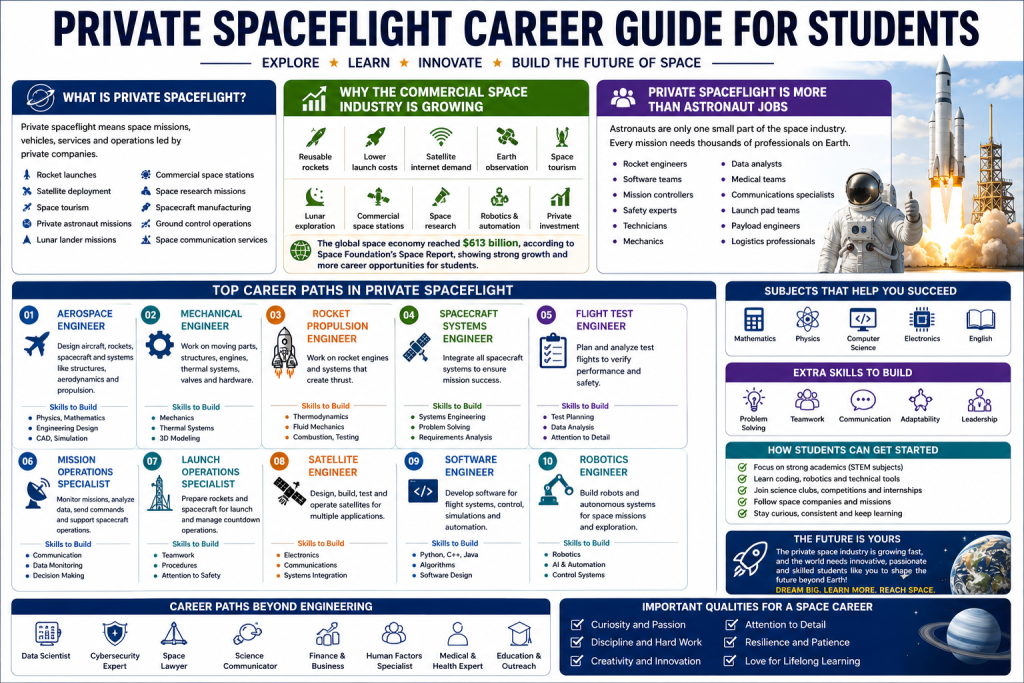
Private spaceflight is opening a new chapter in space exploration. Space is no longer limited only to government agencies and career astronauts. Today, private companies are building rockets, spacecraft, satellites, lunar landers, space stations, astronaut training programs, and space tourism experiences.
For students, this creates exciting career opportunities. You do not need to become an astronaut to work in space. The private space industry needs engineers, software developers, technicians, mission planners, data scientists, cybersecurity experts, medical professionals, operations teams, business specialists, and many more skilled people.
This guide explains what private spaceflight is, which careers students can explore, what subjects and skills matter, and how to start preparing for a future in the commercial space industry.
What Is Private Spaceflight?
Private spaceflight means space-related missions, vehicles, services, and operations led by private companies instead of only government space agencies.
Private spaceflight can include:
- Rocket launches
- Satellite deployment
- Space tourism
- Private astronaut missions
- Lunar lander missions
- Commercial space stations
- Space research missions
- Spacecraft manufacturing
- Ground control operations
- Space communication services
Government agencies still play a major role, but private companies are now important partners in building the future of space exploration.
Why the Commercial Space Industry Is Growing
The commercial space industry is growing because technology, investment, and demand are changing quickly.
Major growth drivers include:
- Reusable rockets
- Lower launch costs
- Satellite internet demand
- Earth observation
- Space tourism
- Lunar exploration
- Commercial space stations
- Space research
- Robotics and automation
- Private investment
The global space economy reached $613 billion, according to Space Foundation’s Space Report release, showing strong growth in commercial and government space activity. This growth means more career opportunities for students interested in STEM and space technology.
Private Spaceflight Is More Than Astronaut Jobs
Many students think space careers only mean becoming an astronaut. That is not true.
Astronauts are only one small part of the space industry. Every mission requires thousands of professionals on Earth.
A single space mission may need:
- Rocket engineers
- Software teams
- Mission controllers
- Safety experts
- Technicians
- Mechanics
- Data analysts
- Medical teams
- Communications specialists
- Launch pad teams
- Payload engineers
- Logistics professionals
So, if you love space but do not want to become an astronaut, you still have many career options.
Top Career Paths in Private Spaceflight
Aerospace Engineer
Aerospace engineers design aircraft, rockets, spacecraft, and related systems. They work on structures, aerodynamics, propulsion, thermal systems, and vehicle performance.
Students interested in this career should study physics, mathematics, engineering design, and computer simulation. Aerospace engineering is one of the most direct pathways into private spaceflight.
Mechanical Engineer
Mechanical engineers work on moving parts, structures, mechanisms, thermal control systems, valves, engines, and hardware.
They may help design rocket components, spacecraft doors, landing systems, robotic arms, or test equipment. This role is useful across almost every space company.
Rocket Propulsion Engineer
Propulsion engineers work on rocket engines and systems that create thrust.
They study combustion, fuel flow, pressure systems, turbopumps, nozzles, and engine testing. This is a highly technical career that requires strong knowledge of physics, thermodynamics, and fluid mechanics.
Spacecraft Systems Engineer
Systems engineers connect different parts of a spacecraft into one working mission.
They make sure power, communication, software, structures, life support, propulsion, and mission requirements work together. This role is ideal for students who enjoy big-picture thinking and problem-solving.
Flight Test Engineer
Flight test engineers plan and analyze test flights. They help verify whether rockets, aircraft, spacecraft, and systems perform safely.
They work closely with pilots, engineers, safety teams, and data analysts. This role requires strong technical knowledge and attention to detail.
Mission Operations Specialist
Mission operations specialists help manage spacecraft missions after launch.
They monitor spacecraft health, review data, send commands, support astronauts or payloads, and respond to technical issues. This career is important for satellites, space stations, lunar missions, and private astronaut flights.
Launch Operations Specialist
Launch operations teams prepare rockets and spacecraft before launch.
They may work on countdown procedures, fueling, ground equipment, safety checks, vehicle readiness, and coordination with mission control. This role is exciting for students who enjoy high-pressure teamwork.
Satellite Engineer
Satellite engineers design, build, test, and operate satellites.
Satellites are used for communication, navigation, weather monitoring, defense, internet services, and Earth observation. Because satellite demand is growing, this is one of the strongest space career areas.
Software Engineer
Software is essential in modern spaceflight.
Software engineers work on flight software, simulations, mission control tools, navigation systems, robotics, cybersecurity, data platforms, and automation.
Students interested in this role should learn programming languages such as Python, C++, Java, or Rust.
Robotics Engineer
Robotics engineers design machines that can work in space, on the Moon, on Mars, or inside spacecraft.
They may work on robotic arms, rovers, autonomous vehicles, inspection robots, or space manufacturing tools.
AI and Machine Learning Engineer
Artificial intelligence is becoming important in spacecraft operations, satellite data analysis, autonomous navigation, and robotics.
AI engineers may build systems that help spacecraft make decisions, analyze images, detect faults, or improve mission planning.
Data Scientist
Space missions create huge amounts of data.
Data scientists analyze satellite imagery, engineering telemetry, mission performance, environmental data, and scientific information. This role combines statistics, programming, and domain knowledge.
Cybersecurity Specialist
Space systems must be protected from cyber threats.
Cybersecurity specialists help secure satellites, ground stations, mission networks, communication links, and company systems. As private space infrastructure grows, cybersecurity will become even more important.
Space Medicine Professional
Space medicine focuses on human health in space.
Doctors, biomedical engineers, psychologists, exercise scientists, and life-support specialists may work on astronaut health, microgravity effects, radiation exposure, emergency care, and human performance.
Space Tourism Operations Specialist
Space tourism companies need professionals who can manage passenger experience, safety procedures, training schedules, customer support, and mission coordination.
This career combines aviation-style operations, hospitality, safety, and spaceflight knowledge.
Commercial Astronaut
Commercial astronauts may fly on private missions for research, tourism, media, education, or private exploration.
This path is highly competitive and requires strong medical fitness, training, discipline, and mission-specific preparation. However, students should remember that becoming a commercial astronaut is only one of many space career options.
Ground Systems Engineer
Ground systems engineers design and manage launch pads, control rooms, antennas, fueling systems, test stands, and mission support equipment.
Without ground systems, rockets and spacecraft cannot launch or operate safely.
Payload Integration Engineer
Payload integration engineers help prepare scientific instruments, satellites, cargo, or experiments for launch.
They make sure payloads fit safely inside the spacecraft or rocket and meet mission requirements.
Leading Private Space Companies Students Should Know
SpaceX
SpaceX works on reusable rockets, spacecraft, satellite internet, cargo missions, crew missions, and long-term space exploration goals.
Careers may include propulsion, avionics, structures, software, manufacturing, mission operations, launch operations, and satellite systems.
Blue Origin
Blue Origin works on reusable launch vehicles, engines, space systems, and human spaceflight. NASA notes that Blue Origin is one of the companies developing commercial space station concepts for low Earth orbit.
Career areas include rocket engineering, engine development, manufacturing, space systems, operations, and mission support.
Virgin Galactic
Virgin Galactic focuses on commercial human spaceflight and space tourism experiences. Its public materials describe SpaceShip as using a hybrid rocket system for human spaceflight experiences.
Students interested in space tourism, flight operations, safety, customer experience, and human spaceflight may find this area useful to study.
Axiom Space
Axiom Space works on private astronaut missions, space habitats, and commercial space station development. Its careers page describes work ranging from private astronaut training to advanced space habitats.
This is a strong example of how private companies are building future human spaceflight infrastructure.
Rocket Lab
Rocket Lab focuses on launch services, spacecraft systems, and small satellite missions.
Career areas may include launch operations, satellite manufacturing, mission design, propulsion, avionics, and software.
Firefly Aerospace
Firefly Aerospace works on launch vehicles and lunar mission services. NASA recently awarded lunar lander mission contracts to Astrobotic, Firefly Aerospace, and Intuitive Machines as part of lunar exploration efforts.
This shows how private companies are becoming important in Moon missions.
Intuitive Machines
Intuitive Machines focuses on lunar services, landers, payload delivery, and space exploration systems.
Students interested in Moon missions, robotics, mission operations, and payload systems may find this type of company inspiring.
Vast
Vast is working on commercial space station concepts. Private commercial stations are expected to become an important part of low Earth orbit after the International Space Station era.
Starlab Space
Starlab Space is developing commercial space station concepts. NASA says Blue Origin and Starlab Space are developing commercial space stations that go directly into low Earth orbit.
Sierra Space
Sierra Space works on space transportation, habitats, and commercial space infrastructure.
Career areas may include spacecraft design, life support, structures, avionics, and space station systems.
Educational Pathways for Students
Students can enter private spaceflight from many educational backgrounds.
Useful degrees include:
- Aerospace Engineering
- Mechanical Engineering
- Electrical Engineering
- Computer Science
- Robotics
- Artificial Intelligence
- Data Science
- Physics
- Mathematics
- Materials Science
- Space Science
- Biomedical Engineering
- Cybersecurity
- Aviation Management
Engineering is a common path, but it is not the only path. Space companies also need people in finance, law, communications, project management, marketing, safety, logistics, and operations.
Important School Subjects
Students should focus on:
- Physics
- Mathematics
- Computer Science
- Chemistry
- English communication
- Design and technology
- Statistics
- Electronics
- Environmental science
Physics and mathematics build the foundation for understanding motion, forces, energy, orbits, engines, structures, and spacecraft behavior.
Computer science is also very important because modern spacecraft depend heavily on software.
Technical Skills Students Should Build
Students should develop practical skills, not just classroom knowledge.
Important technical skills include:
- Programming
- CAD design
- 3D modeling
- Simulation
- Electronics
- Robotics
- Data analysis
- Mechanical design
- Technical writing
- Systems thinking
- Testing and troubleshooting
Useful tools may include Python, MATLAB, SolidWorks, Fusion 360, AutoCAD, ANSYS, Git, Linux, Arduino, Raspberry Pi, and basic cloud platforms.
Soft Skills for Space Careers
Space careers require more than technical talent.
Students should build:
- Teamwork
- Communication
- Discipline
- Problem-solving
- Patience
- Leadership
- Time management
- Adaptability
- Safety awareness
- Attention to detail
Space missions are complex. A small mistake can affect cost, safety, or mission success. That is why communication and discipline are extremely important.
Internships and Student Opportunities
Internships are one of the best ways to enter the space industry.
Students can look for:
- Space company internships
- Aerospace manufacturing internships
- University research projects
- Satellite design teams
- Rocket clubs
- Robotics competitions
- Space hackathons
- Research assistant roles
- STEM competitions
- Space conferences
- Online aerospace communities
Even small projects can help. A student-built drone, rover, CubeSat model, simulation, or coding project can show practical interest.
How Students Can Prepare While in School
Students do not need to wait until college to start preparing.
A good preparation plan includes:
- Study physics and mathematics seriously
- Learn basic programming
- Join a science or robotics club
- Build small engineering projects
- Watch rocket launches and mission briefings
- Read about spacecraft and satellites
- Practice public speaking
- Learn technical writing
- Participate in competitions
- Explore internships and mentorships
The goal is to become curious, skilled, and project-oriented.
Career Roadmap for Students
| Stage | What to Focus On |
|---|---|
| School Level | Physics, math, coding, science clubs |
| Early College | Engineering basics, projects, internships |
| Mid College | Research, competitions, advanced software tools |
| Final Year | Portfolio, resume, internships, industry applications |
| Entry Level | Technician, engineer, analyst, operations role |
| Mid Career | Specialist, systems lead, mission lead, project engineer |
| Senior Career | Program manager, chief engineer, director, founder |
A space career is built step by step. Students should focus on steady progress rather than instant success.
Salary Expectations in Private Spaceflight
Salaries vary widely by country, company, role, experience, and specialization.
| Career | Entry Level | Mid-Level | Senior Level |
|---|---|---|---|
| Aerospace Engineer | Moderate to high | High | Very high |
| Software Engineer | High | Very high | Very high |
| Mission Operations Specialist | Moderate | High | Very high |
| Technician | Moderate | Good | High |
| Data Scientist | High | Very high | Very high |
| Cybersecurity Specialist | High | Very high | Very high |
| Propulsion Engineer | High | Very high | Very high |
| Space Medicine Professional | Varies | High | Very high |
Instead of choosing a career only for salary, students should consider interest, skill fit, long-term growth, and work environment.
Challenges of Working in Private Spaceflight
Private spaceflight is exciting, but it is not easy.
Common challenges include:
- Strong competition
- Difficult technical problems
- Long working hours during mission phases
- High safety standards
- Rapid technology changes
- Strict testing requirements
- Complex regulations
- Expensive projects
- Team pressure
- Mission failure risks
Students should enter this field with passion, patience, and a willingness to keep learning.
Future Trends in Private Spaceflight
The future of private spaceflight may include:
- More reusable rockets
- Commercial space stations
- Lunar lander services
- Space tourism growth
- Private astronaut missions
- In-space manufacturing
- Space-based research
- AI-supported mission control
- Autonomous spacecraft
- Moon base support systems
- Advanced space medicine
- Space resource utilization
NASA’s commercial low Earth orbit work and private station development show that future space activity will likely include more industry participation, not just government-led missions.
Common Myths About Space Careers
| Myth | Fact |
|---|---|
| Only astronauts work in space | Most space jobs are on Earth |
| You must have a PhD | Many roles need bachelor’s degrees, diplomas, or technical skills |
| Space careers are only for pilots | Engineers, programmers, doctors, technicians, and analysts are needed |
| Only government agencies hire space workers | Private companies now hire many space professionals |
| Space jobs are only for toppers | Practical skills and discipline matter a lot |
| You must study only aerospace engineering | Many degrees can lead to space careers |
| Space tourism is the only private space career | Satellites, launch, stations, robotics, and lunar missions also matter |
Tips for Students Interested in Private Spaceflight
Students should follow these practical tips:
- Build strong STEM fundamentals
- Learn programming early
- Work on hands-on projects
- Join engineering clubs
- Follow space company updates
- Build a project portfolio
- Apply for internships
- Learn technical communication
- Study mission failures and lessons
- Stay patient and consistent
A student who builds real projects and keeps learning has a stronger chance of entering the industry.
Frequently Asked Questions
1. What is private spaceflight?
Private spaceflight means space missions, vehicles, services, and operations led by private companies. It includes rockets, satellites, space tourism, astronaut missions, lunar services, and commercial space stations.
2. Can students work in commercial space companies?
Yes, students can prepare through internships, research projects, engineering clubs, coding projects, and university programs. Many companies hire graduates and interns for technical and non-technical roles.
3. Do I need to become an astronaut to work in space?
No. Most space industry jobs are on Earth. Engineers, software developers, technicians, doctors, analysts, mission controllers, and business professionals all support space missions.
4. Which degree is best for space careers?
Aerospace engineering is a strong option, but mechanical engineering, electrical engineering, computer science, robotics, physics, data science, and cybersecurity are also valuable.
5. What programming languages should students learn?
Python is a good starting point. C++, MATLAB, Java, Rust, and Linux skills can also be useful depending on the role.
6. Is aerospace engineering required?
No. Aerospace engineering is helpful, but not required for every role. Space companies also need software engineers, technicians, data scientists, cybersecurity experts, doctors, and operations teams.
7. What skills are most valuable in private spaceflight?
Important skills include physics, math, programming, problem-solving, teamwork, communication, systems thinking, testing, design, and attention to detail.
8. How can students get internships?
Students can apply through company career pages, university placement cells, research labs, aerospace clubs, space conferences, and professional networking platforms.
9. Are private space careers growing?
Yes, the space economy is expanding, and private companies are increasingly involved in launch services, satellites, lunar missions, human spaceflight, and commercial space infrastructure.
10. Can international students work in private space companies?
It depends on the country, company, export-control rules, visa status, and job type. Students should check eligibility requirements carefully before applying.
Conclusion
Private spaceflight is creating a new generation of space careers for students. From rockets and satellites to commercial space stations and lunar missions, the industry needs talented people from many backgrounds. Students who enjoy science, technology, engineering, mathematics, robotics, software, medicine, or operations can find meaningful opportunities in this field.
The best way to prepare is to start early, build strong fundamentals, work on practical projects, seek internships, and stay curious. Space careers are challenging, but for students who are disciplined and passionate, private spaceflight offers one of the most exciting career paths of the future.