Introduction
Space tourism is no longer just a futuristic dream. It is becoming a real part of the modern aerospace industry, where private companies are creating opportunities for civilians to experience space travel, suborbital flights, orbital missions, and advanced astronaut-style training. For beginners, this industry opens the door to exciting career paths beyond becoming an astronaut.
The space tourism industry needs engineers, pilots, operations experts, safety officers, trainers, hospitality professionals, medical teams, customer experience specialists, and many more skilled people. Companies such as Blue Origin, Virgin Galactic, SpaceX, Axiom Space, Sierra Space, and Space Perspective are helping expand the commercial spaceflight sector through launch systems, private astronaut missions, space station development, and near-space travel concepts.
This guide explains what space tourism is, what career options beginners can explore, what skills are required, which education paths are useful, and how to start preparing for a future in commercial space careers.
What Is Space Tourism?
Space tourism means human space travel for recreational, educational, research, or private commercial purposes. Unlike traditional government-led space missions, space tourism is mainly operated by private aerospace companies for civilians, researchers, private astronauts, and commercial passengers.
Space tourism can include:
- Suborbital spaceflights
- Orbital space missions
- Private astronaut missions
- Near-space balloon experiences
- Space station visits
- Future lunar tourism concepts
- Astronaut training experiences
Suborbital flights usually take passengers above the edge of space for a short experience of weightlessness and a view of Earth. Orbital missions are more advanced and can last for several days, usually involving spacecraft that circle Earth.
The biggest difference between government space missions and commercial space tourism is the purpose. Government missions usually focus on science, defense, exploration, and national space programs. Commercial space tourism focuses on passenger experience, private access, research opportunities, and business-driven space travel.
Why Space Tourism Is Becoming a Major Career Sector
Space tourism is becoming a career sector because private companies are investing heavily in reusable rockets, commercial spacecraft, space stations, astronaut training, and passenger safety systems. As the industry grows, it needs a wide range of professionals.
The demand is not limited to astronauts. A single commercial spaceflight requires mission planners, engineers, safety teams, medical experts, simulation trainers, customer service professionals, ground staff, communication specialists, and regulatory teams.
Commercial spaceflight also supports related industries such as aviation, tourism, hospitality, robotics, manufacturing, software, cybersecurity, and healthcare. This makes space tourism a multidisciplinary career field.
Who Can Build a Career in Space Tourism?
A career in space tourism is not only for aerospace engineers. Many backgrounds can enter this field with the right training and skills.
Suitable backgrounds include:
- Students interested in science and technology
- Aerospace and mechanical engineers
- Pilots and aviation professionals
- Cabin crew and hospitality professionals
- Medical professionals
- Tourism and travel professionals
- Software developers
- Robotics specialists
- Safety and compliance experts
- Communication professionals
- Fitness and training experts
- Career changers interested in space
Beginners should understand that space tourism is a team-based industry. Every successful mission depends on many people working together before, during, and after the flight.
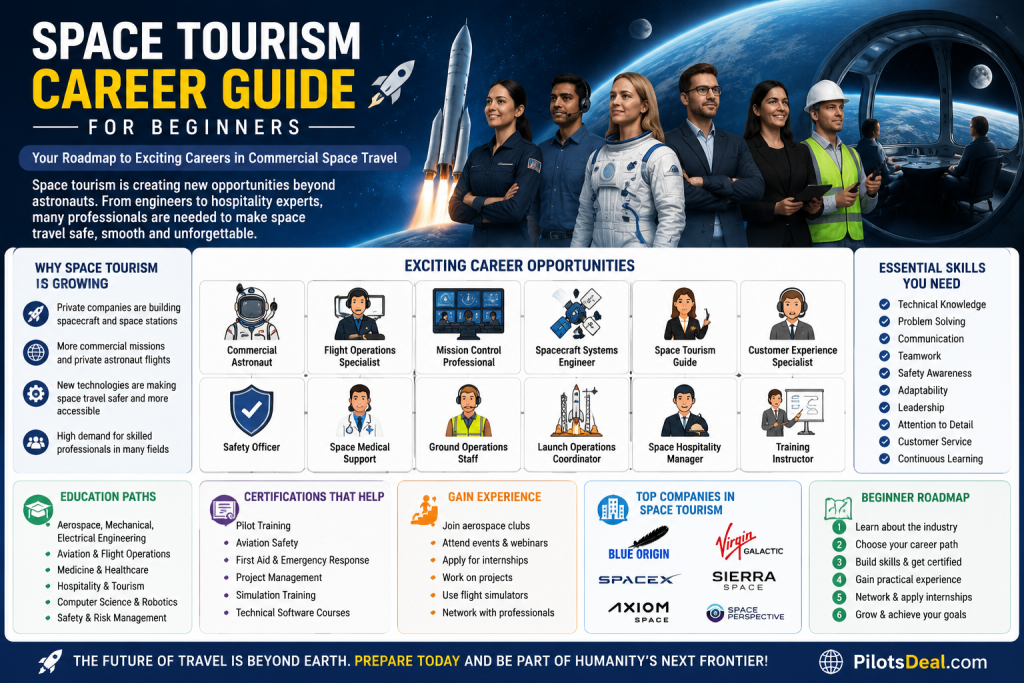
Career Opportunities in Space Tourism
Commercial Astronaut
A commercial astronaut is someone trained to participate in private or commercial space missions. This role may include operating spacecraft systems, conducting research, supporting passengers, and following mission procedures.
Commercial astronauts need strong physical fitness, technical understanding, communication skills, and the ability to stay calm under pressure. This is one of the most competitive roles in space tourism.
Flight Operations Specialist
Flight operations specialists help plan and manage the operational side of space missions. They may work on launch schedules, flight procedures, safety checks, and coordination between teams.
This role is ideal for people who enjoy aviation, mission planning, technical documentation, and problem-solving.
Mission Control Professional
Mission control professionals monitor spacecraft, crew, systems, weather, communications, and mission timelines. They work behind the scenes to make sure the mission runs safely.
This career requires attention to detail, quick decision-making, teamwork, and strong technical knowledge.
Spacecraft Systems Engineer
Spacecraft systems engineers design, test, and maintain spacecraft systems. They may work on propulsion, navigation, life support, communication, power, or control systems.
This role usually requires a degree in aerospace engineering, mechanical engineering, electrical engineering, or a related field.
Space Tourism Guide
A space tourism guide helps passengers understand the experience before, during, and after a commercial spaceflight. They may explain safety procedures, training activities, spaceflight basics, and passenger expectations.
This role combines space knowledge with communication, hospitality, and customer service skills.
Customer Experience Specialist
Space tourism customers need support from booking to training to post-flight experience. Customer experience specialists help passengers understand the process, manage expectations, and feel confident.
People from aviation, luxury travel, hospitality, or tourism backgrounds can explore this career path.
Aerospace Engineer
Aerospace engineers are central to the space tourism industry. They work on spacecraft design, testing, safety, materials, aerodynamics, propulsion, and mission systems.
This is one of the strongest technical career paths for beginners who want to build space vehicles or launch systems.
Safety Officer
Safety officers help ensure that every process follows strict safety standards. They may review risks, emergency procedures, passenger safety requirements, and operational compliance.
Since space tourism involves high-risk environments, safety professionals play a critical role.
Space Medical Support
Space medical professionals support passenger health, fitness checks, emergency readiness, and medical screening. They may also study how microgravity affects the human body.
This path is suitable for doctors, nurses, paramedics, physiologists, and aerospace medicine specialists.
Ground Operations Staff
Ground operations staff manage launch site activities, equipment readiness, passenger movement, logistics, and coordination. They support the mission before launch and after landing.
This role is useful for people interested in aviation operations, airport management, logistics, or technical ground support.
Launch Operations Coordinator
Launch operations coordinators manage schedules, teams, equipment, safety checks, and mission-day workflows. They make sure every department is aligned before launch.
Strong organization, communication, and pressure-handling skills are important in this role.
Space Hospitality Manager
As space tourism grows, hospitality will become more important. Space hospitality managers may support passenger comfort, training experiences, luxury services, and future space hotel concepts.
This career is suitable for hospitality professionals who want to enter the aerospace and tourism sector.
Training Instructor
Training instructors prepare passengers and crew for spaceflight. They may teach safety procedures, zero-gravity movement, emergency response, communication rules, and mission behavior.
This role requires teaching ability, technical knowledge, patience, and strong communication skills.
Simulation Specialist
Simulation specialists create and manage training environments that help passengers and crew practice mission scenarios. They may work with virtual reality, flight simulators, emergency drills, and spacecraft models.
This career is suitable for people interested in technology, training, gaming systems, aviation simulation, or software development.
Space Communications Specialist
Space communications specialists manage communication between spacecraft, mission control, passengers, media, and public relations teams.
This role is ideal for people with skills in communication, public relations, technical writing, broadcasting, or aerospace media.
Skills Needed for a Career in Space Tourism
To succeed in space tourism, beginners should develop both technical and soft skills.
Important skills include:
- Technical knowledge
- Problem-solving
- Communication
- Teamwork
- Leadership
- Physical fitness
- Safety awareness
- Stress management
- Adaptability
- Critical thinking
- Customer service
- Digital skills
- Attention to detail
- Decision-making
- Learning mindset
Technical roles require strong knowledge of engineering, physics, mathematics, computer systems, robotics, or aerospace technology. Non-technical roles still require a basic understanding of spaceflight, safety, passenger experience, and industry operations.
Educational Qualifications
There is no single degree for every space tourism career. The right education depends on the role you want.
Useful academic paths include:
| Career Interest | Recommended Education |
|---|---|
| Aerospace Engineering | Aerospace, Mechanical, Electrical Engineering |
| Flight Operations | Aviation, Aeronautics, Flight Operations |
| Mission Control | Engineering, Physics, Computer Science |
| Space Medicine | Medicine, Nursing, Physiology, Aerospace Medicine |
| Space Hospitality | Hospitality, Tourism, Luxury Travel Management |
| Space Training | Education, Aviation Training, Human Performance |
| Software Systems | Computer Science, Robotics, Data Science |
| Safety & Compliance | Safety Management, Aviation Safety, Risk Management |
Students should focus on science, mathematics, communication, and technology from an early stage. Beginners from non-technical backgrounds can still enter the industry through customer experience, training, tourism, communication, operations, and support roles.
Certifications That Can Help
Certifications can strengthen your profile and show employers that you are serious about the industry.
Helpful certifications include:
- Pilot training
- Aviation safety certification
- First aid and emergency response
- Aerospace-related online courses
- Safety management certification
- Drone operation certification
- Technical software certifications
- Project management certification
- Space science courses
- Human factors training
- Simulation training
- Customer service and hospitality certification
Certifications alone may not guarantee a job, but they can help beginners build credibility and practical understanding.
Best Ways to Gain Experience
Beginners should not wait for a perfect job opening. The best approach is to start gaining related experience early.
Useful ways to gain experience include:
- Join aerospace clubs
- Participate in STEM competitions
- Attend space and aviation events
- Apply for internships
- Learn flight simulation
- Build small engineering or robotics projects
- Take online aerospace courses
- Volunteer at science events
- Network with space professionals
- Follow commercial space companies
- Improve public speaking skills
- Learn basic coding or data analysis
Even small projects can help build confidence and practical skills. For example, a student interested in mission control can learn simulation software, while a hospitality professional can study luxury travel and passenger safety.
Top Companies Driving Space Tourism
| Company | Focus Area | Career Opportunities |
| Blue Origin | Suborbital spaceflight, launch systems, space infrastructure | Engineering, operations, safety, training, launch support |
| SpaceX | Orbital spacecraft, private missions, reusable rockets | Engineering, mission operations, software, manufacturing |
| Virgin Galactic | Suborbital commercial spaceflight | Passenger experience, operations, safety, training |
| Axiom Space | Private astronaut missions, commercial space station development | Mission planning, astronaut support, engineering, operations |
| Sierra Space | Spaceplanes, commercial space stations, space infrastructure | Aerospace engineering, systems, operations |
| Space Perspective | Near-space balloon tourism concepts | Hospitality, operations, passenger experience, safety |
These companies show how broad the space tourism sector can be. Some focus on rockets and spacecraft, while others focus on private astronaut missions, commercial stations, or near-space travel experiences.
Salary Expectations
Salary depends on education, experience, country, company, and job role. Technical roles usually offer higher salaries because they require specialized engineering or science skills.
| Career Role | Expected Salary Level |
| Aerospace Engineer | Medium to High |
| Spacecraft Systems Engineer | High |
| Mission Control Professional | Medium to High |
| Flight Operations Specialist | Medium to High |
| Safety Officer | Medium to High |
| Space Medical Support | Medium to High |
| Customer Experience Specialist | Medium |
| Space Tourism Guide | Medium |
| Ground Operations Staff | Entry to Medium |
| Training Instructor | Medium |
| Simulation Specialist | Medium to High |
| Space Hospitality Manager | Medium to High |
Beginners should focus first on skill-building and experience. Salary growth improves as professionals gain technical knowledge, mission experience, leadership ability, and industry exposure.
Challenges of Working in Space Tourism
Space tourism is exciting, but it is also demanding. Beginners should understand the challenges before entering the field.
Common challenges include:
- Competitive hiring
- High safety standards
- Continuous learning requirements
- Fast-changing technology
- Physical and mental pressure
- Strict regulations
- Limited entry-level openings in some roles
- Need for teamwork and discipline
- Long project timelines
- Expensive training in some paths
The industry rewards people who are patient, curious, disciplined, and ready to keep learning.
Future of Space Tourism Careers
The future of space tourism may include orbital hotels, private space stations, lunar travel, space research missions, and advanced passenger training programs. Axiom Space, for example, is working in the commercial space station and private astronaut mission space, showing how commercial human spaceflight is expanding beyond short tourist flights.
Future careers may include:
- Space hotel manager
- Lunar travel coordinator
- Space wellness specialist
- Space nutrition expert
- Orbital safety officer
- Private astronaut trainer
- Space experience designer
- Commercial space law specialist
- Space tourism marketing strategist
- Space emergency response planner
As the industry grows, people from aviation, hospitality, medicine, engineering, software, and tourism may find new opportunities.
Beginner Roadmap to Start a Space Tourism Career
1. Learn About the Industry
Start by understanding basic spaceflight, commercial space companies, spacecraft types, launch systems, and passenger training.
2. Choose a Career Path
Decide whether you want a technical, operational, medical, hospitality, communication, or customer-focused career.
3. Build Technical Knowledge
Even non-engineers should understand basic aerospace terms, safety concepts, and spaceflight operations.
4. Gain Practical Experience
Look for internships, projects, clubs, competitions, volunteering, and simulation-based learning.
5. Earn Relevant Certifications
Choose certifications based on your career path, such as aviation safety, first aid, project management, or technical tools.
6. Develop Communication Skills
Space tourism involves passengers, teams, engineers, trainers, and regulators. Clear communication is essential.
7. Network With Professionals
Attend events, join aerospace communities, follow companies, and connect with people already working in the industry.
8. Apply for Internships
Internships help beginners understand real industry work and build a professional profile.
9. Continue Learning
The space industry changes quickly. Keep learning about new missions, technologies, safety systems, and regulations.
10. Pursue Career Opportunities
Apply for entry-level roles in aviation, aerospace, tourism, operations, customer experience, engineering, or training.
Common Mistakes Beginners Should Avoid
Beginners should avoid these mistakes:
- Thinking only astronauts can work in space tourism
- Ignoring communication skills
- Avoiding technical learning
- Not building practical experience
- Depending only on degrees
- Ignoring physical fitness
- Having unrealistic salary expectations
- Not networking
- Skipping internships
- Failing to follow industry updates
- Underestimating safety requirements
Space tourism needs serious professionals. Passion is important, but preparation is even more important.
Frequently Asked Questions
1. What qualifications are needed for a career in space tourism?
The qualifications depend on the role. Engineering jobs may require degrees in aerospace, mechanical, electrical, or computer science fields. Operations roles may need aviation or mission planning knowledge. Hospitality, customer experience, and training roles may accept professionals from tourism, education, or service backgrounds with space industry knowledge.
2. Do I need to become an astronaut to work in space tourism?
No, you do not need to become an astronaut. Space tourism requires many professionals, including engineers, safety officers, medical experts, trainers, operations staff, hospitality managers, and communication specialists. Astronaut roles are only one part of the industry.
3. Can non-engineers work in space tourism?
Yes, non-engineers can build careers in space tourism. Roles in customer experience, hospitality, training, tourism management, communications, marketing, safety coordination, and passenger support are suitable for non-engineering backgrounds. However, basic spaceflight knowledge is helpful.
4. Which degree is best for space tourism careers?
For technical roles, aerospace engineering, mechanical engineering, electrical engineering, physics, robotics, and computer science are strong choices. For non-technical roles, aviation management, tourism, hospitality, communication, psychology, and healthcare can be useful. The best degree depends on your chosen career path.
5. Are internships available in space tourism?
Yes, many aerospace and commercial space companies offer internships or early-career programs. Beginners can also look for internships in aviation, robotics, engineering, operations, research labs, and space education organizations. Internships are one of the best ways to gain real-world exposure.
6. How competitive is the space tourism industry?
The industry is competitive because it attracts talented people from aviation, engineering, science, and technology. However, beginners can improve their chances by building practical skills, completing projects, gaining internships, networking, and staying updated with industry trends.
7. Is pilot training mandatory for space tourism careers?
Pilot training is not mandatory for all roles. It may help for flight operations, aviation-related positions, or commercial astronaut pathways. However, many careers in engineering, safety, customer experience, training, hospitality, and mission support do not require pilot training.
8. What skills are most valuable in space tourism?
The most valuable skills include technical understanding, safety awareness, communication, teamwork, problem-solving, adaptability, leadership, and attention to detail. Customer service and emotional intelligence are also important for passenger-facing roles.
9. What is the future of commercial space tourism careers?
The future may include private astronaut missions, orbital stations, space hotels, lunar tourism, research flights, and near-space travel. As commercial space activity expands, new career categories may appear in training, hospitality, safety, healthcare, operations, and space experience design.
10. How can beginners prepare today?
Beginners can start by learning spaceflight basics, choosing a career direction, building technical or service skills, joining aerospace communities, attending events, taking online courses, and applying for internships. Consistent learning and practical experience are the best starting points.
Conclusion
Space tourism is one of the most exciting career sectors for beginners who dream of working in the future of human spaceflight. It offers opportunities not only for astronauts and engineers but also for pilots, medical professionals, hospitality experts, trainers, operations teams, safety specialists, and customer experience professionals. The industry is still developing, which means early preparation can create long-term advantages.
To build a successful space tourism career, beginners should focus on learning, gaining experience, developing strong communication skills, understanding safety standards, and staying updated with commercial spaceflight developments. With the right mindset and preparation, space tourism can become a meaningful career path for those who want to be part of humanity’s next great travel frontier.