
Introduction
Many beginners enter the stock market with excitement but quickly realize they don’t know how to evaluate a company properly. They hear terms like “strong fundamentals,” “undervalued stock,” or “financial analysis,” but struggle to understand what they really mean.
This is where fundamental analysis and stock research becomes important. It helps investors understand the real value of a company instead of relying on tips, rumors, or short-term price movements. Learning these basics is the foundation of stock market education for beginners and smart investing decisions.
In this guide, you will learn how to study stocks step by step in a simple and practical way.
What Is Fundamental Analysis?
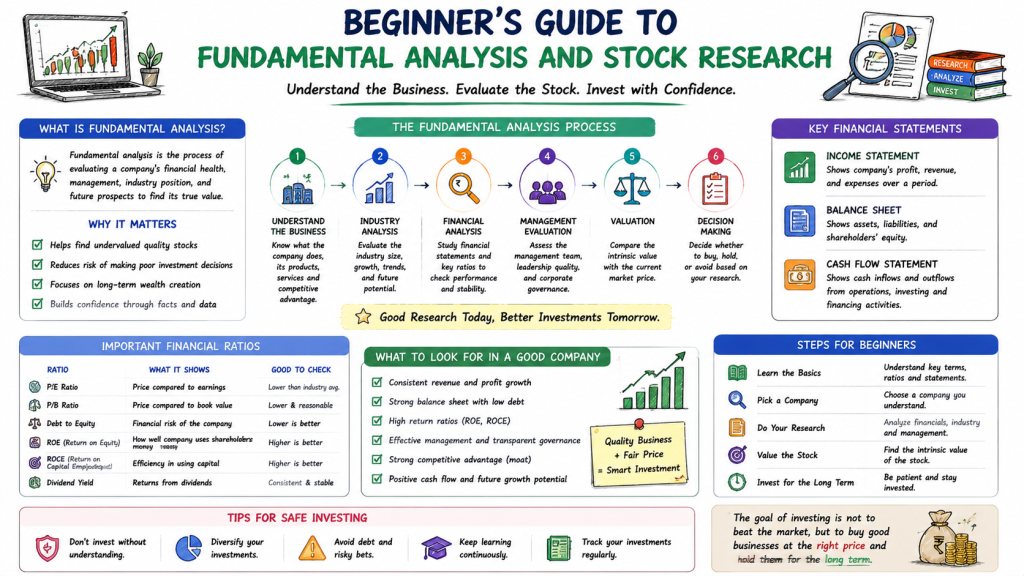
Fundamental analysis is the method of studying a company’s financial health and business strength to understand its real value.
Instead of focusing on price movements, it focuses on:
- Company earnings
- Revenue growth
- Business model
- Debt levels
- Industry position
- Long-term growth potential
In simple words, it helps answer:
👉 “Is this company strong enough to grow in the future?”
Why Fundamental Analysis Is Important for Beginners
Fundamental analysis helps beginners:
- Avoid guessing and gambling in the market
- Understand real business value
- Identify strong long-term companies
- Reduce emotional investing decisions
- Build confidence in stock selection
Without it, investing becomes random and risky.
Stock Research: What It Really Means
Stock research means studying a company before investing money in it.
It includes analyzing:
- Financial statements
- Industry trends
- Competitors
- Management quality
- Future growth opportunities
- Risks involved
Good research helps investors make informed and confident decisions.
Key Areas of Fundamental Analysis
1. Revenue and Profit
Revenue shows how much money a company earns. Profit shows what remains after expenses.
A healthy company usually shows:
- Consistent revenue growth
- Stable or increasing profits
2. Debt Levels
Debt shows how much money a company owes.
- High debt = higher risk
- Low or manageable debt = safer investment
3. Business Model
Understanding how a company makes money is very important.
Ask questions like:
- What does the company sell?
- Who are its customers?
- Is the business scalable?
4. Management Quality
Strong leadership often leads to strong companies.
Look for:
- Experience
- Transparency
- Consistent decision-making
5. Industry Position
A company in a growing industry has better chances of success.
Compare:
- Market share
- Competitors
- Industry growth trends
6. Valuation
Valuation tells whether a stock is expensive or cheap.
Common methods include:
- Price-to-Earnings (P/E ratio)
- Price-to-Book (P/B ratio)
Step-by-Step Guide to Stock Research for Beginners
Step 1: Choose a Company
Start with companies you understand.
Step 2: Study the Business
Learn how the company earns money.
Step 3: Check Financial Performance
Look at revenue, profit, and debt.
Step 4: Compare With Competitors
Understand how the company performs in its industry.
Step 5: Study Future Growth
Check if the company has long-term potential.
Step 6: Identify Risks
Every business has risks—understand them clearly.
Step 7: Make a Learning-Based Decision
Focus on understanding, not guessing.
Fundamental Analysis vs Technical Analysis
| Feature | Fundamental Analysis | Technical Analysis |
|---|---|---|
| Focus | Company value | Price movement |
| Timeframe | Long-term | Short-term |
| Tools | Financial reports | Charts & indicators |
| Purpose | Investment decisions | Trading decisions |
| Best For | Beginners & investors | Active traders |
Stock Market Research: Common Beginner Mistakes
Beginners often make these mistakes:
- Investing without reading company details
- Following social media tips blindly
- Ignoring financial reports
- Focusing only on stock price
- Expecting quick profits
- Not understanding business risks
Avoiding these mistakes improves long-term success.
Importance of Stock Market Education
Learning stock market education helps beginners:
- Understand real investing concepts
- Reduce emotional decisions
- Build discipline in investing
- Avoid unnecessary losses
- Improve long-term financial planning
Education is the first step before investing.
How Stocks Mantra Helps Beginners
Platforms like Stocks Mantra help simplify complex financial concepts for beginners by offering:
- Easy stock market learning content
- Fundamental and technical analysis guides
- IPO insights and explanations
- Market research education
- Beginner-friendly investing knowledge
You can explore more learning resources here:
https://www.stocksmantra.com/
Best Practices for Stock Research
- Always research before investing
- Focus on long-term growth
- Diversify your investments
- Avoid emotional decisions
- Keep learning continuously
- Study financial reports regularly
Expert Tips for Beginners
- Start with simple companies you understand
- Focus on business quality, not stock tips
- Be patient with long-term investing
- Learn from both gains and losses
- Stay consistent with research habits
- Never invest based on hype alone
FAQs
1. What is fundamental analysis in simple words?
It is the study of a company’s financial health and business performance to understand its real value.
2. Why is stock research important?
It helps investors make informed decisions instead of relying on tips or emotions.
3. What should beginners look at first in a stock?
Revenue, profit, debt, and business model are the first things to check.
4. Is fundamental analysis hard to learn?
No, it becomes simple with practice and basic financial understanding.
5. What is the difference between investing and trading?
Investing is long-term, while trading is short-term and based on price movement.
6. Can beginners do stock research?
Yes, beginners can start with simple financial learning and gradually improve.
7. What is valuation in stock analysis?
It shows whether a stock is expensive or cheap based on financial metrics.
8. Do I need financial background to learn stock analysis?
No, anyone can learn with basic guidance and consistent practice.
9. What is the biggest mistake in stock research?
Following tips without understanding the company.
10. Is stock market education necessary before investing?
Yes, it is essential for reducing risk and making better decisions.
Conclusion
Understanding fundamental analysis and stock research for beginners is the foundation of smart investing. Instead of relying on guesses or market rumors, learning how to evaluate a company helps investors make confident and informed decisions.
Stock market success does not come from shortcuts—it comes from knowledge, patience, and discipline. Beginners should focus on learning step by step and building strong financial understanding before investing real money.
To continue your learning journey, explore beginner-friendly financial education resources at:
https://www.stocksmantra.com/
Final Disclaimer
This content is for educational purposes only and should not be considered financial advice.