Introduction
Spacecraft can travel far beyond Earth because rockets provide the energy and velocity needed to overcome Earth’s gravitational pull and enter carefully planned trajectories. Reaching space is only the beginning; traveling to another world requires precise navigation, propulsion, timing, and orbital mechanics. A spacecraft may spend months or years traveling through interplanetary space before reaching its destination. This guide explains how spacecraft journey from Earth into deep space in simple terms for beginners.
What Does It Mean to Travel Beyond Earth?
Traveling beyond Earth means sending a spacecraft on a trajectory that takes it outside Earth’s immediate orbital environment and toward another destination in space.
A spacecraft may travel to:
- The Moon
- Other planets
- Asteroids
- Comets
- The outer Solar System
- Deep-space regions for scientific observation
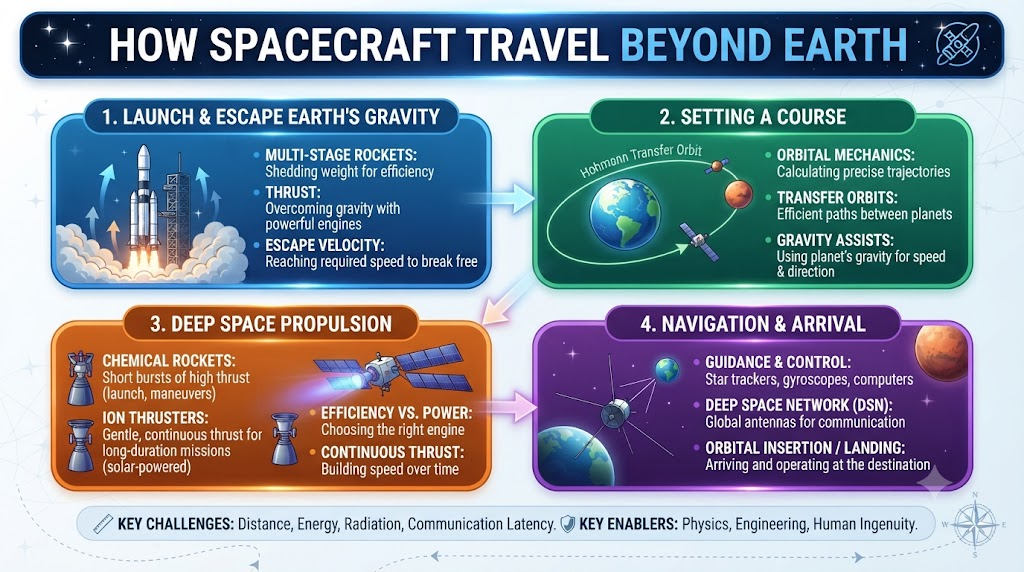
The journey usually begins with a launch from Earth. A powerful launch vehicle accelerates the spacecraft through the atmosphere and places it into an initial orbit or directly onto an appropriate departure trajectory.
From there, the spacecraft uses its velocity, gravity, propulsion systems, and carefully calculated trajectory to continue toward its destination.
How Spacecraft Leave Earth
Earth’s gravity continuously pulls objects toward its surface. A spacecraft therefore needs substantial energy to move away from Earth and enter space on a useful trajectory.
A launch vehicle provides this energy through rocket propulsion.
During launch, the rocket:
- Produces thrust using its engines.
- Accelerates upward through the atmosphere.
- Gradually changes its flight direction.
- Builds both altitude and horizontal velocity.
- Separates spent stages when necessary.
- Places the spacecraft into an intended orbit or departure trajectory.
The rocket does not simply travel vertically throughout the entire launch. For many orbital missions, the vehicle gradually pitches over so that more of its velocity becomes horizontal.
This horizontal velocity is essential for orbital flight and later departure from Earth.
The Role of Rockets and Thrust
A rocket engine generates thrust by accelerating exhaust gases in one direction. The resulting reaction force accelerates the rocket in the opposite direction.
Unlike an aircraft engine, a rocket does not need to obtain oxygen from the surrounding atmosphere. Rocket propulsion systems carry the necessary propellant components onboard, allowing them to operate in space.
The major elements of a rocket propulsion system can include:
- Fuel or another energy-producing propellant component
- Oxidizer
- Combustion chamber
- Turbopumps or other propellant-delivery systems in some engines
- Nozzle
- Engine control systems
Different missions require different propulsion technologies. Large launch vehicles are designed to provide the enormous thrust required during liftoff, while spacecraft may use much smaller propulsion systems for trajectory adjustments and orbital maneuvers.
Reaching Earth Orbit
One of the most important concepts in spaceflight is the difference between reaching space and reaching orbit.
A spacecraft can travel to a high altitude and still fall back to Earth. To remain in orbit, it needs sufficient sideways velocity.
An orbit occurs because the spacecraft is continuously falling toward Earth under gravity while its forward motion carries it around the planet.
For example, imagine throwing an object horizontally. It falls toward the ground while moving forward. If its horizontal velocity were high enough and the conditions were appropriate, Earth’s surface would curve away beneath its trajectory. The object would continue falling around Earth rather than directly into it.
This simplified concept explains why orbital velocity is so important.
Orbit vs. Traveling Beyond Earth
Reaching low Earth orbit does not automatically mean a spacecraft is traveling beyond Earth.
A spacecraft in low Earth orbit remains gravitationally bound to Earth and repeatedly circles the planet.
To travel toward another celestial body, the spacecraft needs to change its orbital energy and trajectory.
This can be achieved through a major propulsion maneuver or, depending on the mission, through carefully planned combinations of propulsion and gravitational effects.
The spacecraft transitions from an Earth-centered orbit to a trajectory that can carry it toward its destination.
Understanding Escape Velocity
Escape velocity is the theoretical speed an object would need at a particular distance from a celestial body to escape its gravitational influence without additional propulsion, assuming ideal conditions.
For Earth, the escape velocity at the surface is approximately 11.2 km/s.
However, real spacecraft missions are more complicated than simply accelerating a spacecraft to one specific speed.
Spacecraft can receive energy from rocket burns while already moving in an orbit. Mission designers use orbital mechanics to calculate the required changes in velocity and energy.
This is why spacecraft can leave Earth using carefully planned trajectories rather than simply pointing upward and continuously accelerating.
How Spacecraft Leave Earth’s Orbit
After reaching an appropriate Earth orbit, a spacecraft may perform a maneuver called a departure burn.
The spacecraft’s propulsion system changes its velocity. This changes the spacecraft’s orbit and can place it onto a trajectory that moves farther away from Earth.
For an interplanetary mission, this trajectory is designed to intersect with the future position of the target planet or another celestial body.
The spacecraft therefore does not necessarily aim at where the destination is located when the spacecraft launches.
Instead, mission planners calculate where the destination will be when the spacecraft arrives.
Planning a Spacecraft Trajectory
A spacecraft does not normally travel from Earth to another planet in a straight line.
The Solar System contains moving bodies, and their gravitational fields continuously influence spacecraft motion.
Mission planners consider:
- Earth’s position
- The target body’s position
- The spacecraft’s velocity
- The Sun’s gravity
- Planetary gravity
- Propulsion capabilities
- Fuel or propellant limitations
- Mission duration
- Communication requirements
- Navigation accuracy
- Arrival conditions
A trajectory is selected to provide an appropriate balance between energy, travel time, mission requirements, and spacecraft capabilities.
Launch Windows and Timing
Timing is extremely important in interplanetary missions.
Earth and other planets are constantly moving around the Sun. Because of this, a spacecraft launched at the wrong time may not reach its destination efficiently.
A launch window is a period during which mission conditions are suitable for beginning a particular trajectory.
The exact launch window depends on the mission and destination.
For example, a mission traveling from Earth toward another planet may require Earth and the destination planet to have a favorable relative position. This allows the spacecraft to follow a trajectory that reaches the destination at the appropriate time.
Transfer Orbits and Interplanetary Travel
A transfer trajectory is a path used to move a spacecraft from one orbit or gravitational environment to another.
For some interplanetary missions, engineers use trajectories that take advantage of the Sun’s gravity and the orbital motion of planets.
One well-known concept is the Hohmann transfer, which provides an efficient idealized transfer between two circular orbits under simplified conditions.
Real missions can use more complicated trajectories because spacecraft may need to account for multiple gravitational bodies, mission constraints, launch opportunities, and desired arrival conditions.
How Spacecraft Travel to the Moon
The Moon is much closer to Earth than other planets, but reaching it still requires careful trajectory planning.
A simplified lunar mission can involve:
- Launch from Earth.
- Entry into an initial Earth orbit.
- A maneuver that increases the spacecraft’s energy.
- Departure from the Earth-centered orbit.
- Travel through space toward the Moon.
- Lunar arrival.
- Lunar orbit insertion, landing, or another planned operation.
Depending on the mission, a spacecraft may orbit the Moon, land on its surface, fly past it, or use the Moon’s gravity as part of a larger trajectory.
How Spacecraft Travel to Other Planets
Traveling to another planet requires much more planning than traveling around Earth.
A spacecraft is launched when Earth and the target planet have a favorable relative arrangement.
After departure from Earth, the spacecraft follows a trajectory around the Sun. The target planet continues moving along its own orbit.
The spacecraft’s trajectory is therefore designed so that both objects arrive at approximately the same region of space at the right time.
This is one reason interplanetary missions can take months or years.
Gravity Assist Maneuvers
A gravity assist uses the movement and gravitational field of a planet or moon to change a spacecraft’s trajectory and, under the right conditions, its speed relative to the Sun.
Instead of using propulsion alone to make every major trajectory change, mission planners can sometimes arrange a close flyby of a planetary body.
The spacecraft’s path bends as it passes through the body’s gravitational field.
The exact change in the spacecraft’s velocity depends on the geometry of the encounter and the movement of the planet.
Gravity assists can help missions:
- Increase or decrease heliocentric velocity
- Change direction
- Reach distant destinations
- Reduce the amount of propellant required for certain trajectories
They require precise planning and navigation.
Propulsion During Deep-Space Travel
A spacecraft does not necessarily keep its main engines running throughout its journey.
After reaching its planned trajectory, a spacecraft may coast for long periods.
Small propulsion systems can then perform course corrections when necessary.
Depending on the mission, spacecraft may use:
- Chemical propulsion
- Electric propulsion
- Cold-gas systems
- Other specialized propulsion technologies
Chemical engines can provide relatively high thrust, making them useful for major maneuvers.
Electric propulsion systems generally produce much lower thrust but can operate efficiently for long periods. This can make them useful for missions where gradual acceleration is acceptable.
Spacecraft Navigation and Guidance
Once a spacecraft leaves Earth, knowing its position and velocity becomes critical.
Spacecraft navigation may use information from onboard sensors and measurements exchanged with ground-based tracking systems.
Navigation determines the spacecraft’s estimated location and motion.
Guidance determines what trajectory or maneuver the spacecraft should follow.
Control commands the spacecraft’s systems to achieve the required orientation or maneuver.
These functions work together throughout a mission.
Small navigation errors can become significant over long distances, so spacecraft teams continuously monitor mission data and make corrections when necessary.
Course Corrections
Even a carefully planned spacecraft trajectory may require adjustments.
Small uncertainties can arise from:
- Initial launch conditions
- Navigation errors
- Propulsion performance
- Gravitational influences
- Solar effects
- Other environmental factors
A spacecraft can perform a course-correction maneuver to adjust its trajectory.
These corrections may be relatively small compared with the initial launch maneuver, but they can make a major difference to the spacecraft’s arrival conditions.
For a planetary mission, a small change made early in the journey can produce a significant change in the spacecraft’s position much later.
Communication Between Spacecraft and Earth
Spacecraft traveling beyond Earth must exchange information with mission teams on the ground.
Communication systems allow spacecraft to:
- Receive commands
- Send scientific data
- Report system conditions
- Transmit navigation information
- Receive software or operational updates when required
As spacecraft travel farther away, communication becomes more challenging.
Signals take time to travel through space. The farther away a spacecraft is, the longer it takes for a signal to reach Earth.
This means deep-space spacecraft cannot always respond immediately to commands from mission control.
Mission teams therefore design spacecraft with significant onboard autonomy.
What Happens When a Spacecraft Reaches Its Destination?
Arrival procedures depend on the mission.
A spacecraft reaching another planet may:
- Fly past the planet
- Enter orbit
- Land on the surface
- Release a lander
- Deploy a probe
- Enter the atmosphere
- Conduct scientific observations
Some missions are designed only for a flyby, while others require precise orbital insertion or landing.
For example, an orbiter must reduce its relative velocity sufficiently for the planet’s gravity to capture it into the desired orbit. This usually requires carefully timed propulsion or another suitable maneuver.
Returning to Earth
Not every spacecraft is designed to return to Earth.
A return mission requires additional planning and hardware.
A returning spacecraft must obtain a trajectory that intersects Earth at the correct time and location. It then needs to enter the atmosphere under suitable conditions.
During atmospheric re-entry, the spacecraft experiences intense heating and aerodynamic forces.
Thermal protection systems help protect the spacecraft and, in crewed missions, the people inside it.
After slowing through the atmosphere, the vehicle may use parachutes, wings, lifting bodies, powered landing systems, or other recovery methods depending on its design.
Practical Explanation: A Spacecraft’s Journey Beyond Earth
Consider a simplified mission in which a spacecraft leaves Earth and travels to another planet.
Step 1: Mission Planning
Engineers first determine the destination, scientific objectives, spacecraft capabilities, expected travel time, and possible launch opportunities.
Step 2: Launch
A launch vehicle carries the spacecraft through Earth’s atmosphere and provides the energy required for the initial trajectory.
Step 3: Earth Orbit
The spacecraft may first enter an Earth orbit. Engineers then verify spacecraft systems and prepare for the departure maneuver.
Step 4: Departure Maneuver
A propulsion burn changes the spacecraft’s energy and places it onto a trajectory that moves it away from Earth.
Step 5: Interplanetary Cruise
The spacecraft travels through space primarily under the influence of gravity. It may coast for long periods while mission teams monitor its condition.
Step 6: Course Corrections
Small propulsion maneuvers may adjust the trajectory to ensure the spacecraft remains on the correct path.
Step 7: Destination Approach
As the spacecraft approaches its target, navigation becomes increasingly important. Mission teams prepare the vehicle for its planned arrival operation.
Step 8: Arrival
The spacecraft may enter orbit, perform a flyby, land, or conduct another mission-specific operation.
Step 9: Mission Operations
Scientific instruments and spacecraft systems perform their planned tasks.
Step 10: Return or Mission Completion
If the spacecraft is designed to return, it begins a carefully planned journey back toward Earth. Otherwise, it may continue operating at its destination or eventually complete its mission.
Major Stages of a Spacecraft’s Journey
| Mission Stage | What Happens |
|---|---|
| Launch | A rocket accelerates the spacecraft away from Earth’s surface |
| Atmospheric Ascent | The vehicle climbs through the atmosphere while building velocity |
| Earth Orbit | The spacecraft reaches an initial Earth-centered orbit when required |
| Earth Departure | A planned maneuver places the spacecraft on a trajectory beyond Earth’s immediate orbit |
| Interplanetary Cruise | The spacecraft travels through space along its planned trajectory |
| Course Correction | Small maneuvers adjust the spacecraft’s path when necessary |
| Destination Approach | Navigation systems help prepare the spacecraft for arrival |
| Arrival | The spacecraft performs a flyby, orbit insertion, landing, or another planned operation |
| Mission Operations | The spacecraft carries out scientific or operational objectives |
| Return | If designed for return, the spacecraft follows a trajectory back toward Earth |
Common Spaceflight Concepts
| Concept | Beginner-Friendly Explanation |
| Thrust | Force generated by a propulsion system to accelerate a spacecraft |
| Orbit | A path around a celestial body created by the interaction of velocity and gravity |
| Escape Velocity | The theoretical speed needed to escape a body’s gravity without further propulsion |
| Trajectory | The planned path followed by a spacecraft |
| Launch Window | A period when launch conditions are suitable for a particular mission |
| Gravity Assist | A maneuver that uses a celestial body’s gravity and motion to alter a spacecraft’s path and energy |
| Course Correction | A propulsion maneuver used to adjust a spacecraft’s trajectory |
| Orbital Insertion | A maneuver that places a spacecraft into an orbit around a celestial body |
| Interplanetary Space | The region of space between planets within a planetary system |
| Deep Space | Regions far beyond Earth’s immediate space environment, often requiring specialized communication and navigation |
Common Mistakes Beginners Make About Spacecraft Travel
Thinking Spacecraft Travel in Straight Lines
Spacecraft generally follow curved trajectories influenced by gravity. Their paths are carefully calculated based on the positions and movements of celestial bodies.
Assuming Reaching Space Means Leaving Earth
A spacecraft can reach space and remain in Earth orbit. Traveling beyond Earth requires an additional change in energy and trajectory.
Believing Spacecraft Continuously Use Their Engines
Most spacecraft do not run their main engines continuously. They often perform specific burns and then coast along their trajectory.
Thinking More Speed Is Always Better
The required velocity depends on the mission. Excessive velocity can be just as problematic as insufficient velocity because spacecraft must arrive under specific conditions.
Ignoring Timing
Planetary positions change continuously. A spacecraft must be launched and guided according to the movement of its destination.
Assuming Gravity Stops in Space
Gravity remains important throughout spaceflight. The Sun, planets, moons, and other bodies can influence spacecraft trajectories.
Confusing Distance With Difficulty
A distant destination is not necessarily difficult for only one reason. Mission difficulty also depends on trajectory, propulsion, communication, navigation, radiation, arrival conditions, and spacecraft reliability.
Important Considerations for Beginners
Gravity Is Always Part of the Journey
Gravity affects spacecraft from launch through interplanetary travel and arrival. Understanding gravity is one of the most useful foundations for learning orbital mechanics.
Velocity Matters as Much as Distance
A spacecraft’s velocity determines how its trajectory changes. A small change in velocity can significantly alter its future position.
Trajectories Are Carefully Planned
Spacecraft are not normally launched directly toward a visible target. Their paths account for the movement and gravity of other celestial bodies.
Fuel and Propellant Are Limited
Every spacecraft has limitations on how much propulsion it can use. Mission designers therefore carefully plan major burns and course corrections.
Communication Is Not Instantaneous
Radio signals require time to travel. At great distances, mission teams must account for communication delays.
Navigation Must Be Extremely Precise
Small trajectory errors can become substantial over millions of kilometers. Navigation teams therefore continuously monitor spacecraft data and make adjustments when required.
Spacecraft Need to Survive the Environment
Beyond Earth, spacecraft encounter vacuum, radiation, temperature extremes, and other environmental challenges. Their systems must be designed to operate reliably under these conditions.
Frequently Asked Questions
1. How does a spacecraft leave Earth?
A launch vehicle uses rocket propulsion to accelerate the spacecraft. The vehicle first climbs through Earth’s atmosphere and then builds the velocity required for an Earth orbit or departure trajectory.
2. Does a spacecraft need to keep its engine running in space?
No. Spacecraft often perform propulsion burns at specific points and then coast for long periods while gravity carries them along their trajectory.
3. How does a spacecraft travel to another planet?
It follows a carefully calculated trajectory around the Sun. The trajectory is designed based on the positions and movements of Earth and the target planet.
4. What is the difference between orbiting Earth and leaving Earth?
Orbiting Earth means remaining on a trajectory around Earth. Leaving Earth’s immediate orbital environment requires changing the spacecraft’s energy and trajectory so that it travels away from Earth.
5. Why can’t spacecraft simply fly directly to another planet?
Planets are constantly moving, and their gravity affects spacecraft. A spacecraft therefore needs a trajectory designed to meet the destination at the appropriate time and location.
6. What is a gravity assist?
A gravity assist is a carefully planned flyby in which a spacecraft uses the gravitational field and motion of a planet or moon to change its trajectory and, under suitable conditions, its speed relative to the Sun.
7. How do spacecraft know where they are?
Spacecraft use navigation measurements from onboard sensors and tracking information obtained through communication with ground-based systems. Mission teams combine these measurements to estimate the spacecraft’s position and velocity.
8. Why are course corrections necessary?
No launch or trajectory is perfectly exact. Small differences in launch conditions, navigation estimates, and propulsion performance can accumulate, so spacecraft may perform correction maneuvers to refine their paths.
9. How long does it take to travel beyond Earth?
There is no single travel time. A mission to the Moon can take days, while missions to other planets can require months or years depending on the destination and trajectory.
10. Can every spacecraft return to Earth?
No. Some spacecraft are specifically designed for return, while others are designed for one-way missions, orbital operations, flybys, landings, or deep-space exploration.
Conclusion
Spacecraft travel beyond Earth through a combination of rocket propulsion, orbital mechanics, precise navigation, carefully selected trajectories, and the gravitational influence of celestial bodies. The journey begins with a powerful launch from Earth but continues with carefully planned maneuvers that determine where the spacecraft will travel and when it will arrive.
For beginners, the most important concept is that space travel is not simply about moving upward or pointing a spacecraft toward another planet. It is about managing velocity, gravity, energy, timing, and trajectory. Once these fundamentals are understood, more advanced subjects such as interplanetary navigation, gravity assists, propulsion systems, and deep-space exploration become much easier to appreciate.