Introduction
Spaceflight is the process of sending spacecraft, satellites, humans, or scientific instruments beyond Earth’s atmosphere and into space. It combines physics, engineering, navigation, propulsion, and careful mission planning. For beginners, understanding spaceflight starts with learning how rockets generate thrust, how spacecraft enter orbit, and how they operate in the space environment. This guide explains the essential concepts of spaceflight in simple language so that newcomers can build a strong foundation.
What Is Spaceflight?
Spaceflight refers to travel through outer space using a spacecraft or launch vehicle. A spaceflight mission may involve sending a satellite into orbit, transporting astronauts to a space station, exploring another planet, or conducting scientific experiments.
Unlike an aircraft, which relies on Earth’s atmosphere to generate aerodynamic lift, a rocket must carry its own propellant and oxidizer. This allows it to operate where there is little or no atmosphere.
Spaceflight can be broadly divided into two categories:
- Crewed spaceflight: Missions that carry astronauts or other humans.
- Uncrewed spaceflight: Missions involving satellites, probes, robotic spacecraft, telescopes, and other equipment.
A space mission can last from a few minutes to several years depending on its purpose.
Spaceflight vs. Air Travel
Aircraft and spacecraft both travel through the sky or space, but they operate according to different physical requirements.
An airplane generally depends on atmospheric air for its engines and wings. Its wings generate lift as air moves over them, while its engines provide forward thrust.
A rocket operates differently. It carries both fuel and an oxidizer, allowing its engine to produce thrust without depending on atmospheric oxygen.
The difference becomes especially important as a vehicle climbs higher. Atmospheric pressure decreases with altitude, and eventually there is not enough atmosphere for conventional aircraft operation. A rocket continues accelerating because its propulsion system does not depend on surrounding air.
How Does a Spacecraft Reach Space?
Reaching space is not simply a matter of traveling upward. A spacecraft must achieve sufficient speed and follow an appropriate trajectory.
A typical rocket launch involves several stages:
- The rocket engines ignite and produce thrust.
- The vehicle begins climbing through the atmosphere.
- The rocket gradually changes its direction to build horizontal velocity.
- Rocket stages may separate after their propellant is consumed.
- The upper stage continues accelerating the payload.
- The spacecraft or payload reaches its intended trajectory.
- The spacecraft separates from the launch vehicle when required.
One of the most important ideas for beginners is that reaching orbit requires sideways speed, not just altitude.
A spacecraft can travel very high above Earth and still fall back down if it does not have enough horizontal velocity. Orbital flight is achieved when the spacecraft is moving forward quickly enough that its continuous fall around Earth follows the planet’s curvature.
Understanding Gravity and Microgravity
Gravity is one of the most important forces in spaceflight.
Earth’s gravity pulls spacecraft toward the planet even when they are hundreds of kilometers above the surface. This is why astronauts in low Earth orbit are not actually outside Earth’s gravitational influence.
Astronauts experience what is commonly called microgravity because both they and their spacecraft are continuously falling around Earth. Their apparent weight becomes extremely small compared with their experience on the ground.
Microgravity allows astronauts to perform experiments involving fluids, materials, biological systems, and human physiology under conditions that are difficult to reproduce on Earth.
Thrust and Rocket Propulsion
Thrust is the force that moves a rocket or spacecraft forward.
Rocket engines create thrust by accelerating gases in one direction. The resulting reaction force pushes the rocket in the opposite direction.
This principle is commonly associated with Newton’s Third Law of Motion: for every action, there is an equal and opposite reaction.
Rocket propulsion systems generally involve:
- Propellant
- Combustion or another energy-release process
- A chamber where gases are generated
- A nozzle that accelerates the gases
- Structural systems that contain and control the propulsion system
Different rockets use different propellant combinations and engine designs. Some use liquid propellants, while others use solid propellants.
The choice depends on factors such as mission requirements, performance, reliability, controllability, storage, and vehicle design.
Understanding Escape Velocity
Escape velocity is the theoretical speed required for an object to escape a celestial body’s gravitational influence without additional propulsion, assuming ideal conditions.
For Earth, escape velocity at the surface is approximately 11.2 kilometers per second.
However, beginners should not assume that every rocket simply launches at 11.2 km/s and immediately escapes Earth. Most missions do not require this.
A spacecraft going into low Earth orbit needs a different velocity profile from a spacecraft leaving Earth for another planet. Mission planners select trajectories and speeds based on the destination and mission objectives.
Escape velocity is therefore a useful concept for understanding gravitational energy, but real missions involve much more detailed calculations.
How Orbits Work
An orbit is not simply a path that allows a spacecraft to float in space.
An orbit results from the relationship between a spacecraft’s forward velocity and gravitational attraction.
Imagine throwing a ball horizontally. It falls toward Earth because of gravity. If it could move forward fast enough while Earth curved away beneath it, it could continuously fall around the planet rather than reaching the surface. This simplified idea helps explain orbital motion.
Different types of orbits are used for different purposes.
Low Earth Orbit
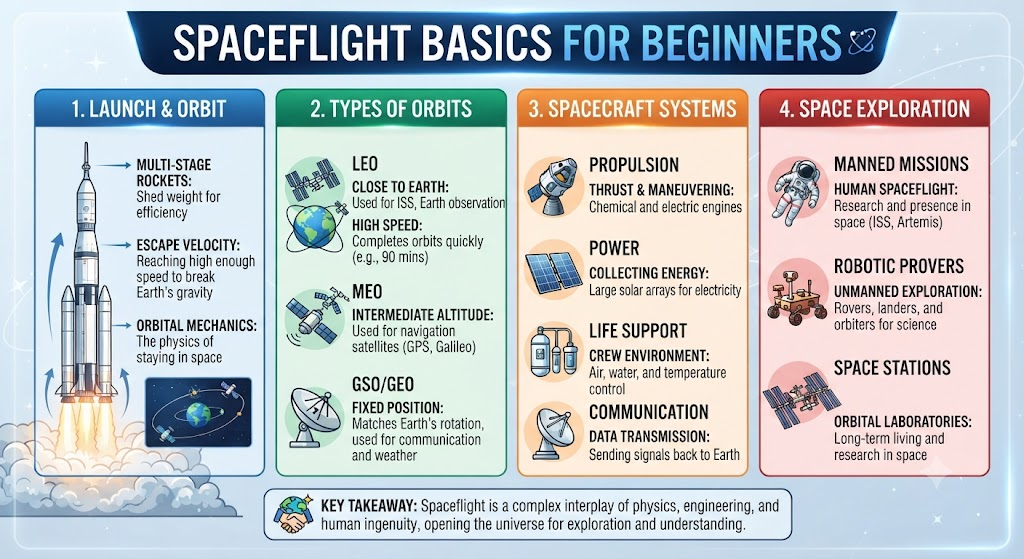
Low Earth orbit, or LEO, is relatively close to Earth and is widely used for Earth observation, scientific missions, crewed spacecraft, and many satellites.
Geostationary Orbit
A geostationary orbit is positioned above the equator at an altitude where a satellite’s orbital period matches Earth’s rotation. From the ground, the satellite appears to remain over approximately the same location.
Polar Orbit
A polar orbit passes over or near Earth’s polar regions. These orbits are particularly useful for Earth observation because the spacecraft can eventually cover much of the planet as Earth rotates underneath it.
Elliptical Orbit
An elliptical orbit has an oval-shaped path rather than a perfect circle. The spacecraft’s distance from Earth changes during the orbit.
Rocket Stages and Launch Vehicles
A launch vehicle is designed to carry a payload from Earth toward its intended space trajectory.
Many launch vehicles use multiple stages because carrying empty tanks, engines, and structures after their propellant has been consumed reduces efficiency.
A simplified multistage rocket may include:
- First stage
- Second stage
- Upper stage
- Payload or spacecraft
The first stage generally provides substantial thrust during the early part of flight. After its propellant is depleted, it may separate.
The next stage can then continue accelerating a smaller vehicle rather than carrying the mass of the empty first stage.
This process is called staging and is one of the fundamental principles of launch vehicle design.
Basic Spacecraft Systems
A spacecraft requires much more than an engine.
Its systems must work together to keep the spacecraft operational throughout the mission.
Power System
Spacecraft need electrical power for computers, communications, scientific instruments, heaters, sensors, and other equipment. Solar panels are commonly used, although some missions use other power sources.
Thermal Control
Space can create challenging temperature conditions. Spacecraft may experience intense sunlight on one side and extreme cold in shadow.
Thermal control systems help maintain equipment within acceptable temperature ranges.
Communication System
Spacecraft communicate with ground stations using radio signals or other communication technologies. These systems allow mission teams to send commands and receive spacecraft data.
Guidance and Navigation
Navigation systems determine where the spacecraft is and where it needs to go. Guidance systems help determine the desired trajectory, while control systems help keep the vehicle on that trajectory.
Structural System
The spacecraft structure supports equipment and protects important components from launch loads, vibration, and the space environment.
Onboard Computer
Modern spacecraft depend heavily on onboard computing systems. Computers process sensor information, control equipment, manage operations, and execute programmed instructions.
Navigation and Guidance
Space navigation is more complicated than simply pointing a vehicle toward its destination.
A spacecraft must account for:
- Gravity
- Velocity
- Position
- Earth’s rotation
- Orbital mechanics
- The movement of other celestial bodies
- Planned trajectory changes
Navigation determines where the spacecraft is and how it is moving.
Guidance determines the desired path.
Control uses spacecraft systems such as engines, reaction wheels, or thrusters to help maintain the required orientation and trajectory.
These three functions work together throughout a mission.
Re-Entry Into Earth’s Atmosphere
Returning from space can be one of the most demanding parts of a mission.
When a spacecraft enters Earth’s atmosphere at high speed, atmospheric resistance causes intense heating around the vehicle.
Spacecraft designed for re-entry therefore require appropriate thermal protection.
The spacecraft’s shape also matters. It influences how the vehicle interacts with the atmosphere and how heat and aerodynamic forces are managed.
During a typical controlled re-entry, the spacecraft must enter the atmosphere within an appropriate range of speed, angle, and position.
If the trajectory is unsuitable, the spacecraft may experience excessive heating, excessive aerodynamic forces, or an incorrect landing location.
Landing and Recovery
Different spacecraft use different recovery methods.
Some crewed spacecraft use parachutes to slow their descent before landing on land or in water. Other spacecraft may use wings, lifting bodies, powered descent, or other techniques.
Reusable launch vehicles can be designed to return portions of the vehicle for future missions.
The recovery approach depends on vehicle design, mission objectives, landing location, and operational requirements.
Crewed and Uncrewed Spaceflight
Human spaceflight introduces additional requirements because the vehicle must protect people as well as equipment.
A crewed spacecraft generally needs systems for:
- Oxygen and atmosphere management
- Temperature control
- Waste management
- Food and water
- Radiation considerations
- Emergency procedures
- Communication
- Crew health and safety
Uncrewed spacecraft do not need life-support systems, but they still require highly reliable power, communications, navigation, thermal control, and mission-specific equipment.
Robotic missions can also operate in environments where sending humans would be extremely difficult or dangerous.
Common Types of Space Missions
Space missions are designed for different purposes.
Earth Observation Missions
These missions collect information about Earth’s atmosphere, land, oceans, weather, and environmental conditions.
Communication Missions
Communication satellites support services such as television, internet connectivity, navigation-related services, and other forms of communication.
Scientific Missions
Scientific spacecraft study subjects such as the Sun, planets, stars, galaxies, space environments, and fundamental physics.
Planetary Exploration
Robotic probes, orbiters, landers, and rovers can explore other worlds and gather scientific information.
Crewed Missions
Crewed missions transport astronauts for activities such as scientific research, technology demonstrations, space station operations, and exploration.
Practical Explanation: From Launch to Orbit
A simplified spaceflight mission can be understood as a sequence of major events.
Step 1: Launch
The launch vehicle begins its ascent using rocket thrust. At this point, the vehicle must overcome gravity and atmospheric resistance while maintaining a controlled trajectory.
Step 2: Atmospheric Ascent
As the rocket climbs, atmospheric conditions change. The vehicle continues accelerating and follows a planned flight path.
Step 3: Stage Separation
When a stage has completed its primary task, it may separate from the remaining vehicle. This reduces unnecessary mass.
Step 4: Upper-Stage Acceleration
An upper stage may continue providing thrust until the spacecraft reaches the required orbital conditions.
Step 5: Orbital Insertion
The spacecraft reaches a suitable velocity and trajectory for its intended orbit.
Step 6: Spacecraft Separation
If the spacecraft is carried as a payload, it may separate from the launch vehicle.
Step 7: Mission Operations
The spacecraft deploys necessary equipment, establishes communication, checks its systems, and begins its planned mission.
Step 8: Mission Completion
Depending on the mission, the spacecraft may continue operating, change orbit, return to Earth, enter another celestial body’s orbit, or eventually end its operational life.
Important Spaceflight Concepts
| Concept | Simple Explanation |
|---|---|
| Thrust | Force produced by a propulsion system that accelerates a vehicle |
| Gravity | Attractive force that influences spacecraft trajectories |
| Orbit | A continuous path around a celestial body resulting from motion and gravity |
| Microgravity | Condition in which objects experience very small apparent weight |
| Escape Velocity | Theoretical speed needed to escape a body’s gravity without additional propulsion |
| Propellant | Material used by a propulsion system to produce thrust |
| Staging | Separating spent rocket sections to reduce vehicle mass |
| Re-entry | Return of a spacecraft through Earth’s atmosphere |
| Payload | Equipment, satellite, spacecraft, or other mission-specific material carried by a launch vehicle |
Common Mistakes Beginners Make When Learning About Spaceflight
Learning spaceflight can be confusing because popular media often simplifies complicated concepts. Beginners should watch for several common misunderstandings.
Mistaking Space With the Absence of Gravity
Spacecraft are still affected by gravity. Astronauts in orbit appear weightless mainly because they and their spacecraft are continuously falling around Earth.
Thinking Rockets Only Travel Straight Up
A rocket initially climbs upward, but orbital missions require substantial horizontal velocity. The vehicle’s trajectory gradually becomes more horizontal during ascent.
Assuming Space Begins at a Single Universal Point
The commonly referenced boundary of space is an approximation used for practical and scientific purposes. Earth’s atmosphere does not suddenly disappear at one exact altitude.
Confusing Orbit With Floating
A spacecraft in orbit is not simply stationary above Earth. It is moving at high speed while gravity continually changes its trajectory.
Assuming All Spacecraft Are the Same
Satellites, crew capsules, probes, space telescopes, rovers, and launch vehicles have very different designs because they serve different purposes.
Ignoring Mission Objectives
A spacecraft’s design cannot be understood without considering what it is supposed to accomplish. A weather satellite has different requirements from a lunar probe or crewed spacecraft.
Space Mission Stages at a Glance
| Mission Stage | What Happens |
| Pre-launch | Vehicle, payload, systems, weather, and mission conditions are checked |
| Liftoff | Engines generate thrust and the vehicle begins ascent |
| Atmospheric ascent | The rocket climbs and accelerates through the atmosphere |
| Stage separation | Spent rocket stages may be discarded or recovered |
| Orbital insertion | The spacecraft reaches the required orbital trajectory |
| Spacecraft deployment | Payloads or spacecraft are separated and configured |
| Mission operations | The spacecraft performs its scientific, communication, exploration, or other mission |
| Re-entry | Returning spacecraft enter Earth’s atmosphere under controlled conditions |
| Landing or recovery | The spacecraft uses its designed recovery method to return safely |
Important Considerations for Beginners
Learn Basic Physics
A basic understanding of force, acceleration, velocity, energy, momentum, and gravity makes spaceflight concepts much easier to understand.
Understand That Spaceflight Is a System
A rocket engine alone does not make a successful space mission. Propulsion, navigation, communications, power, thermal management, structures, software, and mission operations must work together.
Pay Attention to Terminology
Terms such as orbit, trajectory, thrust, acceleration, microgravity, and escape velocity have specific meanings. Learning these definitions accurately prevents confusion later.
Distinguish Launch From Orbit
Reaching a high altitude and achieving orbit are different objectives. A spacecraft needs appropriate velocity and trajectory to remain in orbit.
Remember That Every Mission Is Different
Mission requirements determine the vehicle, trajectory, propulsion system, spacecraft configuration, and operational procedures.
Build Knowledge Gradually
Beginners do not need to understand advanced orbital mechanics immediately. Start with basic physics and progressively move toward more advanced concepts.
Frequently Asked Questions
1. What is spaceflight?
Spaceflight is travel through outer space using a spacecraft or launch vehicle. It can involve humans, satellites, scientific instruments, or robotic vehicles.
2. How does a rocket move without air in space?
A rocket carries its own propellant and oxidizer. Its engine accelerates exhaust gases in one direction, producing thrust in the opposite direction. Therefore, it does not require surrounding air to generate propulsion.
3. Are astronauts outside Earth’s gravity?
No. Earth’s gravity continues to affect astronauts in orbit. Their apparent weightlessness occurs because they and their spacecraft are continuously falling around Earth.
4. Why does a rocket need to travel sideways to reach orbit?
A spacecraft needs sufficient horizontal velocity so that as gravity pulls it toward Earth, its forward motion carries it around the planet rather than directly back to the surface.
5. What is microgravity?
Microgravity describes an environment where objects experience very small apparent weight. It is commonly experienced by astronauts and equipment aboard an orbiting spacecraft.
6. What is the difference between a rocket and a spacecraft?
A rocket or launch vehicle primarily carries a payload from Earth into space. A spacecraft is the vehicle or system that performs operations after reaching space, although some vehicles combine launch and spacecraft functions.
7. Why are rockets divided into stages?
Staging allows a launch vehicle to discard structures, tanks, and engines after they have completed their tasks. This reduces mass and improves the vehicle’s ability to accelerate the remaining payload.
8. What happens during spacecraft re-entry?
A returning spacecraft travels through Earth’s atmosphere at high speed. Atmospheric interaction creates significant heating and aerodynamic forces, so the spacecraft requires an appropriate design and thermal protection system.
9. Can beginners learn spaceflight without studying advanced mathematics?
Yes. Beginners can understand many fundamental spaceflight concepts using basic physics and clear explanations. Advanced mathematics becomes increasingly useful when studying orbital mechanics, trajectory design, propulsion engineering, or spacecraft engineering.
10. What should a beginner study first?
Start with basic physics, gravity, motion, Newton’s laws, rocket propulsion, orbital concepts, and spacecraft systems. Once these foundations are clear, more advanced aerospace subjects become easier to understand.
Conclusion
Spaceflight is a complex field built on fundamental principles of physics and engineering. Rockets provide the thrust needed to leave Earth’s surface, while orbital mechanics explains how spacecraft can continuously travel around a planet. Spacecraft then depend on navigation, communication, power, thermal control, and other systems to complete their missions.
For beginners, the most important step is to understand the fundamentals rather than trying to memorize advanced technical details. Learning how gravity, thrust, velocity, orbits, propulsion, and spacecraft systems work together provides a strong foundation for exploring more advanced areas of aviation, aerospace engineering, and space exploration.