
Introduction
Long-form writing requires more than a good idea. It demands patience, concentration, structure, and enough mental space to develop a subject properly. Writers creating essays, tutorials, research-based articles, personal reflections, detailed guides, or creative stories often need to stay focused for extended periods. Constant notifications, crowded interfaces, advertisements, and unnecessary publishing tools can easily interrupt that process.
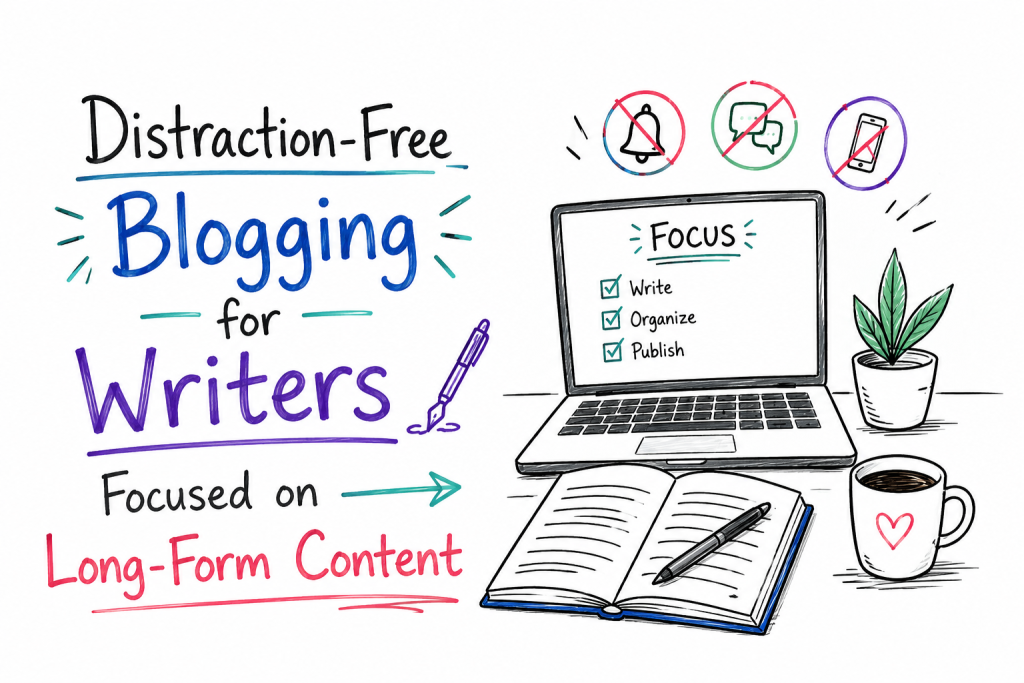
A distraction-free blogging platform helps writers give their full attention to the content. Instead of competing with visual noise or complicated settings, they can concentrate on organising ideas, improving arguments, and creating a smooth reading experience.
This focused approach benefits readers as well. Clean article pages make it easier to follow longer discussions without losing attention. For independent writers, educators, professionals, researchers, and storytellers, distraction-free blogging can turn long-form publishing into a calmer and more sustainable creative practice.
Long-Form Writing Needs a Different Environment
Short social posts can often be written and published within minutes. Long-form content works differently. A detailed article may require research, planning, multiple drafts, careful editing, and thoughtful formatting.
Writers must maintain a clear connection between the opening idea and the final conclusion. They also need to guide readers through several sections without making the article feel confusing or repetitive.
A suitable long-form writing platform should support this process rather than interrupt it. The environment should make it easy to:
- Concentrate on one subject
- Develop ideas in logical order
- Review longer paragraphs
- Organise sections clearly
- Edit without unnecessary visual distractions
- Present the final article in a readable format
When the publishing environment feels calm, writers can spend more energy improving their work instead of managing technical details.
Distractions Affect Writing Quality
Distractions do not always appear as obvious interruptions. Sometimes they are built into the writing environment itself. Busy dashboards, too many menus, promotional messages, complex design controls, and constant performance indicators can divide a writer’s attention.
This divided attention can affect content in several ways. Writers may rush through important points, forget supporting examples, repeat the same information, or lose the original direction of the article.
A distraction-free writing platform reduces unnecessary decisions. Writers can focus on meaningful questions such as:
- Is the main idea clear?
- Does each section support the topic?
- Are examples useful and relevant?
- Can readers understand the language?
- Does the conclusion provide a satisfying ending?
Removing unnecessary visual and technical interruptions does not automatically create better writing. However, it creates conditions in which thoughtful writing becomes easier.
Clear Thinking Produces Stronger Long-Form Content
Long-form content becomes valuable when it gives readers enough depth to understand a subject. Length alone does not create quality. A long article filled with repeated ideas will not hold attention.
Focused writers are more likely to examine their topic carefully. They can identify the central message, remove irrelevant information, and connect each section to the reader’s needs.
Before beginning a detailed article, it helps to define three elements:
The central idea: The main point the article will communicate.
The reader’s need: The reason someone would spend time reading the article.
The intended result: The knowledge, insight, or action the reader should gain.
These elements act as a guide throughout the writing process. Whenever a paragraph feels unnecessary, the writer can check whether it supports the central idea or helps the reader reach the intended result.
Article Structure Protects the Writer’s Focus
A simple structure can prevent long-form articles from becoming difficult to manage. Writers do not need to plan every sentence in advance, but they should understand the general direction of the content.
A useful long-form structure may include:
- An opening that introduces the reader’s situation
- A clear explanation of the central topic
- Supporting sections that explore major ideas
- Practical examples or recommendations
- Common problems and realistic solutions
- A conclusion that connects the main lessons
This outline gives the writer a path to follow. It also reduces the temptation to add unrelated information simply to make the article longer.
Each section should have one clear purpose. When a section tries to explain too many ideas at once, readers may struggle to understand the message. Dividing complex subjects into smaller, descriptive sections improves both writing and reading.
A Calm Writing Routine Supports Consistency
Distraction-free blogging is not only about platform design. Writers also need habits that protect their attention.
A focused writing session can begin with a small and realistic goal. Instead of trying to complete an entire article at once, a writer might aim to finish the outline, introduction, or one major section.
Useful habits include:
- Keeping research notes separate from the main draft
- Closing unrelated browser tabs
- Writing the first draft before making detailed corrections
- Setting a clear purpose for each writing session
- Taking short breaks between major sections
- Proofreading after gaining some distance from the draft
Writers should also avoid constantly checking whether their article is receiving attention immediately after publication. Long-form content often provides value gradually as readers discover, share, and return to it.
A sustainable routine matters more than publishing large amounts of content in a short period.
Readable Presentation Keeps Readers Engaged
A writer may work in a focused environment, but the published article must also provide a comfortable experience for readers.
Large blocks of uninterrupted text can make detailed articles feel difficult. Readers may lose their place or leave before reaching the most useful sections.
Long-form articles become easier to read when writers use:
- Short and focused paragraphs
- Descriptive section headings
- Simple sentence structures
- Lists only where they improve clarity
- Examples that explain complex ideas
- Smooth transitions between sections
- Consistent formatting throughout the article
Readable presentation does not mean reducing the depth of the subject. It means making detailed information easier to understand.
Light and dark reading modes can also support comfort because readers have different preferences and may read under different lighting conditions. Responsive pages are equally important because long-form content should remain readable on computers, tablets, and mobile devices.
Independent Writers Benefit from an Organised Publishing Home
Many writers initially share their work through social media. These platforms can help introduce ideas, but fast-moving feeds are not always suitable for preserving detailed writing.
A personal blog gives long-form content a more organised home. Articles can remain connected to the writer’s identity instead of quickly disappearing beneath newer posts.
An organised publishing space can support:
- Personal essays
- Educational articles
- Professional insights
- Research summaries
- Detailed tutorials
- Fiction and creative stories
- Poetry collections
- Opinion pieces
- Subject-based article series
Over time, these published pieces can form a meaningful writing portfolio. Readers can understand the writer’s interests, knowledge, style, and development through a connected body of work.
This is especially useful for independent writers who want their work to exist beyond temporary social media updates.
BlogAion as a Focused Space for Thoughtful Publishing
BlogAion provides a calm publishing environment for writers who want to create and organise meaningful content. Writers can start a personal blog without coding, use a personal BlogAion subdomain, and publish long-form articles, stories, tutorials, poetry, research, and opinions.
Its clean presentation keeps attention on the written work, while responsive pages and light and dark reading modes support comfortable reading across different devices. The platform also offers a shared discovery environment where readers can explore independent voices and fresh stories.
For writers who prefer collaborative publishing, BlogAion supports multiple contributors. This can be useful for educational publications, research groups, community blogs, professional knowledge platforms, and interest-based magazines.
The purpose of using a simple blogging platform is not to avoid every publishing decision. It is to remove unnecessary technical barriers so writers can spend more time developing useful content.
Long-Form Writing Builds Reader Trust
Readers often choose long-form content when they need more than a quick answer. They may want context, practical guidance, examples, balanced discussion, or a deeper understanding of a subject.
A detailed article can build trust when it is accurate, organised, and honest about its limitations. Writers should avoid adding unsupported claims simply to sound authoritative.
Trustworthy long-form writing usually includes:
- Clear explanations
- Realistic examples
- Balanced viewpoints
- Accurate terminology
- Transparent opinions
- Useful recommendations
- Consistent reasoning
Writers should also separate facts from personal interpretation. Phrases such as “in my experience,” “one possible approach,” or “this may depend on the situation” help readers understand whether a statement is a verified fact or an individual perspective.
Editing Becomes More Important as Articles Grow
Longer articles create more opportunities for repetition, unclear transitions, and unnecessary sections. Editing is therefore an essential part of long-form publishing.
A useful editing process can include several separate reviews.
During the first review, focus on structure. Check whether the sections appear in a logical order.
During the second review, examine clarity. Simplify confusing sentences and explain unfamiliar terms.
During the third review, remove repetition. Combine paragraphs that communicate the same idea.
During the final review, correct grammar, spelling, punctuation, and formatting.
Reading the article aloud can also reveal awkward sentences. If a sentence is difficult to say naturally, it may also be difficult for readers to follow.
Writers should not expect the first draft to be perfect. A first draft captures ideas. Editing turns those ideas into useful published content.
Common Challenges in Distraction-Free Blogging
Even a calm platform cannot remove every difficulty. Writers may still face creative blocks, inconsistent schedules, perfectionism, or uncertainty about their topic.
Starting Without a Clear Direction
A broad topic can lead to an unfocused article. Writers should narrow the subject before drafting and decide which reader problem they want to address.
Editing Every Sentence Too Early
Constant editing during the first draft can interrupt the flow of ideas. It is often better to complete a rough section before improving individual sentences.
Adding Too Many Categories
Publishing across many unrelated subjects can make a personal blog difficult to understand. A few connected themes usually create a clearer identity.
Writing Only for Search Engines
Keywords can improve relevance, but awkward repetition damages readability. Content should answer the reader’s need first and use keywords naturally.
Expecting Immediate Results
Long-form publishing is a gradual practice. Writers need time to develop their voice, create an organised collection, and understand the subjects that connect most strongly with readers.
Depending Entirely on Motivation
Motivation changes from day to day. A simple schedule and realistic writing goals are more dependable than waiting for the perfect creative mood.
A Practical Long-Form Publishing Process
A repeatable process can make long-form blogging feel less overwhelming.
Begin by choosing one specific topic. Write down the central idea and the reader’s likely need.
Next, collect only the research and examples required for that subject. Too much unrelated research can become another form of distraction.
Create a short outline with descriptive section headings. Arrange the sections in the order a beginner would naturally need them.
Write the first draft without trying to make every paragraph perfect. Keep moving until the main ideas are complete.
After drafting, review the article for structure, clarity, repetition, accuracy, and readability.
Finally, preview the published presentation. Check paragraph length, headings, lists, and device readability before making the article public.
Once published, keep the article organised within the larger blog. Related pieces can eventually become a useful collection or series.
Long-Term Value of Focused Publishing
Distraction-free blogging encourages writers to think beyond the pressure of constant posting. Instead of publishing only to remain visible, they can create work that continues to educate, inform, or inspire readers.
A thoughtful collection of long-form articles can show a writer’s growth over time. It can also preserve knowledge that would otherwise be lost in temporary feeds, private documents, or unfinished drafts.
The strongest long-form blogs are not always the ones publishing most frequently. They are often the ones offering clear ideas, useful depth, a recognisable voice, and a comfortable reading experience.
For independent writers, focused publishing creates an opportunity to build something lasting: an organised body of work that represents their interests, experiences, knowledge, and creative identity.
Frequently Asked Questions
1. What is distraction-free blogging?
Distraction-free blogging involves writing and publishing in an environment that reduces unnecessary visual elements, complicated controls, notifications, and technical interruptions. The aim is to help writers focus on planning, drafting, editing, and presenting their content. It also supports readers by providing clean and comfortable article pages.
2. Is distraction-free blogging suitable for beginners?
Yes. Beginners can benefit because a simple publishing environment reduces the number of technical decisions they must make. They can concentrate on developing ideas, learning article structure, and improving their writing. A beginner-friendly platform can also help them publish without needing coding or website-management knowledge.
3. Which types of content work well in long-form blogs?
Long-form blogging is suitable for detailed tutorials, educational articles, professional insights, research discussions, personal essays, opinion pieces, case studies, travel experiences, fiction, poetry collections, and creative stories. The format works best when the subject requires explanation, context, examples, or thoughtful development.
4. Does long-form content need to be several thousand words?
No fixed length is suitable for every topic. An article should be long enough to answer the reader’s need without unnecessary repetition. Some subjects can be explained clearly in a shorter article, while complex topics may require greater depth. Usefulness, structure, and clarity matter more than word count alone.
5. Can multiple writers contribute to one long-form blog?
Yes, when the selected platform supports multiple contributors. Collaborative blogs can be useful for educational groups, professional teams, research communities, publications, and interest-based magazines. Contributors should follow shared editorial guidelines so the blog maintains consistent quality, formatting, and subject focus.
6. Can BlogAion support distraction-free long-form publishing?
BlogAion is designed for calm and organised publishing. Writers can create personal blogs, claim BlogAion subdomains, publish without coding, and present articles through clean, responsive pages. It supports different content formats, multiple contributors, community discovery, and light and dark reading modes.
Conclusion
Distraction-free blogging gives long-form writers the mental and visual space needed to develop meaningful ideas. A calm environment helps writers organise complex subjects, create logical structures, edit carefully, and maintain a realistic publishing routine. Clean presentation also helps readers stay engaged with longer articles.
The platform is only one part of the process. Writers must still choose focused topics, avoid unnecessary repetition, check accuracy, format content carefully, and publish with patience. Strong long-form writing grows through consistent practice rather than rushed production.