Introduction
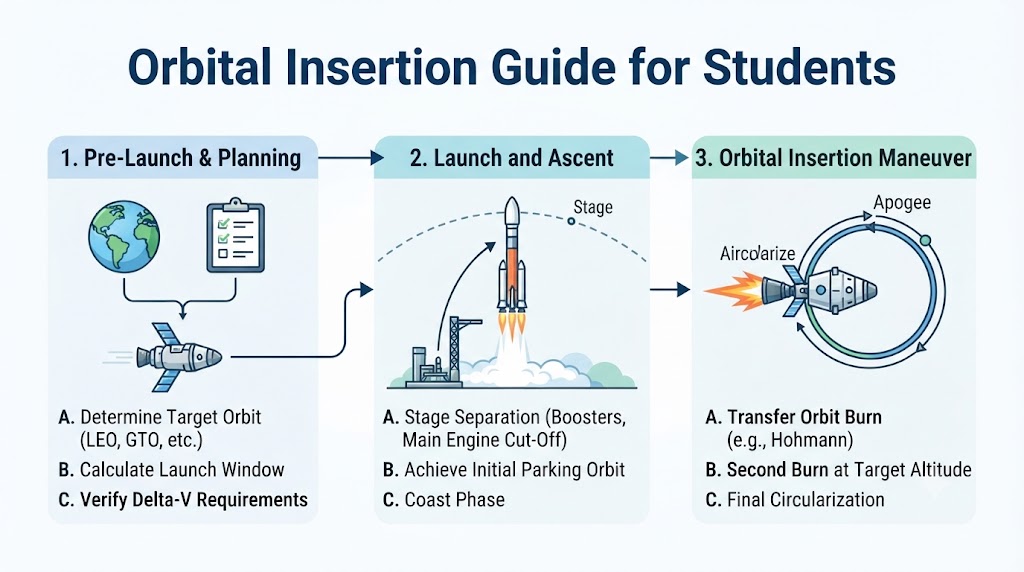
Orbital Insertion Guide for Students explains one of the most important steps in spaceflight. Many students think that reaching space is the same as entering orbit, but both are different.
A rocket can go high above Earth, but if it does not gain the correct speed and direction, it can fall back. Orbital insertion is the step where a spacecraft or satellite is placed onto the correct path around Earth, the Moon, or another planet.
What Is Orbital Insertion?
Orbital insertion is the process of placing a spacecraft into a planned orbit.
An orbit is a curved path around a planet, moon, or other space body. A satellite in orbit keeps moving forward while gravity keeps pulling it inward. Because of this balance, the satellite keeps moving around the planet instead of falling straight down.
In simple words, orbital insertion means putting a spacecraft on the right space “track.”
Why Orbital Insertion Is Important
Orbital insertion is important because every space mission needs the correct path.
A weather satellite needs the right orbit to observe Earth. A communication satellite needs a stable position to send signals. A science spacecraft may need a special orbit to study the Moon, Mars, or another planet.
If the orbit is wrong, the mission may not work properly.
Reaching Space vs Entering Orbit
Reaching space means the rocket has gone above most of Earth’s atmosphere. But entering orbit means the spacecraft has enough sideways speed to keep moving around Earth.
Think of throwing a ball. If you throw it slowly, it falls near you. If you throw it faster, it goes farther. In orbit, the spacecraft is moving so fast sideways that it keeps falling around Earth instead of falling back to the ground.
This is why rockets do not simply fly straight up. They curve during launch to build sideways speed.
How Does Orbital Insertion Work?
The basic process is:
- The rocket launches from Earth.
- It rises through the atmosphere.
- It slowly turns into a curved path.
- The upper stage or spacecraft engine fires.
- The spacecraft gains the correct speed and direction.
- It enters the planned orbit.
- Mission control confirms the orbit.
This controlled engine firing is often called an orbital insertion burn.
What Is an Orbital Insertion Burn?
An orbital insertion burn is a planned engine firing used to change the spacecraft’s speed and path.
NASA explains that spacecraft maneuvers can adjust flight paths or orbits, and orbit trim maneuvers are used to refine a spacecraft’s orbit.
During insertion, the engine may fire for a short time or a longer time, depending on the mission. The goal is to place the spacecraft into the correct orbit safely.
Role of Speed and Direction
Orbit depends on two main things:
- Height above the planet
- Sideways speed
Height alone is not enough. A spacecraft also needs the correct forward speed. If it is too slow, it may fall back. If it is too fast, it may move into a different path or escape the planet’s gravity.
Direction also matters. Even a small angle error can affect the final orbit.
Types of Orbits Students Should Know
ESA lists many types of orbits, including Low Earth Orbit, Medium Earth Orbit, Geostationary Orbit, Polar Orbit, Sun-synchronous Orbit, and transfer orbits.
Low Earth Orbit
Low Earth Orbit, or LEO, is close to Earth compared to other orbits. Many Earth observation satellites and the International Space Station use this region.
Medium Earth Orbit
Medium Earth Orbit, or MEO, is higher than LEO. Navigation satellites often use this type of orbit.
Geostationary Orbit
Geostationary Orbit, or GEO, is much higher above Earth. Satellites in this orbit appear to stay over the same area of Earth. This is useful for communication and weather satellites.
Polar Orbit
A polar orbit passes near Earth’s poles. NASA Earthdata explains that polar-orbiting platforms can travel from pole to pole while Earth rotates, helping instruments collect data across the globe.
Transfer Orbit
A transfer orbit is a temporary path used to move a spacecraft from one orbit to another. For example, a satellite may first enter a transfer orbit before reaching its final orbit.
Lunar and Planetary Orbit
Some spacecraft enter orbit around the Moon, Mars, or another planet. These missions need very accurate timing and speed.
Role of Mission Control
Mission control tracks the spacecraft during and after orbital insertion.
The team checks:
- Speed
- Altitude
- Direction
- Communication signal
- Engine performance
- Fuel status
- Final orbit
If the spacecraft is slightly off path, mission control may plan a correction maneuver.
What Happens After Orbital Insertion?
After successful orbital insertion, the spacecraft begins early operations.
It may:
- Open solar panels
- Start communication
- Check batteries
- Test instruments
- Adjust its orbit
- Stabilize its direction
- Begin its mission work
A satellite may not start full service immediately. First, engineers confirm that all systems are healthy.
Common Challenges During Orbital Insertion
Orbital insertion must be accurate. Common challenges include:
- Wrong speed
- Wrong direction
- Engine issue
- Weak communication
- Fuel limitation
- Need for orbit correction
- Incorrect timing
Space agencies prepare for these risks through testing, planning, and backup procedures.
Simple Student Example
Imagine a train that must enter the correct railway track. If it enters the wrong track, it will not reach the right station.
Orbital insertion is similar. The rocket and spacecraft must place the satellite on the correct orbital track. Once it is on that track, the spacecraft can continue its mission.
Common Misunderstandings
Reaching Space Is Not the Same as Orbit
A spacecraft can reach space but still fall back if it does not gain enough sideways speed.
Satellites Are Always Falling
A satellite in orbit is always falling toward Earth, but it is also moving forward so fast that it keeps missing Earth.
Orbit Needs Direction, Not Just Height
A spacecraft must move in the correct direction. Height alone cannot keep it in orbit.
Orbital Insertion Is Not the End
After insertion, the spacecraft still needs system checks, communication tests, and mission setup.
FAQs About Orbital Insertion
1. What is orbital insertion?
Orbital insertion is the process of placing a spacecraft or satellite into a planned orbit around Earth, the Moon, or another planet.
2. Why is orbital insertion important?
It is important because the spacecraft must reach the correct path to perform its mission properly.
3. Is reaching space the same as entering orbit?
No. Reaching space means going high enough above Earth. Entering orbit means gaining enough sideways speed to keep moving around Earth.
4. How does a spacecraft enter orbit?
A spacecraft enters orbit by reaching the correct altitude, speed, and direction. This often requires a controlled engine burn.
5. What is an orbital insertion burn?
It is a planned engine firing that changes the spacecraft’s speed and path so it can enter the correct orbit.
6. Why does orbit need sideways speed?
Sideways speed helps the spacecraft keep moving around Earth instead of falling straight back down.
7. What happens after orbital insertion?
The spacecraft checks its systems, communicates with mission control, may open solar panels, and begins early mission operations.
8. Who controls orbital insertion?
Onboard computers and mission control teams work together to monitor and manage orbital insertion.
9. Can orbital insertion fail?
Yes, but space agencies plan carefully to reduce risk. Problems may include wrong speed, engine issues, or incorrect direction.
10. What types of orbit are used in space missions?
Common orbits include Low Earth Orbit, Medium Earth Orbit, Geostationary Orbit, Polar Orbit, Transfer Orbit, Lunar Orbit, and Planetary Orbit.
Final Thoughts
Orbital Insertion Guide for Students helps explain why spaceflight is more than simply going upward. A spacecraft must enter the correct orbit with the right speed, direction, and timing.
Orbital insertion is one of the most important steps in any space mission. It turns a launch into a working mission by placing the spacecraft on the correct path.
For students, this concept is the key to understanding how satellites, space stations, lunar missions, and planetary spacecraft stay on their planned routes.