Introduction
Spacecraft Separation Explained for Beginners is an important topic for anyone who wants to understand what really happens after a rocket launch. Many people watch a rocket lift off and think the mission is almost complete. In reality, the most important steps happen after the rocket leaves the launch pad.
One of those steps is spacecraft separation. This is the moment when the spacecraft, satellite, capsule, or probe separates from the rocket and begins its own mission.
For readers of astropilot.co, this guide explains spacecraft separation in simple language. You will learn what it means, why it matters, how it works, and what happens after the spacecraft separates.
What Is Spacecraft Separation?
Spacecraft separation is the process where a spacecraft detaches from the rocket or launch vehicle that carried it into space.
The rocket’s job is to lift the spacecraft from Earth and place it on the correct path. Once the rocket reaches the planned altitude, speed, or orbit, the spacecraft must separate safely.
The spacecraft may be a satellite, cargo vehicle, crew capsule, space telescope, lunar probe, or deep space mission vehicle. After separation, it is no longer just a passenger. It becomes an active space mission.
Why Is Spacecraft Separation Important?
Spacecraft separation is important because the spacecraft must be released at the right place, at the right time, and in the right direction.
If separation happens too early, too late, or in the wrong position, the spacecraft may not reach its planned orbit or mission path.
A successful separation helps the spacecraft:
- Reach the correct orbit
- Avoid collision with the rocket stage
- Start communication with mission control
- Open solar panels safely
- Begin system checks
- Prepare for its main mission
This small moment can decide whether the mission continues successfully.
Rocket and Spacecraft Are Not Always One Object
Many beginners imagine the rocket and spacecraft as one single machine. But they usually have different roles.
The rocket is like a powerful delivery vehicle. The spacecraft is the important package or mission vehicle.
The rocket provides the power needed to escape Earth’s lower atmosphere and reach space. The spacecraft is the object that performs the mission after it is released.
For example, if the mission is to place a weather satellite in orbit, the rocket carries the satellite upward. Once the correct orbit is reached, the satellite separates and starts its own work.
When Does Spacecraft Separation Happen?
Spacecraft separation usually happens after the rocket reaches the planned speed, altitude, or orbit.
The exact timing depends on the mission. ESA notes that for some near-Earth missions, spacecraft separation from the upper stage can happen within about 30 minutes, while missions to higher orbits or interplanetary destinations may take longer and need additional upper-stage burns.
For a low Earth orbit satellite, separation may happen relatively soon after launch. For a Moon, Mars, or deep space mission, separation may happen later after the spacecraft is placed on a special path.
How Does Spacecraft Separation Work?
Spacecraft separation is carefully planned before launch. Engineers test the connection between the spacecraft and launch vehicle many times.
NASA explains that launch integration includes checking whether the spacecraft fits inside the payload fairing, can survive launch forces, and can be placed on the correct trajectory.
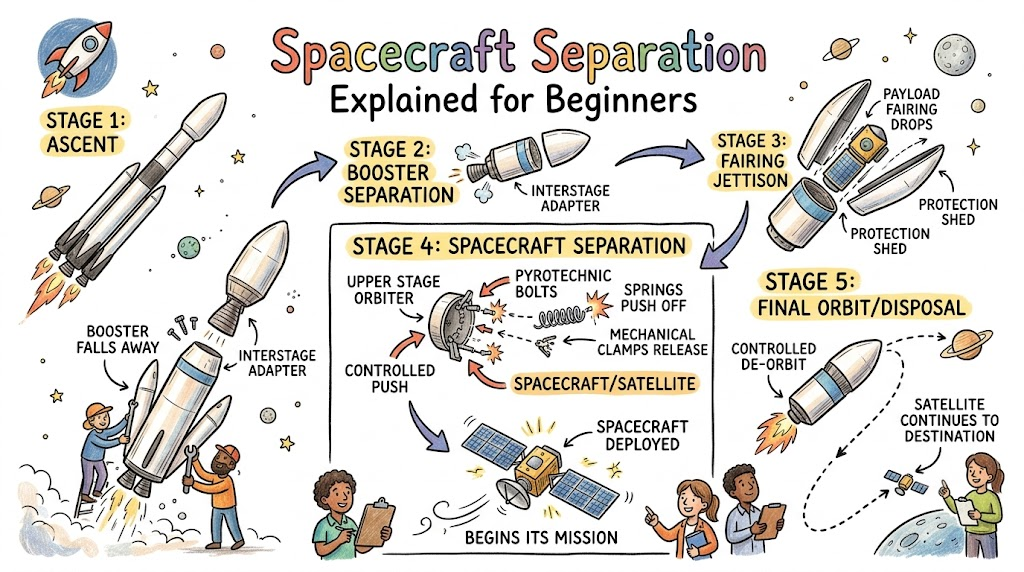
In simple terms, spacecraft separation usually works like this:
- The rocket reaches the planned position.
- The onboard system or mission control sends a separation command.
- Mechanical locks, clamps, or bolts release.
- Springs or small pushers gently move the spacecraft away.
- Sensors confirm that separation has happened.
- Mission control checks the spacecraft signal.
- The spacecraft begins its early operations.
The process may look simple from outside, but it requires very precise timing and engineering.
Main Types of Spacecraft Separation
1. Stage Separation
Stage separation happens when one part of the rocket separates from another.
Many rockets are made of stages. ESA explains that each stage is a complete part of a launch vehicle, usually containing propellant tanks, engines, and other equipment.
When one stage finishes its fuel, it separates. The next stage then continues the flight. This makes the rocket lighter and more efficient.
2. Fairing Separation
The payload fairing is the protective cover around the spacecraft during launch. It protects the spacecraft from air pressure, heat, vibration, and aerodynamic forces while the rocket moves through the atmosphere.
Once the rocket reaches thinner air, the fairing is no longer needed. It separates and falls away.
This reduces weight and prepares the spacecraft for later deployment.
3. Payload Separation
Payload separation is the moment when the satellite, spacecraft, or cargo separates from the rocket’s upper stage.
This is the most important separation step for many missions. Once the payload separates, the spacecraft begins its own journey.
4. Satellite Deployment
Satellite deployment is a type of payload separation. It happens when a satellite is released into orbit.
After deployment, the satellite may open solar panels, connect with ground stations, test its systems, and slowly begin its full service.
5. Crew Capsule Separation
In crewed missions, a capsule carrying astronauts may separate from the rocket or another spacecraft section.
This can happen during normal mission phases or during safety procedures. Crew capsule separation is designed with extra care because human life is involved.
6. Deep Space Probe Separation
For missions beyond Earth orbit, a deep space probe separates after being placed on the correct path toward the Moon, Mars, asteroids, or other destinations.
After separation, the probe may travel for months or years before reaching its target.
What Happens After Spacecraft Separation?
After separation, the spacecraft does not always start full work immediately. First, it must complete early checks.
These checks may include:
- Confirming power supply
- Opening solar panels
- Checking battery health
- Testing communication
- Stabilizing direction
- Activating onboard computers
- Adjusting orbit
- Testing instruments
This early phase is very important. Mission teams want to make sure the spacecraft is healthy before beginning full operations.
Role of Mission Control During Separation
Mission control plays a major role during spacecraft separation.
The team tracks the rocket, monitors spacecraft data, checks signals, and confirms whether separation happened correctly.
Mission control may watch:
- Separation timing
- Spacecraft speed
- Spacecraft direction
- Communication signal
- Power status
- Orbit accuracy
- Sensor confirmation
- Early spacecraft health
If small corrections are needed, commands may be sent to the spacecraft.
What Can Go Wrong During Spacecraft Separation?
Spacecraft separation is designed to be safe, but problems can happen.
Some possible issues include:
- Separation delay
- Weak communication signal
- Incorrect spacecraft direction
- Failure of a release mechanism
- Payload not reaching the correct orbit
- Spacecraft spinning after release
- Solar panels not opening correctly
These situations are rare, but engineers prepare for them in advance. Backup systems, testing, and mission control procedures help reduce risk.
Simple Example: Delivery Truck and Package
A simple way to understand spacecraft separation is to imagine a delivery truck.
The rocket is the delivery truck. The spacecraft is the package. The truck must carry the package to the correct address. Once it reaches the right place, the package is released.
If the package is dropped too early or at the wrong location, the delivery fails.
Spacecraft separation works in a similar way. The rocket must release the spacecraft at the correct point so the mission can begin properly.
Common Misunderstandings About Spacecraft Separation
Separation Does Not Mean the Mission Is Complete
Spacecraft separation is not the end of the mission. It is the beginning of the spacecraft’s independent journey.
Stage Separation and Spacecraft Separation Are Different
Stage separation means one rocket stage separates from another. Spacecraft separation means the mission payload separates from the rocket.
Satellites Do Not Start Full Work Immediately
After release, satellites usually go through testing and setup before starting full operations.
The Rocket Does Not Always Stay With the Spacecraft
After separation, the rocket stage may move away, re-enter the atmosphere, or follow a disposal plan.
Separation Must Be Carefully Controlled
Even a small mistake in timing, speed, or direction can affect the mission.
Why Spacecraft Separation Matters in Space Missions
Spacecraft separation matters because it turns a launch into a real mission.
Before separation, the spacecraft depends on the rocket. After separation, it must survive and operate on its own.
This is the moment when engineers confirm that the spacecraft is ready for the next stage of the mission.
For Earth satellites, this may mean beginning communication or weather observation. For deep space probes, it may mean starting a long journey to another planet.
FAQs About Spacecraft Separation
1. What is spacecraft separation?
Spacecraft separation is the process where a spacecraft, satellite, capsule, or probe detaches from the rocket or launch vehicle that carried it into space.
2. Why does spacecraft separation happen?
It happens because the rocket’s job is only to carry the spacecraft to the correct path. After that, the spacecraft must separate and begin its own mission.
3. When does spacecraft separation happen after launch?
It depends on the mission. Some spacecraft separate within a short time after launch, while others separate later after reaching higher orbit or a deep space path.
4. How does a spacecraft separate from a rocket?
The separation system releases locks or clamps, and springs or pushers gently move the spacecraft away from the rocket.
5. Is spacecraft separation the same as stage separation?
No. Stage separation happens between rocket sections. Spacecraft separation happens when the payload or spacecraft separates from the rocket.
6. What happens after spacecraft separation?
The spacecraft checks its systems, starts communication, may open solar panels, adjusts its position, and prepares for mission operations.
7. Can spacecraft separation fail?
Yes, but failures are rare. Engineers test separation systems carefully before launch to reduce risk.
8. Who monitors spacecraft separation?
Mission control teams monitor spacecraft separation using data from the rocket, spacecraft, sensors, and ground tracking systems.
9. Why is satellite deployment important?
Satellite deployment places the satellite into its planned orbit so it can begin its work, such as communication, navigation, weather tracking, or Earth observation.
10. Does the spacecraft start working immediately after separation?
Not always. Most spacecraft first complete health checks, power checks, communication tests, and system setup before starting full operations.
Final Thoughts
Spacecraft Separation Explained for Beginners helps us understand one of the most important moments in a space mission.
A rocket launch may look like the biggest event, but spacecraft separation is the point where the spacecraft truly begins its own work. The rocket has completed its delivery job, and the spacecraft is now ready to communicate, adjust its position, open systems, and begin the mission.
For beginners, this process shows how space missions depend on timing, engineering, planning, and careful monitoring. The next time you watch a rocket launch, remember that the real mission begins when the spacecraft separates.