
Introduction
Every time a mobile phone connects to a network, it needs to identify the available operator. Mobile networks use specific codes to make this process easier. Three important terms help explain how this system works: MCC, MNC, and PLMN.
These terms play a key role in mobile connectivity, network selection, and international roaming. They also help telecom teams manage network settings and investigate connection problems.
Although these codes work together, each one serves a different purpose. Understanding their roles makes mobile technology easier to follow, whether you use a regular SIM card or an eSIM.
How Mobile Network Identification Works
Mobile operators need a clear way to distinguish their networks from others. A phone may detect several networks in one area, especially in cities, near borders, or while travelling abroad.
Network identification codes help devices and telecom systems recognize the correct network. They also support communication between mobile operators.
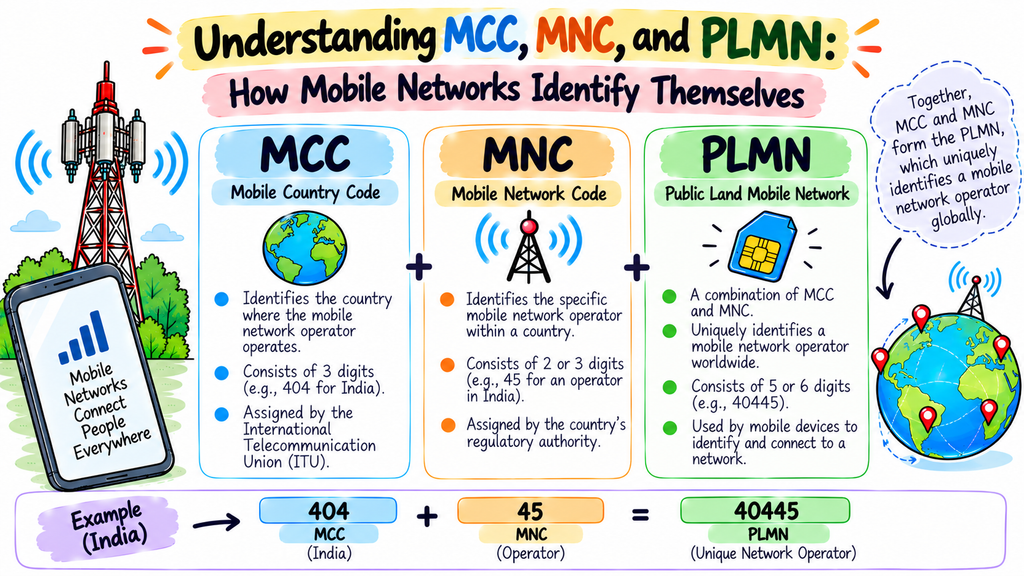
The system uses three related concepts:
- MCC: Identifies the country or geographical numbering assignment associated with a mobile network.
- MNC: Distinguishes a mobile operator’s network within the relevant country-code arrangement.
- PLMN: Refers to a public land mobile network. Its identifier combines the MCC and MNC.
Together, these concepts help mobile devices and network systems identify operators more accurately.
MCC: The Mobile Country Code
The Mobile Country Code, or MCC, identifies the country or geographical area associated with a mobile network’s numbering assignment.
An MCC normally contains three digits. Mobile operators and telecom systems use this code as one part of a network’s identity.
What Does an MCC Do?
An MCC helps a device or telecom system identify the country-code assignment linked to a network. This information supports network selection, roaming procedures, and operator configuration.
However, an MCC does not reveal a phone’s exact physical location. It identifies a numbering assignment rather than a person’s location.
Telecom professionals may check MCC values when they configure network settings or investigate registration issues.
MNC: The Mobile Network Code
The Mobile Network Code, or MNC, works alongside the MCC. It distinguishes a mobile network within the relevant MCC arrangement.
An MNC may contain two or three digits, depending on the numbering plan. Therefore, systems must interpret the code according to the applicable format instead of assuming that every MNC has the same length.
Why Does the MNC Matter?
Mobile operators use MNC values to distinguish their networks from other operators. A device can use the MCC and MNC together to identify a network during supported selection and registration procedures.
Telecom engineers may review these values when they investigate SIM configuration, roaming behavior, or network registration errors.
An MNC does not work as a complete identifier on its own in every context. Systems need the associated MCC to interpret the network identity correctly.
PLMN: The Public Land Mobile Network
PLMN stands for Public Land Mobile Network. It describes a public mobile telecommunications network that provides services such as voice calls, messaging, and mobile data.
A PLMN identifier combines the MCC and MNC. This combination helps devices and telecom systems distinguish one network from another.
For example, two operators may serve the same country. Their MCC values may match, while their MNC values distinguish their respective networks.
PLMN and PLMN Identifier: The Difference
These terms describe related but different things.
- PLMN means the public mobile network itself.
- PLMN identifier means the code that identifies that network through its MCC and MNC.
This distinction matters when engineers read network logs, configure devices, or troubleshoot mobile connectivity.
MCC, MNC, and PLMN Compared
The following table summarizes the main differences.
| Feature | MCC | MNC | PLMN |
|---|---|---|---|
| Full form | Mobile Country Code | Mobile Network Code | Public Land Mobile Network |
| Main role | Identifies the relevant country or geographical numbering assignment | Distinguishes a network within the relevant MCC arrangement | Describes a public mobile network |
| Typical format | Three digits | Two or three digits | Network identified by an MCC and MNC combination |
| Main use | Country-code identification | Operator-network distinction | Network identification and mobile service delivery |
| Works with | MNC | MCC | MCC and MNC identifier |
The key point is simple: the MCC and MNC form the network identifier, while PLMN describes the public mobile network that identifier represents.
How Phones Use These Codes
A mobile phone needs to recognize available networks before it can attempt to connect. MCC and MNC values help the device identify those networks.
The phone also considers other information, such as SIM settings, operator rules, signal strength, and network compatibility.
Network Selection
When a phone searches for service, it detects available networks and evaluates them according to device settings and operator rules. Network identifiers help it distinguish the available options.
The phone may prefer its home operator or a permitted roaming partner. However, the codes alone do not guarantee a successful connection.
Network Registration
After selecting a suitable network, the device attempts to register. The operator checks the subscriber’s authorization and other requirements.
A phone may recognize a network but still fail to register. The subscription, roaming permissions, coverage, or device compatibility may prevent access.
Why These Codes Matter for International Roaming
International roaming allows a subscriber to use a compatible partner network outside the home operator’s service area.
When a traveller arrives in another country, the phone searches for supported networks. MCC and MNC values help identify the available operators and distinguish them from one another.
The home operator and visited operator also rely on agreements, subscriber information, and network procedures to support roaming.
For this reason, network identification is only one part of roaming. A phone may detect a network without receiving permission to use its services.
Travellers who experience connection problems should check roaming settings, plan restrictions, device compatibility, and local coverage.
The Role of MCC and MNC in SIM and eSIM Connectivity
SIM cards and eSIM profiles store information that helps a device connect to a mobile operator. Network selection and registration procedures use that information alongside network identifiers.
An eSIM provides a digital way to install and manage supported mobile profiles. It does not remove the need for network identification.
When users choose an eSIM plan, they should check the supported countries, network partners, data limits, and device requirements. A profile may support several partner networks, but availability still depends on the provider’s arrangements and local conditions.
Services such as esimglobo.com/ can help users explore eSIM-related connectivity options. Before choosing a plan, travellers should confirm its coverage and compatibility with their devices.
Where Telecom Teams Use MCC, MNC, and PLMN
Network identification codes support several telecom tasks. Their exact role depends on the device, network technology, and operator configuration.
Mobile Network Operations
Engineers use network identifiers when reviewing configuration details and investigating registration or selection problems. Correct values help them distinguish one operator’s network from another.
Roaming Management
Operators use network identity information during roaming procedures. Their systems also check subscriber permissions and commercial agreements before allowing service.
Network Testing
Testing teams may examine MCC and MNC values to confirm that a device recognizes the expected network. They can compare device behavior with operator settings and test results.
IoT Connectivity
Internet of Things devices often rely on mobile networks to send information from sensors, meters, vehicles, and industrial equipment. Network identification helps these devices recognize available operators and follow configured connection rules.
Troubleshooting
Incorrect settings or unexpected network identities can contribute to connection problems. Engineers may review identifiers alongside signal measurements, SIM details, device logs, and registration messages.
How to Check Network Identification Details
The method for checking MCC, MNC, or PLMN information depends on the phone, operating system, modem, and mobile operator.
Users and technical teams can try these approaches:
- Check device settings: Some phones display network or SIM details, although they may not show every code.
- Review diagnostic tools: Supported network-testing applications may provide additional information.
- Inspect modem or device logs: Technical teams can use supported diagnostic interfaces to examine network registration details.
- Contact the operator: The mobile provider can confirm relevant network information and help investigate service issues.
- Check device documentation: Manufacturers may explain how to access cellular diagnostics on supported models.
Treat online code lists carefully. Confirm the source and numbering context before using a value in a configuration or troubleshooting process.
Common Mistakes to Avoid
People sometimes confuse these terms because they appear together in mobile network information. A few distinctions can prevent errors.
Assuming MCC identifies an exact location: MCC relates to a country or geographical numbering assignment. It does not provide a phone’s precise location.
Treating MNC as a complete identifier: An MNC normally needs its associated MCC to identify the relevant network correctly.
Confusing PLMN with its identifier: PLMN refers to the public mobile network. The PLMN identifier combines MCC and MNC.
Assuming detection guarantees access: A device may recognize a network but fail registration because of subscription restrictions, roaming rules, compatibility, or coverage.
Ignoring code length: MNC formats can use two or three digits. Systems must preserve and interpret the correct format.
Using unverified examples: Sample codes should not serve as production configuration values unless a reliable source confirms them.
Frequently Asked Questions
What does MCC mean in mobile networking?
MCC means Mobile Country Code. It normally contains three digits and identifies the country or geographical numbering assignment associated with a mobile network.
What is the purpose of an MNC?
MNC means Mobile Network Code. It distinguishes a mobile network within the relevant MCC arrangement and may contain two or three digits.
What does PLMN stand for?
PLMN stands for Public Land Mobile Network. It describes a public mobile network that provides services such as voice, messaging, and mobile data.
How do MCC and MNC work together?
The MCC identifies the relevant country-code assignment, while the MNC distinguishes the network within that arrangement. Together, they form a PLMN identifier.
Can MCC reveal someone’s exact location?
No. MCC identifies a country or geographical numbering assignment. It does not show a person’s exact position or provide precise location tracking by itself.
Do these codes affect roaming?
Yes. Network identifiers help devices and telecom systems recognize networks during roaming procedures. However, subscriber permissions, operator agreements, coverage, and compatibility also affect access.
Do eSIMs use MCC and MNC?
Yes. eSIM-enabled devices use mobile network identification as part of supported network selection and registration procedures. The exact behavior depends on the profile, device, and operator.
Can a phone connect to a network if it recognizes its PLMN?
Not always. Recognition helps the phone identify the network, but the operator must still allow registration. Coverage, subscription status, roaming permissions, and technical compatibility can affect the result.
Final Thoughts
Mobile connectivity depends on more than signal strength. Devices and telecom systems also need reliable ways to identify the networks around them.
MCC identifies the relevant country or geographical numbering assignment. MNC distinguishes a mobile network within that arrangement. PLMN describes the public mobile network, while its identifier combines the MCC and MNC.
These concepts support network selection, roaming, telecom operations, eSIM connectivity, and troubleshooting. Once you understand how they differ, mobile network information becomes easier to interpret.
Remember that network identification does not guarantee access. A successful connection also depends on authorization, coverage, compatible equipment, and operator rules.