Introduction
Launching a spacecraft into orbit is one of the most remarkable achievements of modern science and engineering. Rockets must produce enormous amounts of thrust to lift heavy spacecraft away from Earth’s surface and overcome atmospheric resistance. However, simply traveling upward is not enough to enter orbit. A spacecraft must also reach an extremely high horizontal speed, allowing it to continuously travel around Earth instead of falling back to the ground.
What Does It Mean to Launch a Spacecraft into Orbit?
Many people think that reaching outer space automatically means entering orbit. However, these are two different achievements.
A spacecraft can travel high above Earth’s atmosphere and technically reach space, but if it does not have enough forward speed, gravity will eventually pull it back toward Earth. To achieve orbit, the spacecraft must travel at a carefully calculated speed and direction.
An orbit occurs when an object moves forward so quickly that while gravity pulls it downward, Earth’s curved surface continuously falls away beneath it. As a result, the spacecraft keeps moving around the planet.
In simple terms, an orbit is a continuous state of falling around Earth rather than falling directly back to its surface.
Why Do Spacecraft Need Rockets?
Earth’s gravity constantly pulls objects toward its center. Sending a spacecraft into space requires a powerful system capable of lifting enormous amounts of mass while accelerating it to very high speeds.
Rockets provide the necessary force through thrust.
Unlike airplanes, rockets cannot depend on oxygen from the surrounding atmosphere because space is a vacuum. Instead, rockets carry both fuel and an oxidizer, allowing their engines to continue functioning even after leaving Earth’s atmosphere.
Rockets are essential because they can:
- Generate enormous amounts of thrust.
- Lift spacecraft away from Earth’s surface.
- Carry payloads through the atmosphere.
- Accelerate spacecraft to orbital velocity.
- Operate in the vacuum of space.
- Follow precisely calculated flight paths.
The Science Behind Rocket Propulsion
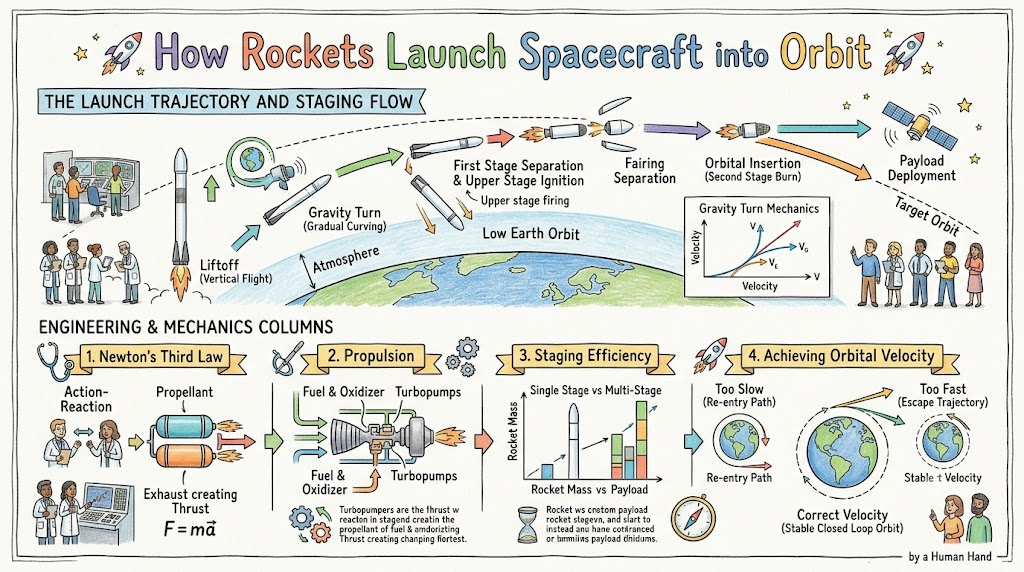
Rocket propulsion is based on fundamental laws of physics, particularly Newton’s Third Law of Motion.
This law explains that every action produces an equal and opposite reaction.
Inside a rocket engine, fuel combines with an oxidizer and undergoes a controlled chemical reaction. This process produces extremely hot gases.
The gases are expelled at high speed through the rocket nozzle.
As the gases move downward, an equal force pushes the rocket upward. This upward force is known as thrust.
The greater the amount of thrust produced, the more effectively the rocket can accelerate.
The Role of Fuel and Oxidizer
Rocket engines require materials that can produce energy through combustion.
The two primary components are:
Fuel: A substance that stores chemical energy.
Oxidizer: A substance that supports the chemical reaction needed to release energy.
Aircraft engines use oxygen from the atmosphere, but rockets cannot rely on atmospheric oxygen because they eventually travel into space. Therefore, rockets carry their own oxidizer.
This ability allows rocket engines to operate beyond Earth’s atmosphere.
Step-by-Step Process of How Rockets Launch Spacecraft into Orbit
Launching a spacecraft involves multiple carefully planned stages. Each stage plays an important role in helping the spacecraft reach its final destination.
1. Countdown and Launch Preparation
Before launch, engineers perform extensive inspections and system checks.
The rocket, spacecraft, engines, navigation systems, communication equipment, and fuel systems are carefully monitored.
Mission teams also check weather conditions because strong winds, lightning, storms, or other environmental conditions can affect launch safety.
The countdown allows engineers to confirm that all systems are ready before ignition.
2. Engine Ignition
When the launch sequence reaches its final moments, the rocket engines begin operating.
The engines generate an enormous amount of energy and produce high-speed exhaust gases.
Before liftoff, engineers confirm that the engines are producing the required level of thrust.
The rocket must generate enough upward force to overcome its own weight and Earth’s gravitational pull.
3. Liftoff
Liftoff occurs when the rocket’s thrust becomes greater than the force pulling it downward.
The rocket begins moving away from the launch pad and gradually accelerates.
During this phase, the rocket is extremely heavy because it is carrying the spacecraft, engines, fuel tanks, and a large amount of fuel.
As fuel is consumed, the rocket becomes lighter, allowing it to accelerate more efficiently.
4. Passing Through Earth’s Atmosphere
After liftoff, the rocket travels through Earth’s atmosphere.
This is one of the most challenging phases of the launch because the rocket experiences aerodynamic forces, vibrations, pressure changes, and atmospheric resistance.
As the rocket accelerates, air pushes against its structure.
Engineers must design rockets capable of surviving these extreme forces.
One particularly important phase is known as maximum dynamic pressure, often called Max-Q. During this period, the combination of speed and atmospheric density creates intense stress on the rocket.
5. Increasing Speed and Altitude
A rocket initially travels mostly upward to escape the dense lower atmosphere.
However, it does not continue moving straight upward for the entire mission.
After reaching an appropriate altitude, the rocket gradually changes direction. This maneuver allows it to gain horizontal speed.
This is extremely important because orbital flight depends on velocity, not just altitude.
The spacecraft must eventually travel sideways at a very high speed to remain in orbit.
6. Stage Separation
Most orbital rockets are designed with multiple stages.
Each stage contains engines and fuel needed for a specific part of the mission.
Once a stage uses most or all of its fuel, it becomes unnecessary weight.
The rocket separates from the empty stage and continues its journey using the next stage.
This process is known as staging.
Stage separation allows the rocket to become lighter and more efficient as it travels toward orbit.
7. Payload Protection and Fairing Separation
During the early part of the launch, the spacecraft is protected by a structure called a payload fairing.
The fairing protects sensitive equipment from atmospheric pressure, aerodynamic forces, and heating.
Once the rocket reaches a high enough altitude where atmospheric effects become minimal, the fairing is no longer necessary.
It separates from the rocket to reduce weight.
8. Achieving Orbital Velocity
The final objective is to give the spacecraft enough horizontal speed to remain in orbit.
For a typical low Earth orbit mission, a spacecraft generally needs to travel at approximately 7.8 kilometers per second.
The exact speed depends on factors such as altitude and mission requirements.
At orbital velocity, gravity continues pulling the spacecraft toward Earth.
However, because the spacecraft is moving forward so quickly, it continuously falls around Earth instead of directly toward the surface.
Understanding Rocket Stages
Rocket staging is an important part of modern spaceflight.
A rocket carries a large amount of fuel at launch. After the fuel in a particular stage is consumed, the empty tanks and engines become unnecessary.
Carrying this empty hardware would reduce efficiency.
For this reason, rockets are divided into multiple stages.
How Rocket Staging Works
The first stage provides powerful thrust during liftoff and the early portion of the flight.
After consuming its fuel, the first stage separates.
The next stage then ignites and continues accelerating the spacecraft.
Some missions use two stages, while others may use additional stages depending on the mission.
Rocket staging provides several advantages:
- Reduces unnecessary weight.
- Improves fuel efficiency.
- Allows greater acceleration.
- Helps rockets reach higher speeds.
- Increases payload capability.
What Is Orbital Velocity?
Orbital velocity is the speed required for an object to remain in orbit around a planet or another celestial body.
A spacecraft cannot remain in orbit simply by reaching a high altitude.
It must also move forward at an extremely high speed.
Imagine throwing a ball.
If the ball is thrown slowly, it quickly falls to the ground.
If it is thrown faster, it travels farther before falling.
Now imagine throwing it so fast that as it falls toward Earth, the curved surface of the planet moves away beneath it.
The object would continue falling without reaching the ground.
This is the basic principle behind orbital motion.
A spacecraft in orbit is constantly affected by gravity, but its high forward velocity keeps it moving around Earth.
Different Types of Earth Orbits
Different space missions require different orbital paths.
Satellites, research spacecraft, communication systems, and Earth observation missions are placed into orbits based on their specific objectives.
| Orbit Type | Approximate Altitude | Primary Purpose | Common Applications |
|---|---|---|---|
| Low Earth Orbit (LEO) | Up to approximately 2,000 km | Close observation and research | Space stations and Earth observation |
| Medium Earth Orbit (MEO) | Between LEO and GEO | Wide-area coverage | Navigation systems |
| Geostationary Orbit (GEO) | Approximately 35,786 km | Continuous coverage of one area | Communication and weather monitoring |
| Polar Orbit | Varies | Global observation | Mapping and environmental monitoring |
Low Earth Orbit
Low Earth Orbit is relatively close to Earth’s surface.
It is commonly used for scientific research, Earth observation, and human spaceflight missions.
Spacecraft in this orbit travel around Earth at very high speeds.
Medium Earth Orbit
Medium Earth Orbit is located between Low Earth Orbit and Geostationary Orbit.
It is useful for missions that require broader coverage than LEO.
Navigation satellites commonly operate in this region.
Geostationary Orbit
A spacecraft in geostationary orbit travels around Earth at the same rate that Earth rotates.
As a result, it appears to remain over approximately the same location on Earth’s surface.
This makes the orbit useful for communication and weather observation.
Polar Orbit
A spacecraft in polar orbit travels over or near Earth’s poles.
As Earth rotates beneath the spacecraft, it can observe different parts of the planet over time.
Polar orbits are particularly useful for Earth observation and environmental monitoring.
Challenges Rockets Face During Launch
Rocket launches involve some of the most demanding conditions in engineering.
Atmospheric Pressure
As a rocket travels through the atmosphere, it experiences changing air pressure and density.
These conditions create aerodynamic forces that affect the rocket’s structure.
Extreme Heat
Rocket engines generate extremely high temperatures.
Engineers use specialized materials and cooling systems to prevent important components from overheating.
Aerodynamic Forces
High-speed movement through the atmosphere creates significant pressure on the rocket.
These forces can cause vibration and structural stress.
Fuel Consumption
Rockets consume large amounts of fuel in a short period.
Fuel management is critical because carrying additional mass affects the rocket’s overall performance.
Precise Navigation
A rocket must follow a carefully calculated trajectory.
Small navigation errors can affect whether the spacecraft reaches its intended orbit.
Guidance systems continuously monitor speed, direction, altitude, and orientation.
Mechanical Reliability
A rocket contains thousands of components, including engines, sensors, computers, pumps, valves, communication systems, and structural parts.
All major systems must operate correctly for the mission to succeed.
How Rockets Protect Spacecraft During Launch
The spacecraft must survive intense conditions during launch.
Engineers use several systems to protect sensitive instruments and equipment.
Payload Fairings
Payload fairings surround the spacecraft during the atmospheric portion of the launch.
They protect the payload from aerodynamic forces and heating.
Once the rocket reaches space, the fairing separates.
Structural Protection
Spacecraft are secured using specially designed support systems.
These structures help reduce the effects of vibration and acceleration.
Guidance Systems
Modern rockets use advanced guidance and navigation systems.
Sensors continuously measure the rocket’s movement and position.
Onboard computers use this information to make adjustments when necessary.
Controlled Separation
Stage separation and spacecraft deployment must occur at precisely calculated times.
Accurate separation ensures that the spacecraft enters the correct trajectory.
Major Phases of a Rocket Launch
| Launch Phase | Main Purpose | What Happens |
|---|---|---|
| Pre-launch Preparation | Ensure mission readiness | Systems, fuel, weather, and communications are checked |
| Engine Ignition | Generate thrust | Rocket engines begin producing power |
| Liftoff | Leave the launch pad | Thrust exceeds the rocket’s weight |
| Atmospheric Ascent | Gain altitude | Rocket travels through Earth’s atmosphere |
| Direction Change | Build horizontal velocity | Rocket gradually changes its flight path |
| Stage Separation | Reduce weight | Empty stages are discarded |
| Upper Stage Flight | Reach orbital speed | Rocket continues accelerating |
| Payload Deployment | Begin the mission | Spacecraft enters its planned orbit |
Common Misconceptions About Rocket Launches
Reaching Space Automatically Means Entering Orbit
This is incorrect.
A spacecraft can travel beyond Earth’s atmosphere but still fall back to Earth if it does not have sufficient horizontal velocity.
Rockets Travel Straight Up Throughout the Mission
Rockets initially travel mostly upward, but they gradually change direction.
This allows them to build the horizontal speed required for orbit.
Gravity Disappears in Orbit
Gravity does not disappear in orbit.
In fact, Earth’s gravity is responsible for keeping satellites and spacecraft moving around the planet.
Spacecraft Stop Moving After Reaching Space
Spacecraft continue traveling at extremely high speeds.
Their forward velocity is one of the main reasons they can remain in orbit.
Important Considerations in Space Launches
Weather Conditions
Weather plays an important role in launch safety.
Strong winds, storms, and lightning can cause delays.
Mission teams carefully monitor weather conditions before launch.
Trajectory Planning
Every mission requires a carefully calculated flight path.
The trajectory depends on the spacecraft’s destination and the type of orbit required.
Fuel Efficiency
Fuel is one of the most important factors in rocket design.
Engineers must balance fuel requirements with the weight of the spacecraft and launch vehicle.
Launch Timing
Some missions must launch during a specific time window.
This ensures that the spacecraft can reach the correct position or trajectory.
Mission Objectives
Every launch has a specific purpose.
A communication satellite, research mission, Earth observation spacecraft, and deep-space mission may all require different launch strategies.
The Future of Rocket Launch Technology
Rocket technology is continuing to develop rapidly.
One important advancement is reusable launch technology. Instead of using major rocket components only once, engineers are developing systems that can recover and reuse parts of launch vehicles.
Future rocket technology may focus on improving efficiency, reducing launch costs, and supporting more ambitious missions.
Important areas of development include:
- Reusable rocket systems.
- Advanced propulsion technology.
- Autonomous navigation.
- Improved spacecraft protection.
- More efficient engines.
- Lunar exploration missions.
- Human missions to Mars.
- Large-scale satellite deployment.
- Future commercial space missions.
As technology continues to improve, rockets may become more capable of supporting scientific research and long-distance exploration.
Frequently Asked Questions
1. How does a rocket overcome Earth’s gravity?
A rocket generates powerful thrust by expelling high-speed gases downward. When the thrust becomes greater than the rocket’s weight, it can lift away from Earth’s surface.
2. Why can’t a spacecraft simply fly straight upward?
Reaching a high altitude is not enough. A spacecraft must also gain significant horizontal velocity to remain in orbit.
3. What keeps a spacecraft in orbit?
Gravity pulls the spacecraft toward Earth while its high forward speed carries it around the planet.
4. How fast does a spacecraft need to travel to reach orbit?
A spacecraft in Low Earth Orbit generally travels at approximately 7.8 kilometers per second, although the exact speed depends on altitude and mission requirements.
5. Why do rockets have multiple stages?
Multiple stages allow rockets to discard empty fuel tanks and engines, reducing weight and improving efficiency.
6. Can rocket engines work in space?
Yes. Rockets carry both fuel and an oxidizer, so they do not need oxygen from Earth’s atmosphere.
7. Why do rockets change direction during launch?
Rockets gradually change direction to gain the horizontal speed necessary to achieve orbit.
8. Is there no gravity in space?
Gravity still exists in space. Spacecraft in orbit remain under the influence of Earth’s gravity.
9. What happens after a spacecraft reaches orbit?
The spacecraft separates from the launch vehicle and begins performing its planned mission, such as communication, observation, research, or exploration.
10. Why is launching a spacecraft so difficult?
Rocket launches require precise engineering because they involve extreme speeds, powerful forces, high temperatures, complex navigation, fuel management, and mechanical reliability.
Conclusion
Launching a spacecraft into orbit requires far more than simply building a powerful rocket and sending it upward. Rockets must generate enormous thrust to overcome Earth’s gravity, travel safely through the atmosphere, reduce weight through stage separation, and accelerate spacecraft to extremely high horizontal speeds. Once the required velocity and trajectory are achieved, the spacecraft can remain in orbit by continuously moving around Earth under the influence of gravity. Every successful launch represents a remarkable combination of physics, engineering, planning, and advanced technology that continues to expand humanity’s ability to explore space.