Introduction
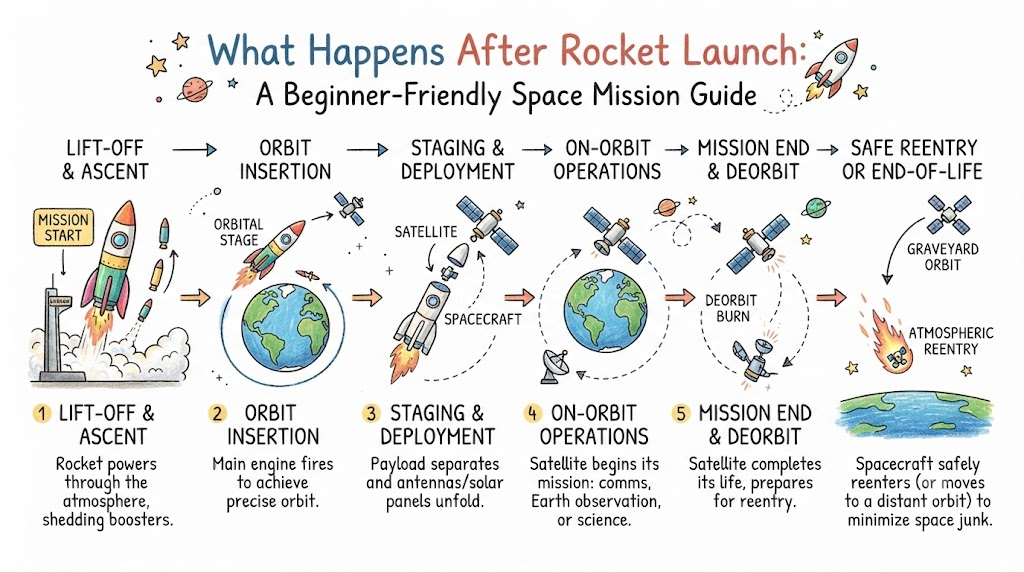
What Happens After Rocket Launch is one of the most exciting questions for anyone who watches a rocket leave the launch pad. Most people see the bright flames, smoke, sound, and powerful liftoff, but the real space mission continues long after the rocket disappears into the sky.
A rocket launch is not the end of the mission. In fact, it is only the beginning. After liftoff, the rocket must travel through the atmosphere, separate its stages, reach space, enter the correct path, release its payload, and communicate with mission control.
For readers of astropilot.co, this guide explains the full journey in simple language. You will learn what happens after rocket liftoff, how rocket stages work, how satellites are deployed, and why mission control plays such an important role after launch.
What Happens Immediately After Liftoff?
The first few seconds after liftoff are very important. When the rocket engines start producing enough thrust, the rocket slowly rises from the launch pad.
During this moment, many systems work together:
- Engines push the rocket upward.
- Computers guide the rocket’s direction.
- Sensors measure speed, pressure, vibration, and temperature.
- Mission control watches every signal from the rocket.
- The rocket begins following its planned flight path.
A rocket does not simply go straight upward forever. It slowly begins to tilt and follow a curved path. This helps it gain the correct speed and direction needed for space travel.
Rocket Ascent Through the Atmosphere
After liftoff, the rocket enters the ascent phase. This means it is climbing through Earth’s atmosphere.
Earth’s atmosphere is thick near the ground and becomes thinner as the rocket climbs higher. During this part of the journey, the rocket faces strong forces such as:
- Air pressure
- Wind resistance
- Heat
- Vibration
- Gravity
- Engine stress
The rocket must stay stable while moving at very high speed. Its guidance system makes small adjustments to keep it on the correct path.
This part of the rocket launch process is carefully planned before launch. Even a small mistake in direction, speed, or engine performance can affect the mission.
Why Rockets Curve After Launch
Many beginners wonder why rockets do not just fly straight up into space. The answer is simple: reaching space is not enough.
To stay in orbit, a rocket or spacecraft needs sideways speed. NASA explains that a rocket must speed up to at least about 17,800 miles per hour and fly above most of the atmosphere in a curved path around Earth so it does not fall back to the ground.
This curved movement helps the spacecraft keep falling around Earth instead of falling back down. That is what orbit means.
So, after rocket launch, the vehicle is not only going upward. It is also building horizontal speed.
Stage Separation Explained
Most large rockets are built in sections called stages. ESA explains that each stage is a complete part of a launch vehicle, usually containing propellant tanks, engines, and other equipment.
As the rocket climbs, it burns a huge amount of fuel. Once one stage has used its fuel, that empty section becomes extra weight. To fly more efficiently, the rocket drops that stage.
This is called stage separation.
Why Stage Separation Is Important
Stage separation helps the rocket:
- Reduce weight
- Save energy
- Increase speed
- Continue toward space more efficiently
- Allow the next engine section to take over
For example, the first stage may do the heavy lifting from the ground. After it finishes, the second stage continues the mission at higher altitude.
What Happens to Rocket Boosters?
Rocket boosters help provide extra power during launch. After their job is complete, they separate from the rocket.
Depending on the rocket design, boosters may:
- Fall into the ocean
- Burn up during re-entry
- Land back on Earth for reuse
- Be recovered and inspected
- Become part of a controlled disposal plan
Reusable booster technology has made modern rocket launches more efficient. Some boosters can return to landing pads or drone ships after separation. This helps reduce launch costs and supports future missions.
Reaching Space
After the rocket passes through the thicker part of the atmosphere, it reaches space or near-space altitude. At this point, the sky outside becomes black, air resistance becomes very low, and the rocket no longer faces the same atmospheric pressure as it did near Earth.
However, reaching space does not automatically mean the mission is complete.
A spacecraft can reach space and still fall back to Earth if it does not gain enough sideways speed. That is why orbital insertion is so important.
Entering Orbit
Orbit is not just a location. It is a motion.
A spacecraft enters orbit when it moves fast enough around Earth that gravity keeps pulling it downward, but it keeps moving forward fast enough to keep missing the ground.
This is why rockets need both altitude and speed.
Simple Example of Orbit
Imagine throwing a ball. It falls to the ground quickly.
Now imagine throwing it much faster. It travels farther before falling.
In orbit, a spacecraft is moving so fast forward that as it falls toward Earth, Earth curves away beneath it. So it keeps moving around the planet.
That is why orbital insertion is one of the most important steps after rocket launch.
Payload Deployment
The payload is the important object carried by the rocket. It may be:
- A satellite
- A space probe
- A crew capsule
- A cargo spacecraft
- A scientific instrument
- A space telescope
- A lunar or planetary mission vehicle
Once the rocket reaches the planned position, the payload is released.
This process is called payload deployment or satellite deployment.
The deployment must happen at the correct time, speed, altitude, and direction. If the payload is released too early or too late, it may not reach its planned orbit or mission path.
What Happens After a Satellite Is Released?
After a satellite separates from the rocket, its own mission begins. It does not always start working fully immediately.
First, the satellite may perform several early steps:
- Open solar panels
- Start power systems
- Connect with ground stations
- Check onboard computers
- Test communication signals
- Adjust its position
- Activate sensors and instruments
- Begin early mission operations
This phase is very important because engineers must confirm that the satellite is healthy and working properly.
Communication With Mission Control
Mission control is the team that tracks and manages the mission after launch. NASA’s Basics of Space Flight describes mission operations as a broad area involving spacecraft activity, navigation, and communication throughout a mission.
After rocket launch, mission control watches important data such as:
- Rocket speed
- Altitude
- Engine performance
- Fuel levels
- Temperature
- Communication signals
- Flight path
- Payload condition
- Orbit accuracy
If the spacecraft needs small path changes, mission control may send commands. NASA describes orbit trim maneuvers and trajectory correction maneuvers as small adjustments used to refine a spacecraft’s path.
Why the First Few Hours After Launch Are Important
The first few hours after launch are often critical. Even if the rocket successfully reaches space, the mission team still has many checks to complete.
During this time, engineers may confirm:
- The payload separated correctly
- The spacecraft has power
- Solar panels opened properly
- Communication is stable
- The orbit is correct
- The spacecraft is not spinning incorrectly
- Instruments are safe
- The mission can continue as planned
This stage is sometimes called early orbit operations. It is like a health check after launch.
What Happens to the Rocket After Payload Deployment?
After the payload is released, the rocket’s job is usually finished. But different rocket parts have different endings.
1. Reusable First Stage
Some modern rockets have reusable first stages. These can return to Earth and land safely. After landing, engineers inspect them, repair them if needed, and prepare them for future launches.
2. Second Stage Disposal
The upper stage may perform a controlled re-entry, move into a disposal orbit, or burn up in Earth’s atmosphere depending on the mission plan.
3. Space Debris Management
Space agencies and launch companies try to reduce space debris. This is important because old rocket parts and unused objects can create risk for future spacecraft.
What Happens During a Deep Space Mission?
Not all missions stay near Earth. Some rockets send spacecraft toward the Moon, Mars, asteroids, or other planets.
In these missions, after launch and Earth orbit, the spacecraft may perform another engine burn to leave Earth’s orbit.
This can send the spacecraft onto a path toward another destination.
For deep space missions, the journey may include:
- Trajectory correction maneuvers
- Long-distance communication
- Solar power management
- Scientific instrument testing
- Planetary flybys
- Orbit insertion around another planet
- Landing or sample collection
So, for deep space missions, launch is only the first step in a much longer journey.
Common Misunderstandings About Rocket Launches
Launch Does Not Mean the Mission Is Complete
Many people think the mission is finished once the rocket reaches space. In reality, the mission may continue for days, months, or years.
Reaching Space Is Different From Entering Orbit
A rocket can reach space but still come back down if it does not gain enough speed to orbit Earth.
Satellites Do Not Start Full Work Immediately
After deployment, satellites often go through testing, setup, and early operations before beginning full service.
Rocket Parts Do Not All Stay in Space Forever
Some parts fall back to Earth, some burn up, some are recovered, and some are moved into safer paths.
Mission Control Remains Active After Launch
Mission control continues tracking, checking, and supporting the mission long after the rocket leaves the launch pad.
Step-by-Step Summary of What Happens After Rocket Launch
Here is a simple step-by-step view:
- Rocket lifts off from the launch pad.
- Engines push the rocket upward.
- The rocket begins turning into a curved path.
- It climbs through the atmosphere.
- Empty stages separate.
- Upper stages continue the flight.
- The rocket reaches space.
- The spacecraft or payload enters orbit or mission path.
- Satellite or payload deployment happens.
- Mission control checks spacecraft health.
- Solar panels and instruments activate.
- The mission officially begins.
Why This Process Matters
Every step after rocket launch matters because space missions are expensive, complex, and carefully planned.
A successful launch must deliver the payload to the correct place safely. If the payload is a communication satellite, it may provide internet, television, weather data, or navigation support. If it is a science spacecraft, it may help us learn about Earth, the Moon, Mars, or the universe.
This is why engineers monitor every second after liftoff.
FAQs About What Happens After Rocket Launch
1. What happens first after a rocket launches?
After launch, the rocket rises from the launch pad and begins following its planned flight path. Its engines produce thrust, and onboard computers guide its direction.
2. Does a rocket go straight up into space?
No. A rocket usually begins turning into a curved path after launch. This helps it gain the sideways speed needed to enter orbit.
3. What is rocket stage separation?
Rocket stage separation happens when an empty fuel section separates from the rocket. This reduces weight and allows the next stage to continue the mission.
4. What happens when a rocket reaches space?
When a rocket reaches space, it still needs the correct speed and direction. Reaching space is not the same as entering orbit.
5. How does a satellite enter orbit?
A satellite enters orbit when it is released at the correct altitude and speed. It continues moving around Earth because of its forward speed and Earth’s gravity.
6. Who controls the rocket after launch?
The rocket is controlled by onboard computers and monitored by mission control teams on Earth. Mission control tracks data and sends commands when needed.
7. What happens to rocket boosters after launch?
Some boosters fall into the ocean, some burn up, and some reusable boosters return to Earth for landing and future use.
8. What is payload deployment?
Payload deployment is the process of releasing the satellite, spacecraft, or cargo carried by the rocket into its planned orbit or mission path.
9. Why are the first few hours after launch important?
The first few hours are important because engineers check communication, power, orbit, solar panels, and spacecraft health.
10. Is the mission complete after launch?
No. Launch is only the beginning. The mission continues after the payload is deployed and begins its planned work in space.
Final Thoughts
What Happens After Rocket Launch is much more than a rocket flying into the sky. After liftoff, the rocket must pass through the atmosphere, separate stages, gain orbital speed, release its payload, and communicate with mission control.
The launch is only the opening chapter of a space mission. The real success depends on what happens after the rocket leaves Earth.
For beginners, students, and space lovers, understanding this process makes every rocket launch more exciting. The next time you watch a rocket launch, remember that the most important mission steps continue far beyond the bright flames of liftoff.