Introduction
Can Engineers Become Astro Pilots is a highly relevant question for students who want to combine engineering knowledge with aviation and space exploration careers. The idea of an “astro pilot” represents professionals who operate advanced aircraft, spacecraft, or aerospace systems that go beyond traditional flying roles.
Engineering and aerospace careers are strongly connected. Engineers design and build the systems that pilots and astronauts use, which means they already understand many of the core technologies involved in flight and space operations. Because of this foundation, engineers are often considered strong candidates for aviation and space-related roles.
In this blog, we will explore whether engineers can become astro pilots, what skills and steps are required, and how engineering can lead to opportunities in aviation and space careers.
Who is an Engineer?
An engineer is a professional who applies science, mathematics, and technical knowledge to design, build, and improve systems and machines.
Engineering Fields Relevant to Aviation and Space
Aeronautical Engineering
Aerospace Engineering
Mechanical Engineering
Electrical Engineering
Electronics and Communication Engineering
Computer Science Engineering
Role of Engineers in Aerospace Industry
Engineers contribute to:
Aircraft and spacecraft design
Navigation and control systems
Engine and propulsion technology
Safety and performance optimization
Software and automation systems
They form the backbone of aviation and space technology development.
What is an Astro Pilot?
An astro pilot is a term used to describe a professional who operates advanced aerospace vehicles such as:
High-performance aircraft
Spacecraft and space missions
Advanced aviation and navigation systems
Simulation-based or experimental flight systems
In simple terms, an astro pilot combines piloting skills with aerospace or space operations knowledge.
Can Engineers Become Astro Pilots?
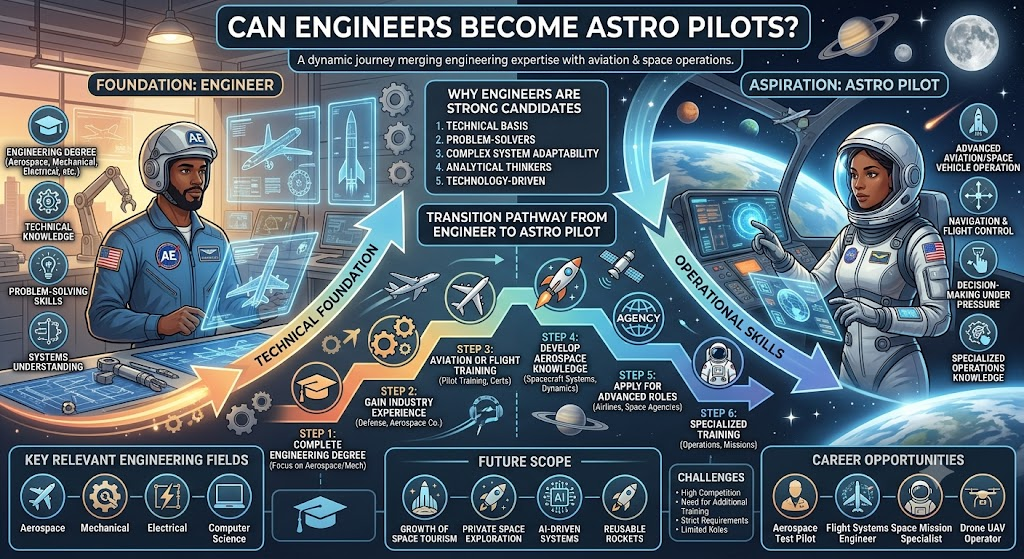
Yes, engineers can become astro pilots. In fact, many aviation and space professionals start their careers as engineers. However, engineering alone is not enough. Additional training in aviation, flight operations, or space systems is required.
Engineers have a strong advantage because they already understand:
Physics and mechanics of flight
Complex systems and control technologies
Mathematical modeling and analysis
Technical problem-solving skills
With the right training, engineers can transition into aviation and even space-related roles.
Why Engineers Are Strong Candidates for Astro Pilot Roles
Engineers are often preferred in aerospace and aviation fields due to their technical background.
- Strong Technical Foundation
Engineers understand how machines, systems, and technologies work at a deep level.
- Problem-Solving Skills
They are trained to analyze complex problems and find practical solutions quickly.
- System Understanding
Aircraft and spacecraft are complex systems that engineers can easily adapt to.
- Analytical Thinking
Engineers are skilled in data interpretation and logical decision-making.
- Adaptability to Technology
Modern aviation and space systems are highly technology-driven, which suits engineers well.
Steps for Engineers to Become Astro Pilots
The journey from engineer to astro pilot involves multiple stages:
Step 1: Complete Engineering Degree
Focus on aerospace, mechanical, electrical, or related engineering fields.
Step 2: Gain Industry Experience
Work in aviation, defense, or aerospace companies to build technical exposure.
Step 3: Aviation or Flight Training (if required)
Enroll in pilot training programs or aviation certifications.
Step 4: Develop Aerospace Knowledge
Study spacecraft systems, flight dynamics, and navigation technologies.
Step 5: Apply for Advanced Roles
Apply to aviation companies, defense organizations, or space agencies.
Step 6: Specialized Training
Complete advanced training in aviation operations or space systems depending on career path.
Skills Required for Astro Pilot Careers
To succeed as an astro pilot, engineers must develop additional skills such as:
Flight control and navigation systems
Aerospace and spacecraft operations
Decision-making under pressure
Physical and mental endurance
Communication with mission control
Understanding of aerodynamics and space physics
Challenges in Becoming an Astro Pilot
The path is competitive and challenging due to several factors:
High level of competition in aviation and space industries
Need for additional flight or space training
Strict physical and medical requirements
Long career preparation time
Limited roles in space-related operations
Despite these challenges, engineers often have a strong foundation to build upon.
Career Opportunities for Engineers as Astro Pilots
Engineers can explore several career paths related to astro pilot roles:
Aerospace test pilot
Flight systems engineer with piloting experience
Space mission operations specialist
Drone and UAV systems operator
Defense aviation pilot roles
Space research and simulation specialist
These roles combine engineering expertise with aviation or space operations.
Future of Astro Pilot Careers
The future of astro pilot careers is expanding rapidly due to technological progress:
Growth of commercial space tourism
Private space companies entering exploration missions
AI-driven aviation and spacecraft systems
Reusable rocket technology development
Advanced autonomous flight systems
Engineers will play a central role in shaping these future opportunities.
FAQs
- Can engineers become astro pilots?
Yes, engineers can become astro pilots if they gain additional aviation or aerospace training and experience.
- Which engineering branch is best for astro pilot careers?
Aerospace, mechanical, electrical, and electronics engineering are most relevant.
- Do engineers need pilot training to become astro pilots?
In many cases, yes. Flight training is important for operational aviation roles.
- Is engineering alone enough for space-related careers?
No, additional training and experience are required beyond engineering.
- Why are engineers preferred in aerospace fields?
Because they understand complex technical systems and problem-solving processes.
- Can software engineers become astro pilots?
Yes, with additional aviation or aerospace training, they can enter related roles.
- What skills are important for astro pilot careers?
Navigation, physics, systems control, and decision-making skills are essential.
- Is it difficult for engineers to become astro pilots?
Yes, it is competitive and requires additional qualifications and training.
- Do space agencies hire engineers?
Yes, engineers are widely recruited in space agencies for various technical roles.
- What is the future scope of astro pilot careers?
The scope is very high due to growth in space tourism and advanced aviation systems.
Conclusion
Can Engineers Become Astro Pilots is a question that highlights the strong connection between engineering, aviation, and space exploration. Engineers already possess a strong technical foundation that makes them suitable for aerospace and aviation careers.
However, becoming an astro pilot requires more than engineering knowledge. It requires additional training, aviation experience, and specialized skills in flight or space systems. With dedication and the right career path, engineers can successfully move into advanced aviation and space-related roles.
As the aerospace industry continues to grow with innovations in space travel, AI, and advanced aircraft systems, engineers will play a key role in shaping the future of astro pilot careers.