Introduction
The connection between aviation and space careers is becoming stronger as the global aerospace industry expands. What was once limited to aircraft operations and defense aviation is now extending into space exploration, satellite systems, robotics, and commercial space travel.
For aviation students, this transition is highly natural. The core subjects of aviation training such as physics, navigation, aerodynamics, and flight systems also form the foundation of space science and aerospace engineering. This shared knowledge base creates a clear pathway for aviation students to move into space-related careers.
With rapid growth in private space companies, satellite networks, and future space tourism projects, aviation students now have more opportunities than ever before. The question is not whether they can enter space careers, but which path suits them best.
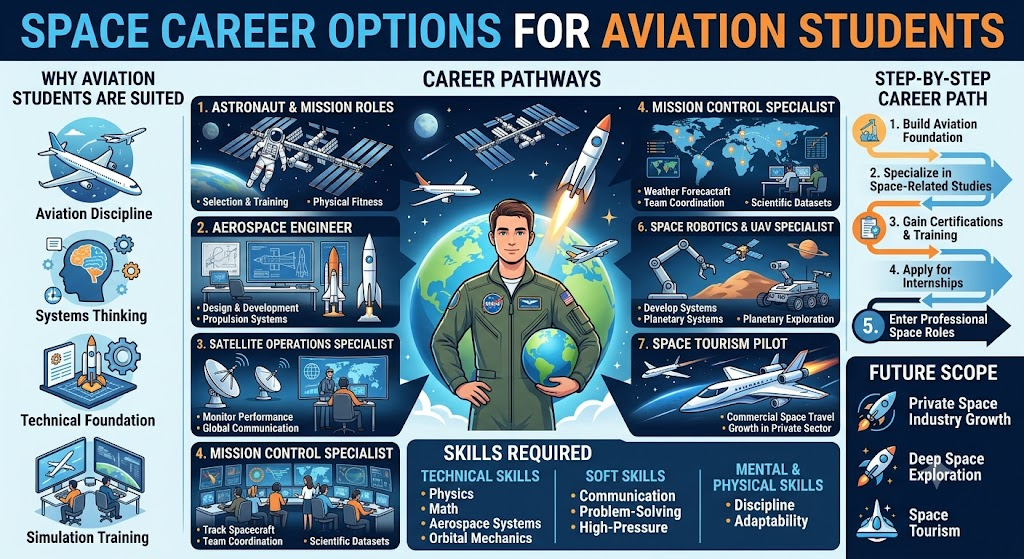
Why Aviation Students Are Well-Suited for Space Careers
Aviation students already develop essential skills that are directly relevant to space industries.
Strong Academic Foundation
- Physics for motion, gravity, and orbital mechanics
- Mathematics for navigation and calculations
- Engineering principles for aircraft systems
Professional Skill Alignment
- High-pressure decision-making
- Precision-based operational thinking
- Discipline and procedural compliance
- Simulation-based training experience
These qualities make aviation students strong candidates for space-related roles.
Space Career Options for Aviation Students
Aviation students can explore multiple career pathways in the space industry.
1. Astronaut and Space Mission Roles
Astronauts participate in space missions, research, and exploration activities.
- Requires advanced selection and training
- Demands physical and mental fitness
- One of the most prestigious space careers
2. Aerospace Engineer (Space Systems)
Aerospace engineers design spacecraft, rockets, and propulsion systems.
- Works on satellite and spacecraft design
- Involved in testing and development of space vehicles
3. Satellite Operations Specialist
Manages communication and Earth observation satellites.
- Monitors satellite performance
- Ensures global communication systems remain active
4. Mission Control Specialist
Operates space missions from Earth-based control centers.
- Tracks spacecraft and mission status
- Communicates with astronauts and technical teams
5. Space Data Analyst
Analyzes data collected from satellites and space missions.
- Supports weather forecasting and space research
- Works with large-scale scientific datasets
6. Space Robotics and UAV Specialist
Focuses on robotic systems used in space exploration.
- Develops robotic arms and autonomous systems
- Supports planetary exploration missions
7. Space Tourism Pilot (Emerging Field)
A future-oriented career in commercial space travel.
- Involves piloting or assisting space tourism vehicles
- Expected to grow with private space companies
8. Defense and Space Technology Roles
Combines aerospace, defense, and space technologies.
- Satellite defense systems
- Surveillance and strategic aerospace applications
Step-by-Step Career Path for Aviation Students
Step 1: Build Aviation Foundation
Start with aviation training or aerospace-related education.
Step 2: Specialize in Space-Related Studies
Move into aerospace engineering, space science, or orbital mechanics.
Step 3: Gain Certifications and Training
- Space systems simulation programs
- Satellite operations training
- Advanced navigation courses
Step 4: Apply for Internships and Programs
Join space agencies, research labs, or private aerospace companies.
Step 5: Enter Professional Space Roles
Transition into mission control, aerospace design, or space research positions.
Skills Required for Space Careers
Technical Skills
- Advanced physics and mathematics
- Aerospace systems understanding
- Orbital mechanics and navigation
- Data analysis and simulation tools
Soft Skills
- Team coordination in critical missions
- Communication in high-pressure environments
- Analytical thinking and problem-solving
Mental and Physical Skills
- Strong focus and discipline
- Ability to handle stress
- Adaptability in complex situations
Challenges in Space Careers
High Competition
Space careers attract global talent, making selection highly competitive.
Long Education Path
Many roles require advanced degrees and specialized training.
Technical Complexity
Space systems involve advanced engineering and scientific knowledge.
Physical and Mental Demands
Some roles require strict health and psychological standards.
Future Scope of Space Careers for Aviation Students
Growth of Private Space Industry
Private companies are rapidly expanding space exploration capabilities.
Space Tourism Development
Commercial space travel is expected to grow in the coming years.
AI and Automation in Space Systems
Artificial intelligence is transforming mission control and navigation.
Deep Space Exploration
Future missions may include lunar bases and Mars exploration.
This expansion creates long-term opportunities for aviation students.
Why Aviation is a Strong Gateway to Space Careers
Aviation training provides a strong foundation for space careers because it builds:
- Flight and navigation understanding
- System-based thinking
- Safety and emergency handling skills
- Real-time operational decision-making
These skills are directly transferable to spacecraft operations and aerospace systems.
FAQs
1. Can aviation students work in space careers?
Yes, aviation students can transition into space careers by gaining additional training in aerospace and space science fields.
2. Is aviation a good background for space industry jobs?
Yes, aviation provides strong fundamentals in physics, navigation, and systems thinking, which are essential in space careers.
3. What are the best space careers for aviation students?
Popular options include aerospace engineering, mission control, satellite operations, and robotics specialization.
4. Do I need engineering to enter space careers?
Not always. Some roles require engineering, but others like operations, data analysis, and training roles may not.
5. Can pilots become astronauts?
Yes, pilots are often strong candidates for astronaut programs due to their flight experience and discipline.
6. What skills are most important for space careers?
Physics, mathematics, problem-solving, communication, and technical system knowledge are most important.
7. Is space tourism a real career option?
Yes, space tourism is an emerging industry expected to grow with private space companies.
8. What is the salary in space careers?
It varies widely depending on the role, experience, and organization, ranging from moderate to very high in advanced roles.
9. Are space careers very competitive?
Yes, space careers are highly competitive due to limited positions and high global interest.
10. What is the future of aviation and space careers?
The future is strong, with increasing integration of AI, automation, and commercial space exploration.
Conclusion
Space careers are no longer limited to astronauts alone. For aviation students, the space industry offers a wide range of opportunities including aerospace engineering, satellite operations, mission control, robotics, and emerging space tourism roles.
With strong foundations in aviation, students already possess many of the essential skills needed for space careers. By gaining additional specialization in aerospace and space science, they can successfully transition into this rapidly growing industry.
As space exploration continues to evolve, aviation students will play a key role in shaping the future of aerospace innovation. The journey from aviation to space is not distant anymore—it is a realistic and achievable career path.