Introduction
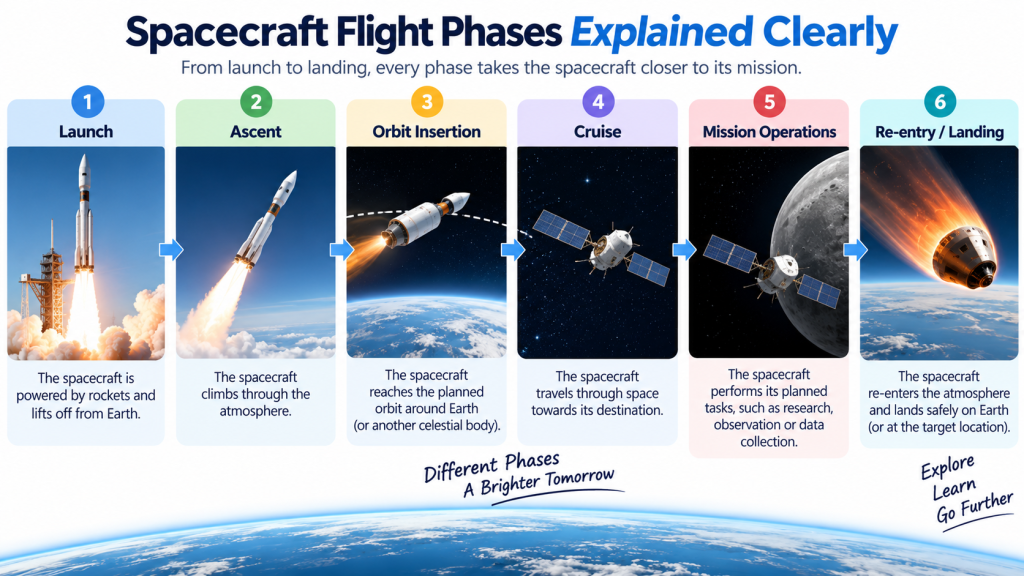
A spacecraft mission involves much more than simply launching a vehicle into space. From preparation on the ground to reaching an orbit, traveling through space, operating at a destination, or returning to Earth, each mission follows a carefully planned sequence of flight phases. Every phase has different objectives, risks, systems, and operational requirements. Understanding these phases helps students and space enthusiasts see how spacecraft actually move through and operate in space.
What Are Spacecraft Flight Phases?
A spacecraft flight phase is a specific period of a mission during which the spacecraft performs a particular set of activities.
Mission planners divide a flight into phases because the spacecraft faces different conditions and requirements at different points. For example, launch involves powerful propulsion and rapidly changing atmospheric conditions, while orbital operations may focus more on communication, navigation, power, and payload activities.
Not every spacecraft follows exactly the same sequence. An Earth-observation satellite, lunar spacecraft, Mars probe, crewed vehicle, and cargo spacecraft can have very different missions.
The basic flight phases depend on the mission’s destination, spacecraft design, propulsion system, and operational objectives.
Major Phases of a Spacecraft Mission
1. Pre-Launch Preparation
The mission begins well before the spacecraft leaves the launch pad.
During the preparation phase, engineers and mission teams check the spacecraft, launch vehicle, communication systems, power systems, navigation equipment, propulsion components, and payloads.
Teams also load required software, verify flight procedures, conduct system tests, and confirm that the spacecraft can communicate with ground stations.
The launch vehicle and spacecraft must work together correctly. A problem discovered during final checks can lead to a launch delay because engineers need to resolve the issue before proceeding.
This phase provides the foundation for the rest of the mission.
2. Launch and Liftoff
The launch phase begins when the launch vehicle’s propulsion system produces enough thrust to lift the vehicle from the launch pad.
During the first part of the flight, the vehicle must overcome Earth’s gravity and atmospheric resistance. The launch vehicle uses powerful engines to rapidly increase its velocity.
Launch is one of the most demanding phases because the spacecraft and rocket experience strong vibration, acceleration, aerodynamic forces, and rapidly changing environmental conditions.
The spacecraft itself may remain protected inside a payload fairing during this stage. The fairing helps protect the payload from atmospheric conditions during ascent.
3. Ascent
After liftoff, the launch vehicle continues climbing through the atmosphere while building the velocity required for the planned trajectory.
The vehicle does not simply travel straight upward. Its trajectory gradually changes so that it can develop the horizontal velocity needed for orbit.
This distinction is important for beginners. Reaching space and reaching orbit are not the same thing.
A spacecraft can travel above most of the atmosphere without having enough horizontal velocity to remain in orbit. Orbital flight requires the correct combination of altitude and velocity.
During ascent, guidance and navigation systems continuously help keep the vehicle on its intended trajectory.
4. Stage Separation
Many launch vehicles use multiple stages. Each stage contains propulsion and other equipment required for a particular part of the ascent.
Once a stage has completed its job, the vehicle can separate it from the remaining vehicle.
Removing an empty stage reduces mass, allowing the remaining stages to operate more efficiently.
Stage separation is a carefully controlled event. The vehicle must confirm that the appropriate conditions have been reached before separation occurs.
After separation, another stage may ignite, or the upper stage may continue the mission toward orbital insertion.
5. Orbital Insertion
Orbital insertion is the process of placing a spacecraft into its planned orbit.
At this point, the spacecraft or launch vehicle must achieve the required velocity and trajectory. Depending on the mission, an upper-stage engine may perform a burn that places the spacecraft into its initial orbit.
The resulting orbit can have specific requirements for altitude, inclination, eccentricity, and other orbital characteristics.
Some spacecraft enter an initial parking orbit before performing another maneuver. Others may be inserted directly into an operational orbit.
For many satellite missions, orbital insertion marks the transition from launch operations to spacecraft operations.
6. Early Orbit Operations
Once the spacecraft reaches its initial orbit, mission teams begin checking whether its major systems are working correctly.
This period is sometimes called the early orbit or commissioning phase.
Teams may deploy solar arrays, antennas, booms, or other spacecraft components. They also check power generation, communications, attitude control, thermal conditions, and onboard systems.
Engineers carefully monitor telemetry received from the spacecraft.
If the spacecraft needs to reach a different operational orbit, mission controllers may perform additional maneuvers during this period.
The spacecraft may not immediately begin its primary mission. Engineers usually need time to verify and configure its systems first.
7. Transfer or Cruise Phase
Not every spacecraft remains close to Earth.
A spacecraft traveling toward the Moon, Mars, another planet, or another deep-space destination may enter a transfer or cruise phase.
During this phase, the spacecraft travels along a planned trajectory while mission teams monitor its condition.
Deep-space missions may use relatively small propulsion corrections rather than continuous engine operation. These trajectory correction maneuvers help adjust the spacecraft’s path when necessary.
The spacecraft also manages power, communication, thermal conditions, orientation, and onboard systems during the journey.
Communication can become more challenging as distance increases. Signals take longer to travel between Earth and a distant spacecraft, which means mission teams cannot always control the spacecraft instantaneously.
8. Approach and Rendezvous
Some missions require a spacecraft to approach another spacecraft, an asteroid, a planet, or another destination.
A rendezvous mission involves carefully controlling the relative position and velocity of two objects.
For example, a crewed spacecraft may need to approach a space station. The spacecraft must gradually reduce differences in speed and position before attempting to operate near the station.
Navigation becomes particularly important during this phase.
The spacecraft may use sensors, cameras, radar, or other navigation systems depending on the mission. Small errors can become significant during close operations, so spacecraft often perform carefully controlled maneuvers.
Not every mission includes a rendezvous phase.
9. Entry, Descent, and Landing
Some spacecraft return to Earth or land on another planetary body. These missions may include entry, descent, and landing operations.
During atmospheric entry, a spacecraft encounters significant aerodynamic heating. A heat shield or thermal protection system can protect the vehicle and its occupants or payload from extreme temperatures.
After entry, the spacecraft must reduce its speed and control its descent.
Different spacecraft use different landing methods. Depending on the mission, these can include parachutes, powered descent engines, landing legs, airbags, or combinations of systems.
A spacecraft designed only to orbit Earth does not require this phase. Therefore, entry and landing should not be considered universal spacecraft flight phases.
How Spacecraft Change During Each Flight Phase
A spacecraft’s operating environment changes significantly throughout a mission.
During launch, the vehicle experiences high acceleration, vibration, and aerodynamic forces. Propulsion systems operate at high power while guidance systems continuously monitor the vehicle’s trajectory.
After reaching orbit, the spacecraft operates in a microgravity environment and relies heavily on attitude-control systems to maintain its desired orientation.
Power also changes from one phase to another. Solar panels may provide electricity during normal operations, while batteries can support the spacecraft during periods when sunlight is unavailable or power demand temporarily increases.
Communication requirements also change.
Near Earth, ground stations can maintain relatively frequent contact with spacecraft. Deep-space missions face longer communication delays and may require carefully planned communication windows.
Thermal conditions also require continuous attention. Spacecraft must control heat generated by onboard electronics and propulsion systems while managing exposure to sunlight and the cold environment of space.
Role of Mission Control During Different Flight Phases
Mission control teams support spacecraft throughout their missions.
During launch, ground teams monitor vehicle performance, trajectory, propulsion, communications, and other critical parameters.
After orbital insertion, teams analyze telemetry to determine whether the spacecraft is operating as expected.
During long-duration missions, operators may send commands to adjust spacecraft orientation, modify trajectories, operate instruments, or manage onboard systems.
Mission control does not necessarily control every action manually. Modern spacecraft can perform many tasks autonomously using onboard computers and programmed procedures.
Autonomy becomes especially important when communication delays make real-time control impossible.
Mission teams therefore prepare commands and procedures carefully while allowing spacecraft systems to respond automatically to certain conditions.
Common Challenges During Spacecraft Flight
Atmospheric Effects
During launch and atmospheric entry, spacecraft and launch vehicles interact with the atmosphere.
Aerodynamic forces, drag, pressure, and heating can affect the vehicle. Engineers must design spacecraft and launch vehicles to handle these conditions safely.
High Acceleration
Launch and some spacecraft maneuvers can produce significant acceleration.
Spacecraft structures, electronics, instruments, and crew-support systems must be designed to operate within appropriate limits.
Stage Separation
Multi-stage launch vehicles depend on reliable separation events.
A separation problem can affect the remaining mission because the spacecraft may not receive the expected trajectory or propulsion capability.
Communication Delays
Communication signals do not travel instantaneously.
For distant spacecraft, a command may take significant time to reach the vehicle, and telemetry can take time to return to Earth. Mission teams must account for this delay when planning operations.
Navigation Errors
Spacecraft need accurate information about their position, velocity, and orientation.
Small navigation errors can become more important during long journeys or precise operations such as planetary approaches and rendezvous.
Propulsion Problems
Propulsion systems are essential for launch, orbital maneuvers, trajectory corrections, and certain landing operations.
Spacecraft often carry limited propellant, so mission planners carefully determine when and how propulsion should be used.
Thermal Conditions
Spacecraft must manage heat throughout their missions.
Some components generate heat, while other parts can become extremely cold when they are not exposed to sunlight. Thermal-control systems help maintain equipment within acceptable operating conditions.
Radiation
Spacecraft operating beyond Earth’s protective atmosphere and magnetic environment can experience increased exposure to space radiation.
Engineers consider radiation when designing spacecraft electronics, instruments, and other systems.
Power Management
Spacecraft have limited power resources.
Solar arrays, batteries, power-control systems, and operational schedules must work together to maintain sufficient electricity for essential spacecraft functions.
Common Mistakes Beginners Make
One common misunderstanding is assuming that every spacecraft follows the same flight sequence. In reality, mission phases depend heavily on the spacecraft’s purpose.
Another mistake involves confusing launch with orbital insertion. A rocket can travel high above Earth without achieving the velocity required for a stable orbit.
Beginners may also assume that spacecraft engines operate continuously during a mission. Most spacecraft use propulsion selectively for specific maneuvers.
It is also easy to assume that every spacecraft needs a landing phase. Many satellites and scientific spacecraft remain in orbit throughout their missions.
Another common misconception involves altitude and orbital velocity. Reaching a particular altitude alone does not guarantee that an object will remain in orbit. Orbital motion depends on velocity and gravitational dynamics as well.
Finally, people sometimes imagine mission control as continuously steering a spacecraft like an aircraft. Space missions generally involve a combination of ground commands, onboard computers, autonomous systems, navigation data, and preplanned procedures.
Important Considerations
Understanding spacecraft flight phases requires looking at the mission as a complete system.
The spacecraft, launch vehicle, ground stations, communication networks, navigation systems, propulsion systems, power systems, and mission-control teams all contribute to mission operations.
Redundancy also plays an important role. Spacecraft can operate far away from Earth, where physical repairs are usually impossible. Engineers therefore design systems with backup capabilities and fault-management procedures where practical.
Mission planners also consider changing conditions. A spacecraft may need to modify its trajectory, adjust its orientation, conserve power, or respond to an unexpected system condition.
For deep-space missions, communication delays make planning even more important. The spacecraft must often handle certain situations using onboard software rather than waiting for instructions from Earth.
The exact sequence of phases also depends on mission objectives. A communications satellite, lunar orbiter, Mars rover, space telescope, and crewed spacecraft all have different operational requirements.
Frequently Asked Questions
1. What are the main phases of a spacecraft flight?
Major phases can include pre-launch preparation, launch, ascent, stage separation, orbital insertion, early orbit operations, transfer or cruise, destination operations, and mission completion. Some missions also include rendezvous, entry, descent, and landing.
2. What happens immediately after spacecraft launch?
The launch vehicle continues its ascent while building the velocity and trajectory required for the mission. Guidance and navigation systems monitor the flight, while different rocket stages may operate and separate as planned.
3. What is orbital insertion?
Orbital insertion is the process of placing a spacecraft into a planned orbit by achieving the required velocity and trajectory.
4. Why do rockets use multiple stages?
Multiple stages allow a launch vehicle to discard components after they complete their jobs. Removing unnecessary mass can help the remaining vehicle achieve the velocity required for the mission.
5. What happens during the spacecraft cruise phase?
During cruise, the spacecraft travels toward its destination while mission teams monitor its systems. The spacecraft may perform trajectory corrections, manage power and thermal conditions, communicate with Earth, and maintain its planned orientation.
6. Do all spacecraft need a landing phase?
No. Many spacecraft operate in orbit and never land. Landing is required only when the mission involves reaching a planetary, lunar, asteroid, or other physical surface, or when a spacecraft is designed to return to Earth.
7. What is a spacecraft rendezvous?
A rendezvous occurs when one spacecraft carefully approaches another object in space while controlling its relative position and velocity. A docking operation may follow a successful rendezvous.
8. How does mission control monitor spacecraft?
Mission teams receive telemetry containing information about spacecraft systems, position, power, temperature, communications, and other operating conditions. They analyze this information and send commands when required.
9. Why is communication important during a spacecraft mission?
Communication allows spacecraft to transmit information to ground teams and receive commands from Earth. It becomes particularly important during critical operations and deep-space missions.
10. What happens when a spacecraft reaches the end of its mission?
The final phase depends on the mission and spacecraft design. A spacecraft may be moved to a disposal orbit, remain in a planned orbit, enter an atmosphere, land, or continue operating if its systems and mission objectives allow it.
Conclusion
A spacecraft mission consists of a series of carefully planned phases, with each stage serving a specific purpose. Launch and ascent focus on leaving Earth and building the required velocity, while orbital insertion establishes the spacecraft’s planned path. Later phases may involve orbital operations, deep-space travel, rendezvous, scientific activities, landing, or returning to Earth.
Understanding these phases makes complex space missions easier to follow. It also shows how propulsion, navigation, communication, power, thermal control, onboard computers, and mission-control teams work together throughout a spacecraft’s journey.
For students and aspiring aerospace professionals, learning about spacecraft flight phases provides a useful foundation for exploring more advanced subjects such as orbital mechanics, spacecraft systems, mission design, propulsion, and space operations.