Introduction
A career in aviation or space exploration requires more than technical knowledge, flight training, and professional qualifications. Vision is also an important part of many aviation and aerospace roles because professionals may need to interpret instruments, monitor displays, identify visual references, judge distances, and maintain situational awareness in demanding environments.
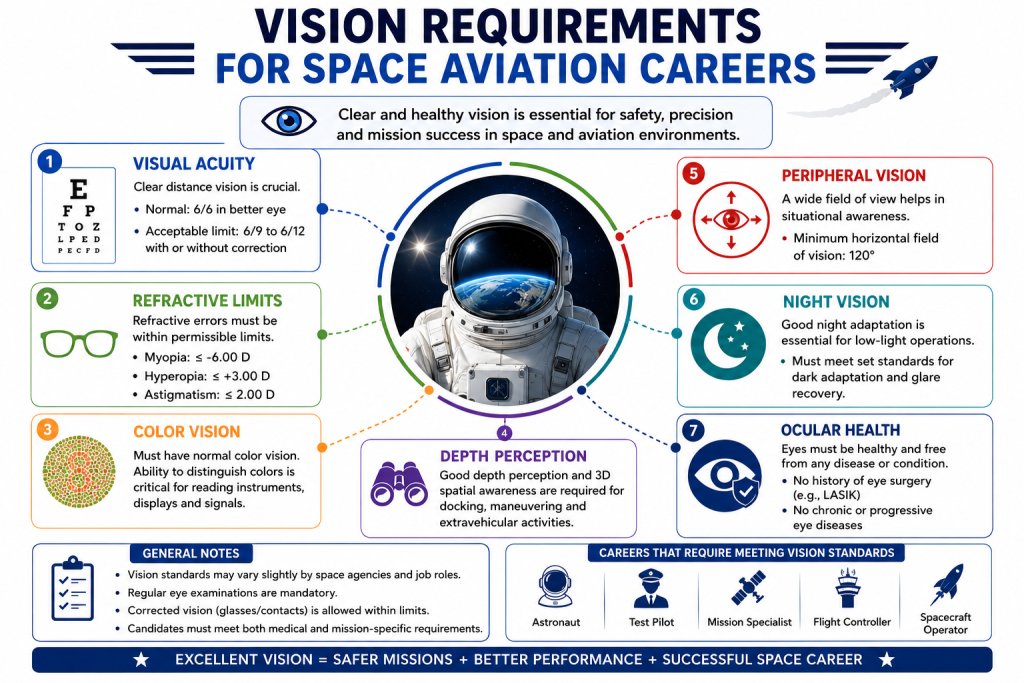
For aspiring pilots, test pilots, astronauts, and other space-related professionals, understanding vision requirements early can help with career planning. However, there is no single vision standard that applies to every space aviation career. Requirements can vary according to the position, organization, aviation authority, medical certificate, and specific operational responsibilities.
Visual assessment may consider more than simply whether a person can read an eye chart. Depending on the role, evaluations may consider visual acuity, colour vision, depth perception, peripheral vision, binocular function, and overall eye health.
This makes it important for aspiring aviation professionals to understand the general principles while checking the current requirements of the specific organization or authority they plan to apply to.
Understanding Vision Requirements in Space Aviation Careers
Vision requirements are medical or occupational standards used to determine whether a person’s visual capabilities are suitable for a particular role.
The specific requirements depend heavily on the career.
A commercial pilot, military pilot, test pilot, astronaut, flight controller, and aerospace engineer may all have different visual expectations because their responsibilities are different.
Areas that may be considered include:
- Distance vision
- Near vision
- Corrected vision
- Colour vision
- Depth perception
- Peripheral vision
- Binocular vision
- Eye health
- Stability of vision
Not every career requires the same tests or standards.
For this reason, applicants should avoid assuming that meeting one aviation vision standard automatically means they meet the requirements for every space-related position.
Why Good Vision Matters in Space Aviation
Visual performance is closely connected with situational awareness and accurate information processing.
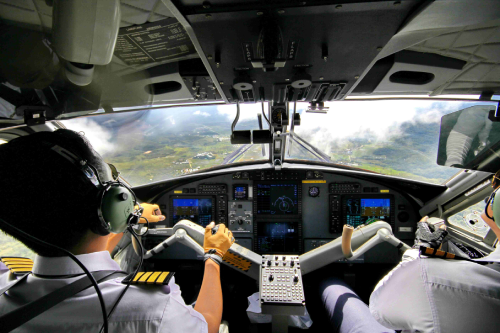
Pilots and space professionals may need to interpret information from instruments and displays while also monitoring their surroundings.
Vision can be important for:
- Reading cockpit instruments
- Monitoring digital displays
- Identifying visual references
- Interpreting navigation information
- Detecting potential hazards
- Performing precision tasks
- Observing equipment
- Maintaining situational awareness
- Supporting communication and teamwork
Modern aircraft and spacecraft rely heavily on advanced electronic displays, but this does not eliminate the importance of visual capability.
In many situations, professionals need to process several types of visual information quickly and accurately.
Vision Requirements for Different Space Aviation Careers
Vision requirements can differ considerably depending on the career path.
Astronauts
Astronaut selection programs typically evaluate candidates against medical and physical standards appropriate to the demands of spaceflight.
Visual capabilities can be relevant to tasks such as:
- Monitoring spacecraft systems
- Reading displays
- Performing experiments
- Operating equipment
- Conducting mission procedures
- Maintaining situational awareness
However, astronaut-selection requirements are organization-specific. A candidate should always consult the official requirements of the space agency or program they are interested in.
Space Pilots and Test Pilots
Pilots involved in advanced aviation, flight testing, experimental aircraft, or spacecraft development may have specific medical and visual requirements.
These professionals may need strong visual performance for:
- Aircraft control
- Instrument interpretation
- Visual references
- Experimental flight operations
- Precision maneuvering
- Monitoring unusual aircraft behavior
Test pilots may also operate aircraft under conditions that differ from normal commercial flying, making the applicable medical and occupational requirements particularly important.
Commercial and Military Pilots Working Toward Space Careers
Some people pursue space-related careers after developing professional aviation experience.
Commercial and military pilots may have their own aviation medical standards, but these should not automatically be treated as equivalent to astronaut or space-program requirements.
A pilot may meet the requirements for one type of aviation activity while still needing to satisfy additional requirements for a space-related role.
Mission Specialists and Other Space Professionals
Not every person working in space operations is a pilot.
Mission specialists, scientists, engineers, robotics operators, flight controllers, and other professionals may have different occupational requirements.
Their visual needs can depend on their specific responsibilities. Someone operating complex equipment may have different requirements from someone directly responsible for flying an aircraft.
Visual Acuity and Space Aviation
Visual acuity refers to the ability to see details clearly.
It is commonly assessed for both distance and near vision.
For aviation and aerospace careers, visual acuity can be relevant when a professional needs to:
- Read instruments
- Interpret display information
- Identify objects
- Recognize visual references
- Perform detailed tasks
The required level of visual acuity depends on the specific occupation and applicable standard.
A person should therefore avoid assuming that one numerical vision requirement applies to every aviation or space career.
Corrected Vision, Glasses, and Contact Lenses
Wearing glasses or contact lenses does not automatically prevent someone from pursuing an aviation or aerospace career.
Many people rely on corrective lenses for clear vision in everyday life and professional environments.
During a medical or occupational assessment, the relevant authority may consider:
- Corrected visual acuity
- Uncorrected visual acuity
- Stability of the prescription
- Eye health
- Type of corrective lenses
- Specific occupational requirements
The rules vary by organization.
Aspiring professionals who wear glasses or contact lenses should check the requirements of their intended career instead of assuming that corrective lenses make them ineligible.
Colour Vision Requirements
Colour vision can be important in aviation because pilots may encounter information presented using different colours.
Examples include:
- Instrument indicators
- Warning systems
- Navigation information
- Signal lights
- Displays
- Aviation markings
The importance of colour recognition depends on the specific job and equipment involved.
Some colour-vision deficiencies may affect eligibility for certain aviation roles, while other careers may have different standards.
A person who is concerned about colour vision should obtain a proper assessment rather than relying on informal online tests.
Depth Perception and Binocular Vision
Depth perception is the ability to judge the relative distance and position of objects.
Binocular vision, which involves using both eyes together, contributes to normal depth perception.
These capabilities can be useful in aviation and other precision-oriented environments.
They may be relevant when professionals need to:
- Judge distances
- Identify spatial relationships
- Handle equipment
- Perform precision tasks
- Assess proximity to objects
- Interpret visual information
The importance of depth perception varies according to the role.
Peripheral Vision
Peripheral vision refers to what a person can see outside the central area of their vision.
It contributes to general environmental awareness and can help people detect movement or objects outside their direct line of sight.
For aviation professionals, peripheral vision can support situational awareness while monitoring instruments and the surrounding environment.
An assessment of the visual field may therefore be relevant in certain medical evaluations.
Eye Health and Common Conditions
Vision requirements are not limited to how clearly someone can read an eye chart.
Overall eye health can also be considered.
Examples of conditions or circumstances that may require medical evaluation include:
- Significant refractive errors
- Colour-vision deficiencies
- Corneal conditions
- Previous eye injuries
- Retinal conditions
- Glaucoma
- Cataracts
- Previous eye surgery
- Persistent or significant visual disturbances
Having one of these conditions does not automatically mean that someone is unsuitable for every aviation or aerospace career.
The significance of a condition can depend on factors such as its severity, stability, treatment, functional effect, and the standards applicable to the particular position.
Vision Testing for Space Aviation Candidates
A candidate may undergo different types of visual assessments depending on the career and medical standard.
Possible assessments include:
Visual Acuity Testing
This measures how clearly a person can see at specified distances.
Refraction Assessment
Refraction determines whether corrective lenses are required and helps establish the appropriate prescription.
Colour Vision Testing
This evaluates the ability to distinguish specific colours that may be important for certain occupational tasks.
Depth-Perception Testing
This assesses the ability to judge differences in distance or spatial relationships.
Visual-Field Testing
This evaluates areas of vision outside the central field.
Slit-Lamp Examination
A slit-lamp examination allows an eye-care professional to examine structures at the front of the eye in detail.
Retinal Examination
A retinal examination allows an eye-care professional to evaluate the back of the eye and identify potential abnormalities.
Other Specialist Assessments
Additional examinations may be requested if a medical history or initial finding requires further evaluation.
Not every candidate will require every test.
Vision Requirements and Space Environment Challenges
Space environments can introduce visual demands that differ from ordinary activities on Earth.
Astronauts and other space professionals may work with:
- Artificial lighting
- Digital displays
- Complex instrument panels
- Limited natural visual references
- Specialized equipment
- Changing visual environments
Spaceflight can also involve physiological changes that are relevant to vision and eye health.
Because of this, space agencies and aerospace medicine programs may consider visual health as part of a broader medical assessment.
The exact requirements depend on the program and mission.
Can People With Glasses Pursue Space Aviation Careers?
Yes, corrective lenses do not automatically eliminate every aviation or space career option.
However, the answer depends on the specific role.
A person considering a career in aviation should determine:
- What visual standard applies?
- Is corrected vision accepted?
- Are there limits on the required prescription?
- Are additional eye examinations necessary?
- Does the organization have specific medical requirements?
The best approach is to check the official requirements of the target organization before making assumptions about eligibility.
Can Laser Eye Surgery Affect Eligibility?
Some people consider procedures such as LASIK or PRK to correct refractive errors.
Previous refractive surgery may be relevant during an aviation or aerospace medical evaluation.
Depending on the applicable standard, factors that may be considered include:
- Stability of vision
- Recovery after surgery
- Current visual performance
- Eye health
- Surgical history
- Possible complications
- Time since the procedure
Laser eye surgery should therefore not be viewed as an automatic route to meeting a particular aviation vision standard.
Anyone considering such a procedure while pursuing an aviation or space career should understand the applicable medical requirements beforehand and discuss the situation with an appropriate qualified medical professional.
How to Prepare for a Vision Assessment
Good preparation means making sure your medical information is accurate and up to date.
Schedule a Comprehensive Eye Examination
If you are planning an aviation or aerospace career, a comprehensive eye examination can help you understand your current visual health.
It can also identify issues that may require professional attention.
Keep Previous Eye Records
Keep copies of relevant eye examination reports, prescriptions, and records of previous procedures.
These documents may be useful during an occupational or aviation medical assessment.
Bring Your Corrective Lenses
If you wear glasses or contact lenses, take them to relevant examinations unless the examiner provides different instructions.
Know Your Prescription
Knowing your current prescription can make it easier to provide accurate information during a medical assessment.
Disclose Previous Eye Surgery
Applicants should accurately report previous eye procedures or significant eye conditions.
The examiner needs complete information to assess the situation appropriately.
Follow the Examiner’s Instructions
Different medical assessments may have different preparation requirements.
Always follow the instructions provided by the relevant examiner or organization.
Do Not Try to Manipulate Test Results
Applicants should never attempt to artificially improve their performance during a medical assessment.
The purpose of the examination is to determine whether their visual capabilities are appropriate for the intended role.
How to Maintain Eye Health for an Aviation Career
Maintaining good eye health is useful for anyone pursuing a visually demanding profession.
General measures include:
- Attend regular eye examinations.
- Use appropriate eye protection when necessary.
- Follow professional advice for existing eye conditions.
- Use prescribed treatment correctly.
- Protect the eyes from avoidable injury.
- Pay attention to significant or persistent changes in vision.
- Seek professional assessment when visual symptoms occur.
These measures do not replace an official aviation or aerospace medical assessment.
Common Mistakes When Evaluating Vision Requirements
Assuming Every Space Career Has the Same Standard
Space careers are diverse.
An astronaut, test pilot, engineer, and flight controller do not necessarily have identical visual requirements.
Assuming Glasses Automatically Disqualify a Candidate
Corrective lenses are accepted in many professional environments.
The relevant question is whether the applicant meets the applicable standard with the permitted correction.
Ignoring Colour Vision
Someone may have excellent visual acuity but still have a colour-vision deficiency.
Because colour information can be important in aviation, applicants should understand whether their intended career has specific colour-vision requirements.
Failing to Report Previous Eye Surgery
Previous surgery can be relevant to a medical assessment.
Applicants should provide accurate information rather than assuming that an old procedure is irrelevant.
Relying on Outdated Information
Aviation and occupational medical standards can change.
Information found in an old article, forum, or social media post may no longer represent current requirements.
Confusing Pilot and Astronaut Standards
Pilot licensing and astronaut selection are different processes.
Meeting the medical requirements for one does not automatically establish eligibility for the other.
Assuming Good Visual Acuity Means Perfect Eye Health
Being able to read an eye chart clearly does not necessarily mean that every aspect of eye health is normal.
A comprehensive assessment may consider several additional factors.
How to Research Vision Requirements for a Specific Career
Before committing to a career path, applicants should identify the organization and position they are targeting.
Useful sources of information include:
- Official space-agency career pages
- National aviation authority requirements
- Official pilot licensing information
- Employer occupational standards
- Authorized aviation medical examiners
- Qualified aerospace medicine professionals
Applicants should check the requirements as early as possible.
This is particularly important if the career involves extensive training, relocation, or significant financial investment.
General Vision Considerations by Career
| Career Area | Common Vision Considerations | Why Vision Matters |
|---|---|---|
| Commercial Pilot | Visual acuity, colour vision, eye health | Aircraft operation and situational awareness |
| Military Pilot | Occupation-specific visual and medical standards | High-performance aviation activities |
| Test Pilot | Detailed aviation and occupational medical requirements | Experimental and flight-test operations |
| Astronaut | Program-specific medical and visual standards | Spaceflight and mission activities |
| Mission Specialist | Role-specific occupational requirements | Mission tasks and equipment operation |
| Aerospace Engineer | Occupational requirements related to the role | Technical and engineering activities |
| Flight Controller | Role-specific visual and occupational requirements | Monitoring displays and mission systems |
This table provides a general educational comparison. It should not be treated as an official eligibility chart.
Frequently Asked Questions
1. What vision requirements are needed for a space aviation career?
There is no single vision requirement for every space aviation career. Requirements depend on the position, organization, medical standards, and responsibilities involved.
2. Can someone with glasses become an astronaut?
Wearing glasses does not automatically determine astronaut eligibility. The relevant space agency or program applies its own medical and visual standards.
3. Is perfect eyesight required to become a pilot?
Not necessarily. Many aviation systems permit certain forms of corrected vision, but the applicable standards depend on the licence and aviation authority.
4. Does colour blindness affect aviation careers?
It can affect eligibility for some aviation roles because colour recognition may be important for instruments, signals, and other operational information. The impact depends on the specific role and applicable standard.
5. Why is depth perception important for pilots?
Depth perception helps with judging distances and spatial relationships. Its importance depends on the particular aviation role and operating environment.
6. Can people with contact lenses work in aviation?
Contact lenses may be acceptable for some aviation careers, depending on the applicable medical requirements. Applicants should verify the rules for their specific licence or position.
7. Can laser eye surgery affect space aviation eligibility?
Previous refractive surgery may be considered during a medical evaluation. Eligibility depends on the procedure, recovery, current vision, eye health, and applicable standards.
8. Are astronaut and pilot vision requirements the same?
No. Astronaut selection and pilot medical certification are separate processes and may involve different standards.
9. How often should aspiring aviation professionals have their eyes examined?
The appropriate frequency depends on age, eye health, existing conditions, corrective-lens use, and professional requirements. A qualified eye-care professional can provide appropriate guidance.
10. Where can candidates find official vision requirements?
Candidates should consult the official aviation authority, space agency, employer, or organization responsible for the specific career. An authorized aviation medical examiner may also provide guidance on applicable medical standards.
Conclusion
Vision plays an important role in many aviation and space-related careers. Pilots, astronauts, test pilots, mission specialists, and other professionals may depend on clear and reliable visual information to operate equipment, interpret displays, maintain situational awareness, and perform precision tasks.
However, there is no universal vision standard for every space aviation career. Requirements can vary according to the position, organization, aviation authority, medical certificate, and operational responsibilities.
Visual acuity is only one part of the picture. Colour vision, depth perception, peripheral vision, binocular function, corrective vision, and overall eye health may also be relevant.
For aspiring aviation and space professionals, the best approach is to investigate the requirements of the intended career early, maintain appropriate eye care, keep relevant medical records, and obtain guidance from qualified professionals when necessary.