Introduction
Space exploration places extraordinary demands on the human body and mind. Astronauts do not simply travel to space and begin working. Before a mission, they go through extensive training designed to prepare them for environments that are very different from normal life on Earth.
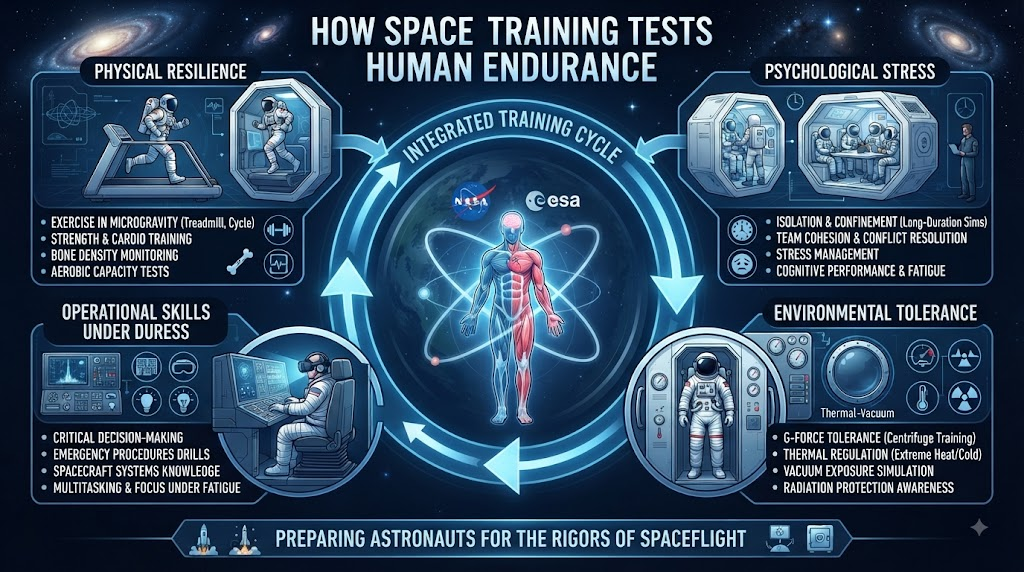
Space training tests endurance in several ways. Astronauts must develop physical fitness, maintain concentration during demanding tasks, respond to emergencies, work effectively with a small team, and remain mentally prepared during isolation and confinement.
Conditions such as microgravity, unusual sleep schedules, high workloads, restricted living spaces, and long periods away from Earth can challenge human performance. Training helps astronauts become familiar with these conditions and develop the skills needed to operate safely.
Human endurance in space is therefore not only about physical strength. It includes physical stamina, mental resilience, emotional control, technical competence, and the ability to continue performing important tasks under pressure.
What Does Human Endurance Mean in Space Training?
Human endurance refers to the ability to continue performing physical or mental tasks effectively over a period of time despite demanding conditions.
For astronauts, endurance can involve several areas:
- Physical stamina
- Cardiovascular fitness
- Muscular strength
- Coordination
- Concentration
- Mental resilience
- Decision-making
- Stress management
- Adaptability
- Teamwork
An astronaut may be physically fit but still need to develop the mental endurance required to handle isolation or unexpected problems.
Similarly, technical knowledge alone is not enough. Astronauts must be able to apply that knowledge while tired, under pressure, or in an unfamiliar environment.
Why Astronaut Training Is Physically Demanding
Astronaut training involves much more than ordinary exercise.
Candidates may spend long periods learning spacecraft procedures, practicing emergency responses, training with equipment, participating in simulations, and preparing for activities that require specialized physical skills.
Training can be demanding because astronauts need to become comfortable performing tasks that may be difficult or unfamiliar.
They may need to practice:
- Spacecraft operations
- Emergency procedures
- Equipment handling
- Spacesuit operations
- Spacewalk-related activities
- Survival procedures
- Mission simulations
- Physical conditioning
The objective is to prepare astronauts to perform consistently when actual mission conditions are challenging.
Cardiovascular Endurance
Cardiovascular fitness is an important part of general astronaut preparation.
Aerobic conditioning helps support the body’s ability to perform physical activities for extended periods. Training programs can include activities such as running, cycling, swimming, or other forms of structured exercise.
Good cardiovascular conditioning can contribute to overall physical readiness during demanding training sessions.
However, astronaut fitness is not based on endurance alone. Physical preparation generally combines cardiovascular conditioning with strength, flexibility, coordination, and other forms of fitness.
Muscular Strength and Physical Conditioning
Muscular strength is another important part of astronaut preparation.
On Earth, gravity provides continuous resistance against which the body works. In microgravity, many normal movements require much less effort. This changes how the body is loaded during everyday activities.
Astronauts therefore need appropriate physical conditioning before, during, and after space missions.
Strength and conditioning can support activities such as:
- Handling equipment
- Performing training simulations
- Preparing for spacewalks
- Operating tools
- Managing emergency procedures
- Maintaining general physical capability
Physical conditioning is particularly important for missions in which astronauts may spend extended periods in space.
Training for Microgravity
Microgravity creates an environment that is very different from Earth.
Astronauts may need to adapt to:
- Floating rather than walking
- Different body orientation
- Changes in movement
- Different ways of handling objects
- Reduced gravitational loading
- Changes in balance and coordination
Tasks that appear simple on Earth can require different techniques in space.
Training allows astronauts to practice these movements before a mission and learn how to work efficiently in an environment where normal concepts of up and down may not apply in the same way.
Underwater Training and Spacewalk Preparation
Underwater training is commonly associated with preparation for spacewalks.
Astronauts can train in large pools using specialized equipment and spacesuits. The underwater environment can provide neutral buoyancy, allowing astronauts to practice certain movements and procedures that resemble aspects of working in space.
Training may involve:
- Wearing a spacesuit.
- Handling tools.
- Operating equipment.
- Practicing procedures.
- Communicating with support personnel.
- Moving around a simulated structure.
- Completing tasks within a limited time.
Underwater training does not perfectly reproduce microgravity. Water creates resistance that does not exist in the same way in space. However, neutral-buoyancy training can provide a valuable environment for practicing certain spacewalk-related skills.
Mental Endurance in Space Training
Physical preparation is only one part of astronaut endurance.
Astronauts also need mental endurance because space missions can involve high workloads, strict procedures, unexpected events, and prolonged periods away from familiar surroundings.
Mental endurance can involve the ability to:
- Maintain concentration.
- Follow procedures carefully.
- Manage stress.
- Solve problems.
- Make decisions.
- Adapt to changing circumstances.
- Continue working effectively during difficult situations.
Training helps astronauts become familiar with stressful situations before they encounter them during a real mission.
Training for Isolation and Confinement
Spacecraft provide limited living and working space. During long missions, astronauts may spend significant amounts of time with the same small group of people.
This makes interpersonal skills extremely important.
Astronaut training can include preparation for:
- Working in confined environments.
- Maintaining personal routines.
- Communicating clearly.
- Managing disagreements.
- Cooperating with teammates.
- Maintaining emotional stability.
- Handling periods away from family and familiar surroundings.
Isolation does not necessarily mean astronauts are completely disconnected from Earth, but the physical distance and restricted environment can create unique psychological challenges.
The ability to communicate and cooperate effectively can therefore be just as important as technical knowledge.
Sleep and Circadian Challenges
Sleep is essential for human performance, and space missions can create unusual scheduling challenges.
Astronauts may have demanding mission schedules involving scientific experiments, spacecraft operations, maintenance, exercise, communication, and other responsibilities.
Factors that can affect normal sleep routines include:
- Changing schedules
- Workload
- Mission timelines
- Artificial lighting
- Environmental conditions
- Stress
Adequate sleep supports:
- Concentration
- Memory
- Reaction time
- Decision-making
- Emotional stability
- Physical recovery
Astronaut training and mission planning therefore consider sleep and scheduling as important aspects of maintaining human performance.
Training Under Pressure
Astronaut training often places candidates in demanding situations.
The purpose is not simply to make training uncomfortable. It is to help astronauts learn how to remain effective when circumstances become difficult.
Training scenarios may include:
- Equipment failures
- Communication problems
- Time-sensitive procedures
- Unexpected technical problems
- Emergency situations
- High-workload operations
During these exercises, astronauts need to remain focused and follow appropriate procedures.
Repeated exposure to challenging scenarios can help build familiarity and confidence.
Emergency Training
Emergency preparation is one of the most important aspects of astronaut training.
Spacecraft are designed with multiple safety systems, but astronauts still need to know how to respond if something goes wrong.
Training may address situations involving:
- Fire
- Loss of cabin pressure
- Equipment malfunction
- Emergency evacuation
- Medical problems
- Other spacecraft emergencies
Astronauts practice these procedures repeatedly because an emergency may require them to respond quickly and accurately.
The goal is to make important actions familiar enough that astronauts can apply their training even when they are under significant pressure.
Training for Spacecraft Launch and Re-Entry
Launch and re-entry are physically and operationally demanding phases of a space mission.
Astronauts must remain properly restrained, communicate with other crew members, monitor systems, and follow established procedures.
They may experience:
- Acceleration
- Vibration
- High workload
- Physical forces
- Significant environmental changes
Training helps astronauts understand what to expect and become familiar with the procedures required during these phases.
The preparation also includes emergency scenarios so that crew members know how to respond if a problem occurs.
Psychological Resilience
Psychological resilience is the ability to adapt and continue functioning effectively during difficult circumstances.
Astronauts may encounter:
- Stress
- Uncertainty
- Isolation
- Unexpected technical problems
- Performance pressure
- Repetitive tasks
- Separation from family
Resilience does not mean that astronauts never experience fear, frustration, or stress.
Instead, it means developing appropriate ways to manage difficult situations without allowing them to interfere unnecessarily with important responsibilities.
Training, teamwork, communication, preparation, and established procedures can all contribute to resilience.
Teamwork and Social Endurance
Space missions are team operations.
Astronauts need to work together closely, sometimes for extended periods. A technically skilled individual may still struggle in a mission environment if they cannot communicate or cooperate effectively with others.
Important teamwork skills include:
- Clear communication
- Active listening
- Cooperation
- Trust
- Leadership
- Conflict management
- Respect
- Shared responsibility
Crew members may have different personalities, backgrounds, and working styles. Training helps them learn how to work together effectively despite these differences.
Training for Repetitive Tasks
Not every space mission activity is dramatic or exciting.
Astronauts may perform routine maintenance, scientific experiments, inspections, equipment checks, and other repetitive tasks.
Maintaining concentration during routine activities is important because small errors can have consequences in a complex environment.
Repeated training helps astronauts:
- Become familiar with procedures.
- Improve consistency.
- Reduce hesitation.
- Build procedural confidence.
- Practice correct responses.
- Maintain readiness for unexpected situations.
Endurance therefore also involves the ability to remain attentive when a task becomes familiar.
Nutrition and Physical Recovery
Nutrition and recovery are important components of maintaining human performance.
Astronaut preparation includes attention to general physical health, exercise, recovery, hydration, and nutrition.
A demanding training schedule requires the body to recover between activities.
Appropriate recovery can support:
- Physical readiness
- Concentration
- Exercise performance
- Learning
- General well-being
Astronauts also need to adapt to the unique food and living conditions associated with space missions.
Medical Monitoring During Training
Astronaut candidates undergo extensive medical and physical evaluation as part of the selection and preparation process.
Depending on the program, evaluation can consider areas such as:
- Cardiovascular health
- Vision
- Hearing
- Physical fitness
- Musculoskeletal health
- General medical condition
- Psychological suitability
Medical evaluation helps space agencies understand whether candidates are capable of meeting the demands associated with spaceflight.
The exact medical standards and procedures vary between space agencies and mission types.
How Training Simulates the Challenges of Space
It is impossible to perfectly recreate space on Earth.
However, training facilities can simulate individual aspects of spaceflight.
Astronauts may train using:
- Neutral-buoyancy facilities
- Spacecraft simulators
- Virtual-reality systems
- Specialized aircraft
- Isolation environments
- Emergency simulators
- High-fidelity mission rehearsals
Each environment serves a different purpose.
A spacecraft simulator may allow astronauts to practice operating onboard systems, while underwater training can help them rehearse certain spacewalk procedures.
These simulations help astronauts develop familiarity before they face actual mission conditions.
How Space Training Builds Human Endurance
Space training develops several different forms of endurance.
Physical Endurance
Astronauts develop physical fitness to support demanding activities and long-duration missions.
Mental Endurance
Training helps astronauts maintain concentration, solve problems, and make decisions under pressure.
Operational Endurance
Astronauts must be able to perform procedures accurately over long periods without allowing fatigue or routine to reduce their attention.
Team Endurance
Long missions require crew members to maintain effective communication and cooperation.
Emotional Endurance
Astronauts need appropriate ways to manage isolation, uncertainty, pressure, and unexpected situations.
These forms of endurance work together. A successful astronaut needs more than physical fitness alone.
Challenges That Astronauts Must Adapt To
Astronauts must prepare for a combination of unusual conditions.
Microgravity
Moving and working without normal gravitational forces requires adaptation.
Confinement
Spacecraft provide limited living and working areas.
Isolation
Astronauts may spend extended periods away from Earth and familiar surroundings.
Sleep Disruption
Mission schedules and environmental factors can interfere with normal sleep routines.
High Workload
Astronauts may have multiple responsibilities and time-sensitive tasks.
Emergency Situations
Unexpected technical or operational problems require calm and organized responses.
Communication Limitations
Future missions farther from Earth may involve greater communication delays.
Repetitive Procedures
Routine tasks still require careful attention and consistency.
Training helps astronauts become more familiar with these challenges before encountering them during a mission.
How Space Training Differs From Normal Fitness Training
Astronaut training is much broader than conventional physical exercise.
Normal fitness training may focus primarily on improving strength, endurance, flexibility, or cardiovascular health.
Astronaut training combines physical preparation with technical and psychological preparation.
It can involve:
| Area | Purpose |
|---|---|
| Physical conditioning | Supports general physical readiness |
| Technical training | Develops spacecraft and equipment skills |
| Emergency training | Prepares astronauts for unexpected situations |
| Psychological preparation | Develops coping and resilience skills |
| Team training | Improves communication and cooperation |
| Simulation | Provides realistic mission practice |
| Environmental training | Helps astronauts adapt to unusual conditions |
The combination of these areas helps astronauts prepare for the complexity of actual space missions.
Common Misconceptions About Astronaut Endurance
Astronauts Need to Be Extremely Muscular
Astronauts need appropriate physical fitness, but becoming extremely muscular is not the primary objective.
Astronaut selection and preparation consider many different abilities, including technical knowledge, physical capability, teamwork, and psychological suitability.
Astronaut Training Is Only Physical
Physical training is only one component.
Astronauts also spend considerable time learning spacecraft systems, practicing procedures, preparing for emergencies, and developing teamwork skills.
Astronauts Never Feel Fear or Stress
Astronauts are human and can experience stress, uncertainty, or fear.
Training helps them develop appropriate ways to manage these responses and continue performing their responsibilities.
Space Training Completely Recreates Space
No Earth-based training environment can perfectly reproduce every aspect of spaceflight.
Instead, different simulations are used to reproduce specific aspects of the mission environment.
Endurance Means Ignoring Fatigue
Endurance does not mean pretending that fatigue does not exist.
Recognizing fatigue, managing workload, maintaining sleep, and allowing appropriate recovery are important parts of safe human performance.
How Training Helps Prepare Astronauts for Long-Duration Missions
Long-duration missions create additional challenges because astronauts may need to live and work in space for extended periods.
Training helps astronauts prepare for:
- Consistent daily routines
- Exercise
- Sleep management
- Team cooperation
- Psychological challenges
- Emergency procedures
- Continuous learning
- Equipment maintenance
- Physical conditioning
Maintaining performance over time requires discipline and adaptability.
An astronaut may need to perform routine tasks correctly on the first day of a mission and continue doing them accurately many weeks or months later.
The Future of Human Endurance Training for Space Missions
Future space exploration may create new demands on human endurance.
Potential missions to the Moon and Mars could involve longer travel periods, extended surface operations, greater isolation, and communication delays.
Future astronauts may need to prepare for:
- Longer missions
- Lunar exploration
- Mars missions
- Greater communication delays
- More autonomous operations
- Advanced spacesuits
- New spacecraft environments
- Increased psychological demands
As missions move farther from Earth, astronauts may have to solve more problems independently.
This could make mental resilience, teamwork, technical versatility, and decision-making even more important.
Frequently Asked Questions
1. What does human endurance mean in space training?
Human endurance in space training refers to an astronaut’s ability to maintain physical, mental, and operational performance while dealing with demanding conditions such as microgravity, isolation, high workloads, and unexpected situations.
2. Why do astronauts need physical fitness?
Physical fitness supports astronauts during demanding training activities, spacecraft operations, spacewalk preparation, and long-duration missions. It also helps them maintain physical capability during and after exposure to spaceflight conditions.
3. How does microgravity affect the human body?
Microgravity changes how the body experiences normal gravitational loading. Over time, spaceflight can affect areas such as muscles, bones, balance, and cardiovascular function, which is why astronauts use exercise and other measures to support physical health.
4. Why do astronauts train underwater?
Underwater neutral-buoyancy training can help astronauts practice certain spacewalk-related tasks. It provides an environment where astronauts can rehearse movements and procedures while wearing specialized equipment.
5. How do astronauts prepare for isolation?
Astronauts receive training that emphasizes communication, teamwork, personal routines, stress management, and cooperation in confined environments. These skills can help crews work effectively during extended missions.
6. Why is mental endurance important for astronauts?
Astronauts may face high workloads, isolation, uncertainty, emergencies, and long periods away from familiar surroundings. Mental endurance helps them remain focused and make appropriate decisions under challenging conditions.
7. How do astronauts train for emergencies?
They repeatedly practice simulated emergency scenarios involving situations such as fire, equipment problems, loss of cabin pressure, or other spacecraft failures. Repetition helps make important procedures more familiar.
8. Does astronaut training involve sleep and fatigue management?
Yes. Sleep and recovery are important because insufficient sleep can affect concentration, memory, reaction time, and decision-making. Mission schedules and training programs take human performance and rest into consideration.
9. How does teamwork affect astronaut endurance?
Astronauts often live and work closely with other crew members for extended periods. Effective communication, cooperation, trust, leadership, and conflict management help crews maintain performance throughout a mission.
10. How will future space missions change astronaut training?
Longer missions to destinations such as the Moon and Mars may require additional preparation for isolation, communication delays, autonomous decision-making, extended physical demands, and psychological challenges.
Conclusion
Space training tests human endurance in ways that go far beyond conventional physical fitness. Astronauts must prepare their bodies for demanding activities while also developing the mental resilience, technical knowledge, communication skills, and discipline required for complex missions.
Microgravity, isolation, confined environments, demanding schedules, repetitive procedures, and emergency situations can all challenge human performance. Training allows astronauts to practice these conditions and develop appropriate responses before facing them during an actual mission.
The most important aspect of astronaut endurance is therefore balance. Physical fitness is important, but so are concentration, emotional stability, teamwork, adaptability, and the ability to make sound decisions under pressure.