Introduction
A career as an astro pilot requires much more than technical knowledge, flying skills, and physical preparation. Professionals working in advanced aviation and space-related environments may have to manage complex information, make important decisions, work closely with teams, and respond calmly when situations change unexpectedly. For this reason, mental fitness is an important part of professional preparation.
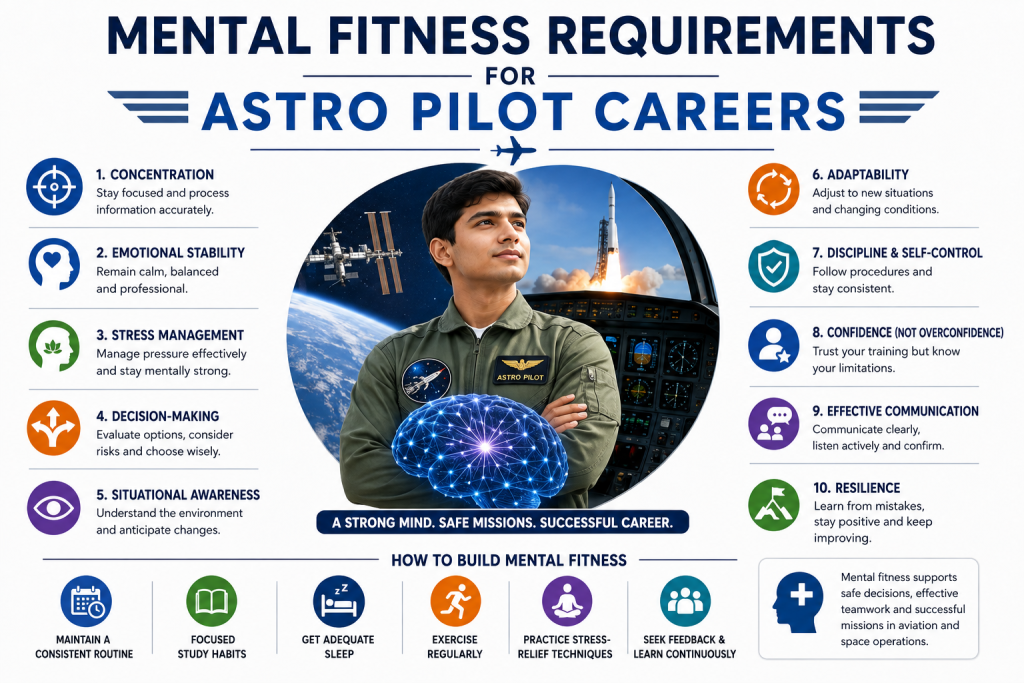
Mental fitness for an astro pilot involves qualities such as concentration, emotional control, decision-making, adaptability, communication, discipline, and resilience. These abilities can help aspiring professionals remain focused and perform responsibly during demanding training and operational situations.
However, mental fitness should not be confused with official medical or psychological certification. Formal requirements vary depending on the country, aviation authority, employer, license, aircraft, and specific spaceflight program. Aspiring professionals should always check the current requirements that apply to their intended career path.
What Is Mental Fitness for an Astro Pilot?
Mental fitness refers to the ability to manage thoughts, emotions, attention, and behavior effectively while dealing with professional responsibilities and challenging situations.
For someone pursuing an astro pilot career, mental fitness can include the ability to:
- Stay focused during demanding tasks
- Process information accurately
- Make responsible decisions under pressure
- Manage stress appropriately
- Adapt to changing circumstances
- Communicate clearly with team members
- Accept feedback and learn from mistakes
- Follow procedures consistently
- Recognize personal limitations
- Maintain professional discipline
Mental fitness does not mean that a person never experiences stress, nervousness, or difficult emotions. Instead, it involves developing healthy ways to manage these experiences while maintaining appropriate professional behavior and performance.
Why Mental Fitness Matters in Astro Pilot Careers
Aviation and space-related careers can involve complex environments where professionals must process information and respond appropriately to changing conditions. An individual may need to monitor systems, communicate with team members, follow established procedures, and make decisions within limited time.
NASA identifies leadership, teamwork, and communication as important skills for astronaut candidates. Its astronaut information also emphasizes the importance of being mentally, physically, and emotionally prepared for demanding missions.
These expectations demonstrate why aspiring astro pilots should begin developing mental skills early in their education and training.
Mental fitness can support:
- Better concentration
- Responsible decision-making
- Effective communication
- Improved situational awareness
- Better stress management
- Stronger teamwork
- Greater adaptability
- Consistent professional behavior
Key Mental Fitness Requirements for Astro Pilot Careers
1. Strong Concentration
Concentration is one of the most important mental abilities for any demanding flight-related career. Pilots may need to monitor several sources of information while remaining aware of their surroundings.
An aspiring astro pilot should learn how to maintain attention without becoming easily distracted. This can be particularly important during technical training, simulator sessions, examinations, and flight operations.
Students can strengthen concentration by:
- Studying in a distraction-free environment
- Breaking complex subjects into manageable sections
- Practicing focused study sessions
- Following procedures carefully
- Reviewing important information before performing tasks
- Taking appropriate breaks during long study periods
The goal is not simply to study for longer but to develop the ability to focus on important information when it matters.
2. Emotional Stability
Emotional stability is another valuable quality for professionals working in demanding environments.
Unexpected problems, challenging training sessions, examinations, or performance feedback can create pressure. An aspiring astro pilot should learn how to manage emotional reactions without allowing them to interfere with responsible decisions or professional communication.
Emotional stability can involve:
- Remaining calm during challenging situations
- Avoiding impulsive reactions
- Listening carefully before responding
- Thinking logically under pressure
- Communicating concerns appropriately
- Maintaining professionalism during disagreements
Developing emotional control does not mean suppressing emotions. It means learning how to respond to situations in a balanced and responsible way.
3. Stress Management
Stress can occur during pilot training and professional aviation. The ability to recognize and manage stress is therefore an important part of mental preparation.
Students can develop healthy stress-management habits by:
- Maintaining regular sleep
- Planning study and training schedules
- Taking appropriate breaks
- Exercising regularly
- Practicing relaxation techniques
- Staying organized
- Seeking professional support when needed
The FAA provides guidance on pilot mental fitness and encourages pilots to address mental-health concerns appropriately rather than avoiding necessary care.
Managing stress effectively can help aspiring professionals maintain focus and avoid allowing pressure to negatively affect their training.
4. Responsible Decision-Making
Pilots may sometimes need to make decisions using changing or incomplete information. Good decision-making is therefore an important professional skill.
Responsible decision-making involves:
- Understanding the situation
- Identifying important information
- Considering available options
- Evaluating potential risks
- Following applicable procedures
- Taking appropriate action
- Reviewing the outcome when possible
Students can develop these skills through flight training, simulator exercises, scenario-based learning, and discussions with instructors.
Being a good decision-maker does not simply mean making decisions quickly. It means making appropriate decisions based on available information, training, procedures, and risk awareness.
5. Situational Awareness
Situational awareness is the ability to understand what is happening around you and recognize how a situation could change.
For an astro pilot, this may involve understanding aircraft or vehicle status, environmental conditions, mission objectives, communications, and other operational factors.
Strong situational awareness requires:
- Careful observation
- Active listening
- Accurate information processing
- Awareness of changing conditions
- Anticipation of possible developments
- Regularly reviewing the current situation
Students can improve this skill by developing the habit of continuously monitoring their environment instead of focusing on only one task.
6. Adaptability
Not every flight or training session will go exactly according to plan. Weather conditions, technical issues, schedule changes, instructions, or operational requirements can change unexpectedly.
An adaptable professional can adjust to changing circumstances while continuing to follow safety procedures and professional standards.
Adaptability means being able to:
- Adjust to new information
- Stay calm when plans change
- Consider alternative solutions
- Follow revised instructions
- Continue working effectively under changing conditions
Being adaptable does not mean ignoring procedures. It means responding appropriately when circumstances require a change in approach.
7. Discipline and Self-Control
Professional pilot training requires consistency and discipline. Students need to study technical subjects, complete training activities, prepare for examinations, follow instructions, and review their performance.
Strong discipline can help aspiring pilots develop reliable habits.
Self-control is equally important. It can reduce impulsive behavior and encourage thoughtful decision-making.
Simple habits such as preparing in advance, following checklists, arriving on time, completing assigned work, and reviewing mistakes can contribute to professional discipline.
8. Confidence Without Overconfidence
Confidence can help pilots trust their training and perform their responsibilities effectively. However, overconfidence can create unnecessary risks.
A professional should understand the difference between healthy confidence and excessive confidence.
Healthy confidence means:
- Knowing your strengths
- Understanding your limitations
- Preparing before performing a task
- Asking questions when something is unclear
- Accepting constructive feedback
- Following established procedures
A good pilot does not need to prove that they can handle every situation alone. Knowing when to communicate, ask for assistance, or reconsider a decision is also a sign of professional maturity.
9. Effective Communication
Communication is essential in aviation because pilots often work with other professionals.
Depending on the environment, an astro pilot may need to communicate with instructors, pilots, engineers, controllers, mission personnel, or other members of a technical team.
Effective communication includes:
- Speaking clearly
- Listening carefully
- Confirming important information
- Reporting problems promptly
- Asking relevant questions
- Avoiding assumptions
- Remaining professional during disagreements
NASA also identifies communication and teamwork among the skills expected of astronaut candidates.
Good communication can reduce misunderstandings and help teams coordinate their actions more effectively.
10. Resilience and Learning From Mistakes
No student performs perfectly throughout training. Mistakes, difficult examinations, challenging lessons, and critical feedback can all be part of the learning process.
Resilience helps aspiring pilots recover from setbacks and continue improving.
After a difficult training session, a student can ask:
- What happened?
- What caused the problem?
- What could I have done differently?
- What feedback did I receive?
- What should I practice before the next session?
This approach turns mistakes into learning opportunities instead of allowing them to become a reason to give up.
How Can Students Improve Their Mental Fitness for Pilot Training?
Mental fitness develops gradually through consistent habits and experience. Students can begin working on these abilities during their early training years.
Maintain a Consistent Routine
A structured routine can help students balance studying, training, rest, and personal responsibilities.
Practice Focused Study
Set clear study objectives and remove unnecessary distractions. Focused study can help develop concentration and information-processing skills.
Maintain Healthy Sleep Habits
Adequate sleep is important for concentration, learning, and general performance. Students should avoid making a habit of sacrificing sleep for additional study time.
Practice Decision-Making
Use realistic scenarios and training exercises to practice evaluating situations, considering risks, and selecting appropriate actions.
Review Mistakes Objectively
Instead of focusing only on the fact that a mistake occurred, identify its cause and determine what can be changed next time.
Improve Communication Skills
Practice active listening, clear explanations, appropriate questioning, and professional communication.
Learn Healthy Stress-Management Techniques
Students can use appropriate relaxation methods, physical activity, planning, and professional support to manage stress effectively.
Signs That an Aspiring Pilot Should Work on Mental Fitness
Everyone experiences stress, frustration, and occasional mistakes. However, repeated difficulties may indicate that additional preparation or professional support could be useful.
Some examples include:
- Frequently losing concentration during important tasks
- Struggling to manage normal training pressure
- Making repeated impulsive decisions
- Having difficulty accepting constructive feedback
- Becoming overwhelmed by changing situations
- Avoiding communication when problems occur
- Finding it consistently difficult to maintain a training routine
These signs should not be treated as a medical diagnosis. Anyone concerned about their mental health or ability to perform safely should speak with an appropriately qualified professional.
Mental Fitness vs. Medical or Psychological Certification
It is important to understand that general mental fitness advice is different from official aviation medical or psychological requirements.
There is no single universal set of mental fitness requirements that applies to every astro pilot career. Requirements can depend on:
- Country
- Aviation authority
- Type of pilot license
- Employer
- Aircraft
- Operational environment
- Spaceflight organization
- Specific mission
For example, aviation authorities may have formal medical certification systems that include mental-health considerations. Specialized spaceflight programs can also have their own selection and medical standards.
Therefore, students should not assume that meeting general mental fitness recommendations automatically means they meet official eligibility requirements.
Anyone preparing for a specific career should check the latest requirements published by the relevant aviation authority, employer, or space organization.
Building Mental Fitness During Pilot Training
Mental fitness should be developed throughout pilot training rather than treated as a separate activity.
Flight instructors can provide feedback that helps students identify areas for improvement. Simulator exercises can help students practice responding to changing situations. Classroom activities can strengthen technical understanding, while teamwork exercises can improve communication.
Students can also maintain a simple training record that includes:
- What went well
- What was difficult
- Feedback received
- Skills requiring additional practice
- Changes to make during the next session
Regular self-review can help students understand their progress and identify areas that need additional attention.
Frequently Asked Questions
1. What mental skills are important for aspiring astro pilots?
Important skills include concentration, situational awareness, decision-making, emotional control, adaptability, communication, discipline, and resilience.
2. Why is emotional stability important in aviation?
Aviation professionals may encounter stressful or unexpected situations. Emotional control can help them remain professional, communicate effectively, and make responsible decisions.
3. How can pilot students improve stress management?
Students can maintain healthy routines, get adequate sleep, stay organized, exercise appropriately, practice relaxation techniques, and seek qualified professional support when necessary.
4. Is confidence important for an astro pilot career?
Confidence can help professionals rely on their training and perform their responsibilities. However, confidence should always be balanced with self-awareness, preparation, risk awareness, and respect for procedures.
5. How does concentration affect pilot performance?
Good concentration helps pilots monitor important information, follow procedures, maintain situational awareness, and respond appropriately when conditions change.
6. Can mental fitness be improved during pilot training?
Yes. Skills such as concentration, communication, decision-making, stress management, and resilience can be developed through training, practice, feedback, and healthy daily habits.
7. Are mental fitness requirements the same in every country?
No. Formal requirements can vary between aviation authorities, licenses, employers, and specialized aviation or space programs. Candidates should check the current official requirements for their intended career path.
8. Does mental fitness replace aviation medical certification?
No. General mental fitness is not a replacement for formal aviation medical or psychological certification. Candidates must meet the requirements applicable to their specific license, role, authority, or organization.
Conclusion
Mental fitness is an important part of preparing for a demanding astro pilot career. Technical knowledge and flying ability are essential, but professionals also need the mental skills required to remain focused, manage pressure, communicate clearly, make responsible decisions, and adapt to changing situations.
Aspiring pilots can begin developing these qualities through consistent training, focused study, healthy routines, scenario-based practice, teamwork, and honest self-evaluation. Learning from mistakes and accepting constructive feedback can also help build resilience and professional maturity.
At the same time, general mental fitness should not be confused with official medical or psychological certification. Requirements differ depending on the aviation authority, employer, country, license, and specific spaceflight program. Anyone pursuing this career should consult the relevant official requirements before making decisions about eligibility.
Developing mental fitness is an ongoing process. By building these skills alongside technical and physical preparation, aspiring astro pilots can become better prepared for the demands of advanced aviation and space-related careers.