
Introduction
Earth moves through space every moment. It does not stay in one place.
Earth travels around the Sun in a large path. We call this path an orbit.
Gravity helps keep Earth on this path. Earth also keeps moving forward.
These two effects work together. They allow Earth to continue its journey around the Sun.
Understanding Earth’s orbit helps explain our year and seasons. It also gives beginners a simple view of how planets move.
What Is an Orbit?
An orbit is the path of one object around another object.
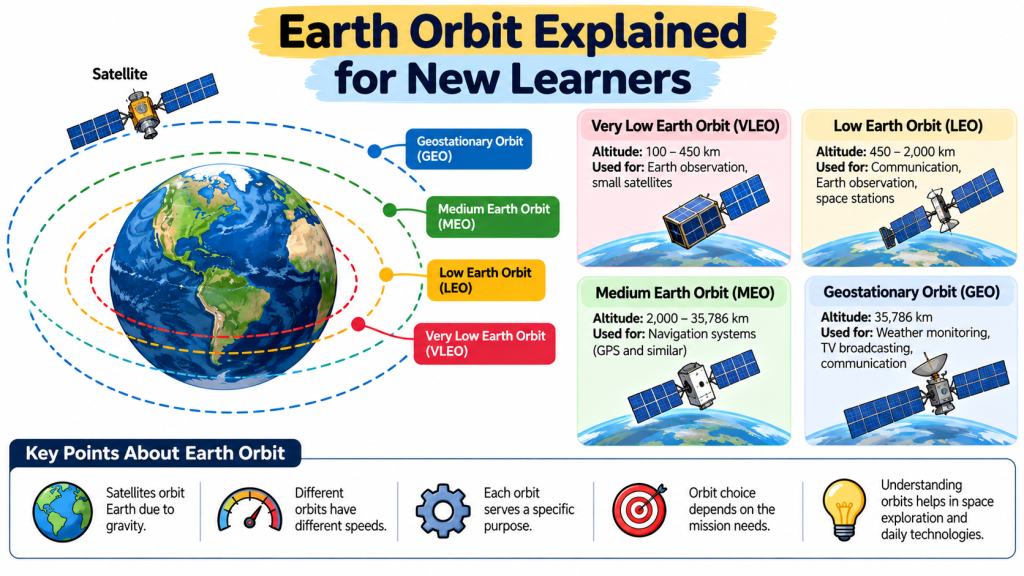
Many objects can follow orbits in space. Planets orbit stars. Moons orbit planets. Satellites orbit Earth.
Gravity plays a key role in these paths. A large object creates a strong gravitational pull.
The Sun has much more mass than Earth. So, its gravity strongly affects Earth.
Earth also moves forward through space. Its forward motion works with the Sun’s gravity.
This keeps Earth traveling around the Sun instead of moving away.
An orbit does not mean an object stops moving. An object in orbit keeps moving all the time.
How Earth Orbits the Sun
Earth travels around the Sun once during each year.
The average distance between Earth and the Sun is about 150 million kilometers.
Earth does not travel in a perfect circle. Its path has a slightly oval shape.
The Sun also does not sit at the exact center of this oval.
Earth travels at different speeds during different parts of its orbit. It moves faster when it gets closer to the Sun.
It moves slower when it travels farther from the Sun.
These changes happen because of gravity and orbital motion.
For beginners, the key idea is simple. Earth continuously moves around the Sun.
Earth’s Orbit and Its Shape
Earth’s orbit has an elliptical shape.
An ellipse looks like a slightly stretched circle. Earth’s orbit, however, is only mildly elliptical.
This means Earth’s distance from the Sun changes during the year.
Earth reaches its closest point to the Sun around early January. This point is called perihelion.
Earth reaches its farthest point around early July. This point is called aphelion.
The difference is not large enough to cause our seasons.
Earth’s orbit remains fairly close to a circle.
So, beginners should avoid thinking of Earth’s orbit as a very stretched oval.
How Long Does Earth Take to Orbit the Sun?
Earth takes about 365.25 days to complete one orbit.
We use this period to define one year.
But our normal calendar has 365 days. This creates a small time difference each year.
That extra quarter day adds up over several years.
So, most years have 365 days. A leap year usually has 366 days.
The extra day helps keep our calendar aligned with Earth’s journey around the Sun.
This small adjustment keeps our seasons close to the same calendar dates.
Earth’s Orbit vs Earth’s Rotation
New learners often confuse Earth’s rotation with its orbit.
They describe two different movements.
Earth’s Rotation
Earth rotates around its own axis.
One rotation takes about 24 hours.
This movement causes day and night.
The side facing the Sun experiences daylight. The other side experiences nighttime.
Earth’s Orbit
Earth also travels around the Sun.
One complete trip takes about 365.25 days.
This movement gives us the length of a year.
So, rotation relates mainly to day and night. Orbit relates to Earth’s year.
Both movements happen at the same time.
Why Does Earth Stay in Orbit?
The Sun’s gravity pulls Earth toward the Sun.
At the same time, Earth moves forward through space.
Earth’s forward motion prevents it from simply falling straight into the Sun.
The Sun’s gravity keeps pulling Earth inward. Earth’s motion keeps carrying it forward.
Together, these effects create an orbital path.
A simple way to imagine this is to picture a ball moving around a large curved path.
The ball keeps moving forward while another force changes its direction.
In space, gravity provides this constant change in direction.
That is why Earth can keep orbiting the Sun.
Does Earth’s Orbit Stay Exactly the Same?
Earth’s orbit does not remain perfectly unchanged forever.
Other objects in the solar system also have gravity.
The Moon, planets, and other bodies can affect Earth slightly.
These gravitational effects can change Earth’s orbit over very long periods.
Earth’s orbital shape and tilt can also change slowly.
These changes happen over very long time scales.
They do not cause sudden changes in Earth’s daily movement.
For beginners, the main point is simple. Earth’s orbit changes slowly, but it remains stable over human time scales.
Earth’s Orbit and the Seasons
Many people think seasons happen because Earth gets much closer to the Sun.
That idea is incorrect.
Earth’s seasons mainly result from the tilt of Earth’s axis.
Earth’s axis tilts by about 23.5 degrees.
As Earth travels around the Sun, this tilt changes how sunlight reaches each hemisphere.
When the Northern Hemisphere tilts toward the Sun, it receives more direct sunlight.
It also gets longer daylight hours.
These conditions produce summer in the Northern Hemisphere.
At the same time, the Southern Hemisphere experiences winter.
About six months later, the situation reverses.
So, Earth’s orbit works with its tilted axis to create the yearly pattern of seasons.
Common Misunderstandings About Earth’s Orbit
Earth Travels in a Perfect Circle
Earth’s orbit is not a perfect circle.
It has a slightly elliptical shape.
However, the difference from a circle is quite small.
Earth’s Orbit Causes Seasons Directly
Earth’s orbit alone does not cause the seasons.
Earth’s axial tilt plays the main role.
The orbit determines where Earth is during its yearly journey.
The tilt determines how sunlight reaches each hemisphere.
Gravity Does Not Exist in Orbit
Gravity still exists in orbit.
Earth’s gravity holds the Moon in orbit. The Sun’s gravity affects Earth’s orbit.
Astronauts appear weightless because they are continuously falling around Earth.
Gravity does not simply disappear.
Earth Stops Moving Forward
Earth never stops moving along its orbital path.
Its motion continues throughout the year.
Gravity keeps changing the direction of that motion.
This creates a curved path around the Sun.
Rotation and Orbit Mean the Same Thing
They do not mean the same thing.
Rotation means spinning around an object’s own axis.
Orbit means traveling around another object.
Earth does both at the same time.
Important Things New Learners Should Remember
- Earth travels around the Sun.
- Earth completes one orbit in about 365.25 days.
- Earth’s orbit has a slightly elliptical shape.
- The Sun’s gravity helps keep Earth in orbit.
- Earth continues moving forward through space.
- Earth rotates once in about 24 hours.
- Rotation causes the cycle of day and night.
- Earth’s axis tilts by about 23.5 degrees.
- Axial tilt plays the main role in creating seasons.
- Earth’s distance from the Sun changes during its orbit.
Frequently Asked Questions
1. What is Earth’s orbit?
Earth’s orbit is the path Earth follows around the Sun.
2. How long does Earth take to orbit the Sun?
Earth takes about 365.25 days to complete one orbit.
3. Is Earth’s orbit a perfect circle?
No. Earth follows a slightly elliptical orbit around the Sun.
4. Why does Earth stay in orbit?
The Sun’s gravity pulls Earth inward. Earth’s forward motion carries it along its orbital path.
5. What is the difference between rotation and orbit?
Rotation means Earth spins around its axis. Orbit means Earth travels around the Sun.
6. Does Earth’s orbit cause the seasons?
Earth’s orbit helps create the yearly pattern. However, Earth’s axial tilt mainly causes the seasons.
7. Does Earth’s distance from the Sun change?
Yes. Earth gets slightly closer to and farther from the Sun during its orbit.
8. What would happen if Earth stopped moving around the Sun?
The Sun’s gravity would pull Earth toward it. Earth’s current forward motion helps maintain its orbit.
9. Does gravity exist in orbit?
Yes. Gravity exists throughout space. It plays a major role in keeping objects in orbit.
10. Why does Earth not fall into the Sun?
Earth is constantly moving forward while the Sun’s gravity pulls it inward. This combination keeps Earth in orbit.
Conclusion
Earth’s orbit is a simple idea with an important role.
Earth travels around the Sun once each year. The Sun’s gravity helps guide this movement.
Earth also rotates around its own axis. This creates the cycle of day and night.
Its tilted axis helps create the seasons as Earth travels around the Sun.
Earth’s orbit may seem complex at first. But the basic idea is easy to understand.
Earth keeps moving forward while gravity keeps pulling it toward the Sun.
Together, these effects create the stable path we call Earth’s orbit.
Learning this basic idea can also help beginners understand satellites, planets, and spacecraft.