Introduction
A career in the space industry requires more than technical knowledge, academic qualifications, and physical preparation. Aspirants also need strong mental resilience to handle pressure, uncertainty, demanding training, and challenging situations. From astronauts and aerospace engineers to pilots, mission specialists, and space researchers, professionals in this field often work in environments where focus and emotional control are essential. Developing mental strength early can help space career aspirants approach challenges with greater confidence, discipline, and adaptability.
Why Mental Strength Matters in Space Careers
Space-related careers are highly demanding and often involve long periods of preparation, strict procedures, complex decision-making, and high levels of responsibility. Mental strength helps individuals remain focused when situations become stressful or unpredictable.
For astronauts and other mission-oriented professionals, the ability to stay calm can be particularly important. A stressful situation can make it difficult to process information or make appropriate decisions. Mental resilience helps professionals maintain concentration and respond thoughtfully rather than reacting impulsively.
Mental strength is also valuable beyond actual missions. Aspirants may face difficult examinations, competitive selection processes, intensive training, setbacks, and long preparation periods. Learning to manage these challenges can make the journey more sustainable.
Mental Challenges Space Career Aspirants May Face
Managing Pressure
Space careers can involve significant responsibility. Training and selection processes may also create performance pressure. Aspirants should learn to focus on preparation and controllable factors rather than becoming overwhelmed by the final outcome.
Dealing With Failure
Not every examination, training exercise, application, or selection attempt will produce the desired result. Failure should be viewed as an opportunity to identify weaknesses and improve rather than as proof that a career goal is impossible.
Maintaining Focus
Long-term career preparation requires consistent effort. Motivation can naturally fluctuate, especially when progress seems slow. Developing routines and focusing on small, measurable improvements can help maintain concentration.
Handling Uncertainty
Space exploration involves complex environments and situations that cannot always be predicted. Developing adaptability allows aspiring professionals to respond more effectively when plans change.
Working With Others
Space missions depend heavily on teamwork. Professionals may need to communicate clearly, accept feedback, resolve disagreements, and support colleagues under pressure. Emotional maturity and interpersonal skills are therefore important parts of mental preparation.
Key Mental Strength Skills to Develop
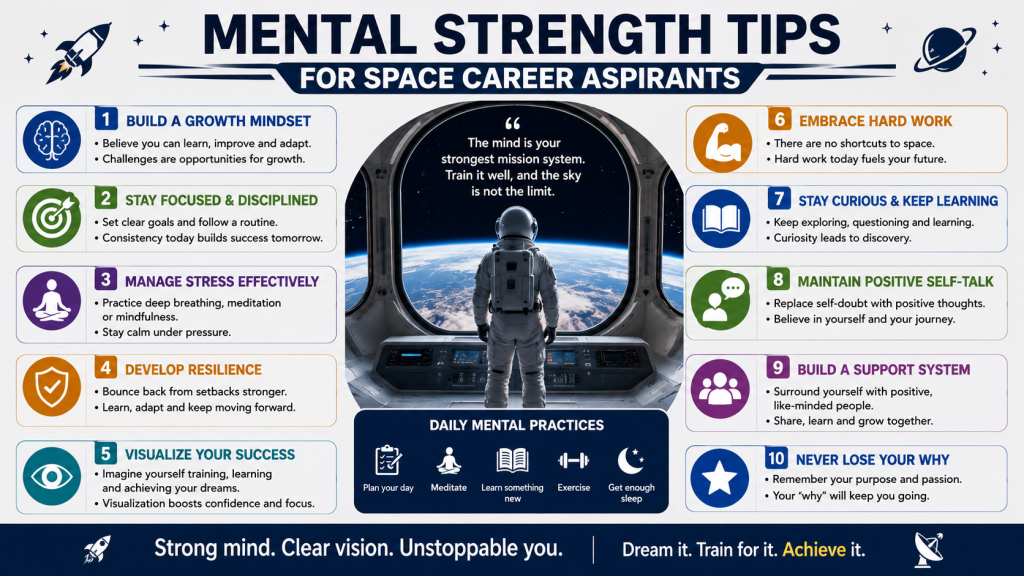
1. Emotional Resilience
Emotional resilience means being able to recover from setbacks and continue working toward meaningful goals. Aspirants can develop it by recognizing difficult emotions without allowing them to control their decisions.
2. Discipline
Mental strength is closely connected with discipline. A consistent study, fitness, skill-development, and rest routine can help aspirants build habits that remain useful during demanding training.
3. Concentration
Strong concentration helps individuals process information accurately and avoid unnecessary distractions. Activities such as structured study sessions, simulation-based training, and deliberate practice can improve the ability to maintain attention.
4. Adaptability
Plans can change quickly in aviation and space-related environments. Developing an adaptable mindset helps aspirants accept new information and adjust their approach without losing focus.
5. Self-Confidence
Confidence is useful when it is based on preparation and realistic self-assessment. Aspirants should recognize their strengths while remaining willing to learn from instructors, teammates, and previous mistakes.
6. Patience
Building a career in the space sector can take years of education and preparation. Patience helps aspirants remain committed when results do not appear immediately.
Practical Ways to Build Mental Strength
| Practice | How It Helps | Example |
|---|---|---|
| Goal setting | Creates direction and measurable progress | Set weekly study and skill-development targets |
| Controlled breathing | Helps manage immediate stress | Practice slow breathing before an important task |
| Regular exercise | Supports overall resilience and routine | Maintain a consistent fitness schedule |
| Reflection | Helps identify strengths and weaknesses | Review what went well after a difficult task |
| Simulation and practice | Builds familiarity with demanding situations | Practice technical or decision-making scenarios |
| Adequate rest | Supports concentration and recovery | Maintain a consistent sleep routine |
Set Realistic Goals
Instead of focusing only on becoming an astronaut or securing a particular position, divide the larger objective into smaller milestones. Academic improvement, technical knowledge, communication skills, physical fitness, and practical experience can each become individual goals.
Practice Under Pressure
Aspirants can gradually become comfortable with pressure by practicing important tasks under realistic conditions. Mock tests, timed exercises, simulations, and structured problem-solving activities can help reduce anxiety associated with unfamiliar situations.
Learn From Mistakes
After making a mistake, ask three questions: What happened? Why did it happen? What can I do differently next time? This approach turns setbacks into practical learning opportunities.
Develop a Healthy Routine
Mental performance is influenced by daily habits. A balanced routine involving study, exercise, rest, hobbies, social interaction, and personal time can help prevent unnecessary exhaustion.
Practice Clear Communication
Space-related careers often involve teamwork. Practice listening carefully, explaining ideas clearly, accepting constructive criticism, and communicating concerns without hesitation.
Common Mistakes to Avoid
One common mistake is believing that mental strength means never feeling nervous, tired, or uncertain. These emotions are normal. Mental resilience is better understood as the ability to recognize these feelings and respond to them constructively.
Another mistake is focusing exclusively on technical skills while ignoring communication, emotional regulation, and teamwork. A technically capable professional still needs to function effectively within a team.
Aspirants should also avoid comparing their progress constantly with others. Career paths differ, and comparison can create unnecessary pressure. Personal progress should be measured against realistic goals and previous performance.
Finally, ignoring rest in the belief that working continuously demonstrates dedication can be counterproductive. Recovery is an important part of maintaining consistent performance.
Benefits and Limitations of Mental-Strength Training
| Benefits | Limitations |
| Improves stress-management skills | Does not eliminate stressful situations |
| Supports better concentration | Results require consistent practice |
| Encourages resilience after setbacks | Individual responses to stress vary |
| Can improve confidence and discipline | Cannot replace professional support when needed |
| Supports teamwork and communication | Mental preparation alone cannot replace technical training |
| Helps with long-term goal commitment | Progress may be gradual rather than immediate |
Mental-strength practices can provide valuable preparation, but they are not a substitute for comprehensive professional training. Space careers require a combination of education, technical competence, physical readiness, teamwork, decision-making, and psychological preparedness.
Important Considerations for Space Career Aspirants
Mental preparation should be treated as part of a broader development plan. Aspirants should focus on academic performance, technical knowledge, communication, physical fitness, practical experience, and healthy lifestyle habits alongside psychological resilience.
It is also important to understand personal limits. Experiencing stress or emotional difficulty does not mean someone lacks the qualities needed for a demanding career. When mental or emotional challenges become difficult to manage, seeking appropriate professional support can be a responsible part of preparation.
Most importantly, mental strength develops gradually. It is built through repeated practice, realistic challenges, reflection, recovery, and learning from experience rather than through a single technique.
Frequently Asked Questions
1. Why is mental strength important for a space career?
Mental strength can help professionals manage pressure, maintain concentration, adapt to changing situations, and recover from setbacks during training and professional responsibilities.
2. Can mental strength be developed?
Yes. Resilience, discipline, concentration, adaptability, and stress-management skills can be strengthened through consistent practice and experience.
3. How can students prepare mentally for a space career?
Students can build useful habits through structured study, regular exercise, realistic goal setting, problem-solving practice, teamwork, adequate rest, and reflection after challenging experiences.
4. How should aspiring astronauts deal with failure?
Failure can be treated as feedback. Reviewing what went wrong, identifying areas for improvement, and adjusting future preparation can make setbacks productive learning experiences.
5. Does confidence matter in space-related careers?
Yes, but confidence should be supported by preparation and realistic self-assessment. Being confident while remaining open to feedback is generally more useful than overconfidence.
6. How can aspirants manage stress during preparation?
Maintaining a balanced routine, organizing tasks, practicing relaxation techniques, exercising regularly, getting adequate rest, and seeking appropriate support can help manage stress.
7. Why is adaptability important for space professionals?
Space and aerospace environments can involve unexpected technical, operational, or environmental challenges. Adaptability helps professionals adjust to new information and changing circumstances.
8. Is physical fitness enough for a space career?
No. Physical preparation is only one component. Space-related careers can also require technical knowledge, emotional resilience, communication, teamwork, decision-making, and discipline.
9. How can someone improve concentration?
Consistent study routines, reducing distractions, practicing tasks for focused periods, taking appropriate breaks, and getting adequate sleep can support better concentration.
10. What is the most important mental-strength quality for a space career aspirant?
There is no single quality that guarantees success. However, resilience, discipline, adaptability, emotional control, and a willingness to keep learning are all valuable qualities for demanding careers.
Conclusion
Mental strength is an important part of preparing for a challenging career in the space sector. Technical knowledge may open opportunities, but resilience, discipline, adaptability, concentration, and teamwork can help aspirants handle the demands that come with long-term preparation and professional responsibility. By setting realistic goals, learning from setbacks, maintaining healthy routines, and practicing under challenging conditions, aspiring space professionals can gradually strengthen their mental readiness. The goal is not to eliminate pressure or failure, but to become better equipped to respond to them constructively.