Introduction
Spaceflight training demands more than technical knowledge, because the human body must adapt to challenging physical and psychological conditions.
Medical fitness helps determine whether a person can safely participate in demanding training and spaceflight activities.
Astronaut candidates may undergo different health evaluations depending on the organization, mission, and role they are preparing for.
Understanding these medical considerations gives new learners a clearer picture of how humans prepare for life and work in space.
Why Medical Fitness Matters in Spaceflight Training
Spaceflight exposes the human body to conditions that are very different from those experienced on Earth. Training may involve physically demanding exercises, simulated spacecraft environments, underwater activities, high-performance aircraft, isolation exercises, and other challenging situations.
Medical fitness is important because astronauts need to perform tasks reliably while dealing with physical stress, unfamiliar environments, and changing workloads. A candidate’s health can also affect their ability to participate safely in training activities.
Medical evaluation is therefore not simply about determining whether someone is physically strong. It is a broader process that can consider multiple aspects of physical and psychological health.
General Health Assessment
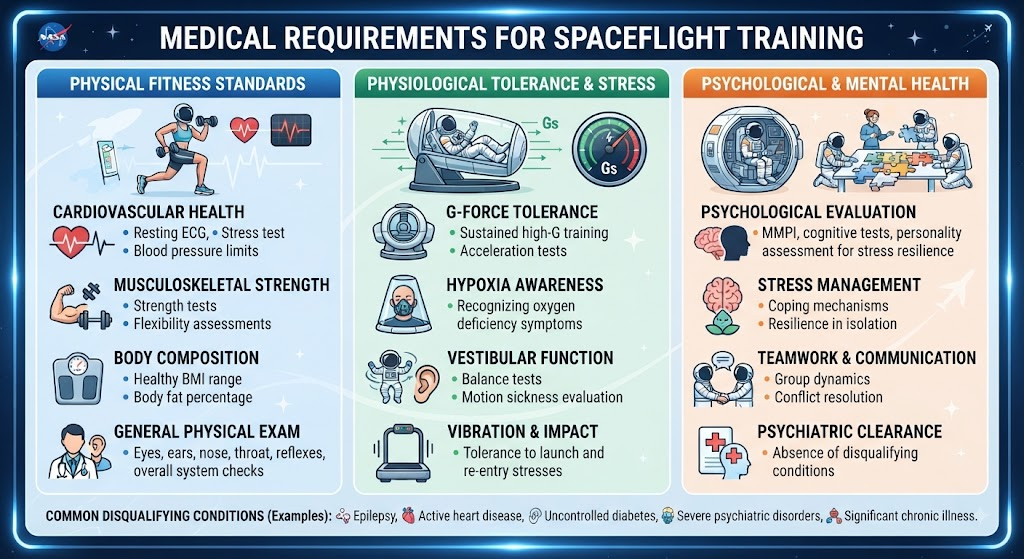
A general medical assessment provides an overall picture of a candidate’s health. Depending on the organization and the purpose of the evaluation, healthcare professionals may review medical history, physical condition, previous injuries, current health concerns, and other relevant factors.
The goal is generally to understand whether an individual can safely manage the demands associated with training and spaceflight.
There is no single medical checklist that applies identically to every astronaut program. Requirements can change according to the space agency, mission profile, crew responsibilities, and current medical standards.
Cardiovascular Fitness
The cardiovascular system includes the heart and blood vessels, which supply oxygen and nutrients throughout the body. Good cardiovascular function is important when a person is performing physically demanding activities.
Astronaut training can include activities that place significant demands on the body. Candidates therefore need an appropriate level of physical conditioning for the training they are expected to complete.
Cardiovascular health may be evaluated as part of a broader medical assessment. Physical conditioning can also help candidates prepare for activities that require endurance and sustained effort.
Musculoskeletal Health
Bones, muscles, joints, and connective tissues play an important role in movement and physical performance. Healthy musculoskeletal function can be particularly relevant during astronaut training because candidates may need to complete demanding physical tasks.
Spaceflight also creates a unique environment for the human body. In microgravity, the body does not experience the same mechanical loading that it normally experiences on Earth. Extended exposure can contribute to changes in muscles and bones.
For this reason, physical conditioning and appropriate medical monitoring are important parts of spaceflight preparation.
Vision and Eye Health
Vision is an important part of many astronaut activities. Crew members may need to read displays, operate equipment, observe instruments, perform scientific tasks, and work in complex environments.
Medical evaluations may therefore include assessments related to eyesight and general eye health. However, the specific standards can differ between organizations and roles.
It is important to avoid assuming that every astronaut program requires exactly the same level of visual performance. Candidates should refer to the current medical standards of the organization to which they are applying.
Hearing and Balance
Hearing allows astronauts to communicate with crew members and ground teams, while the body’s balance system helps a person understand movement and orientation.
The inner ear contains structures involved in detecting motion and maintaining balance. In space, the absence of normal gravity cues can affect how the brain interprets movement and orientation.
During training, candidates may encounter environments that challenge their sense of balance and spatial orientation. Hearing and balance may therefore be relevant considerations when evaluating an individual’s ability to perform certain tasks.
Psychological and Mental Fitness
Spaceflight is not only a physical challenge. Astronauts may spend long periods in confined environments, work closely with the same crew members, follow demanding schedules, and make decisions under pressure.
Psychological fitness can therefore be an important part of astronaut preparation. Evaluations may consider areas such as stress management, concentration, emotional regulation, teamwork, adaptability, and decision-making.
The purpose is not simply to find people who never experience stress. Instead, spaceflight programs need individuals who can function effectively in demanding circumstances and cooperate with others when conditions become difficult.
Medical Screening and Testing
Medical screening can involve several types of evaluation. The exact process depends on the organization, mission, and stage of selection or training.
A candidate may undergo a combination of medical history reviews, physical examinations, laboratory assessments, cardiovascular evaluations, vision and hearing checks, and other assessments considered appropriate for the role.
The following table provides a simplified overview of the major areas that may be considered.
| Medical Evaluation Area | Why It May Matter |
|---|---|
| Cardiovascular health | Supports physical performance and the ability to handle demanding activities |
| Musculoskeletal health | Helps assess movement, strength, joints, bones, and physical function |
| Vision and eye health | Supports tasks involving displays, equipment, observation, and navigation |
| Hearing and balance | Important for communication, orientation, and movement |
| Psychological fitness | Supports concentration, teamwork, decision-making, and coping with demanding conditions |
These areas should be viewed as general categories rather than a universal medical eligibility checklist.
Physical Conditioning Before Spaceflight Training
Physical preparation can help candidates approach demanding training with an appropriate level of fitness. Conditioning may involve several aspects of physical performance rather than focusing on one particular type of exercise.
Cardiovascular endurance can support sustained activity, while strength training can help develop physical capacity. Flexibility, coordination, balance, and recovery are also relevant to overall physical preparation.
The goal is not simply to become as strong or fast as possible. Training should be appropriate to the person’s health, experience, and the requirements of the specific program.
Anyone preparing for a demanding physical program should follow appropriate professional guidance rather than attempting an extreme training routine independently.
Training and Health Considerations
Medical fitness and physical preparation are connected to many parts of astronaut training. Different activities may place different demands on the body, so preparation needs to consider the full training environment.
| Training or Health Consideration | Why It Is Relevant | General Preparation Focus |
| Physical endurance | Some training activities can be prolonged or demanding | Appropriate cardiovascular conditioning |
| Strength | Certain tasks require controlled physical effort | Functional strength development |
| Balance and coordination | Training can involve unusual movements and environments | Coordination and body awareness |
| Recovery | Repeated training requires adequate recovery between activities | Rest, nutrition, and appropriate workload management |
| Psychological readiness | Challenging environments can require sustained concentration and teamwork | Stress management and effective communication |
These considerations are not a substitute for formal medical evaluation. They simply illustrate why astronaut preparation involves more than classroom learning.
Health Considerations During Training
Medical evaluation does not necessarily stop once a candidate has been selected. Astronauts may continue to receive health monitoring during training and mission preparation.
Ongoing monitoring can help identify health concerns, track physical condition, and ensure that individuals are appropriately prepared for upcoming activities.
This is especially relevant because astronaut training can extend over a considerable period. A person’s health and physical condition can change, so maintaining appropriate medical oversight is an important part of preparation.
Factors That Can Influence Medical Requirements
Medical requirements are not necessarily identical across all spaceflight programs. Several factors can influence what is expected from a candidate.
Space Agency or Organization
Different organizations may establish their own selection and medical standards. Their requirements may also change as programs and missions evolve.
Mission Type
A short mission, long-duration mission, scientific mission, or specialized flight may involve different physical and operational demands.
Crew Role
A person’s responsibilities can influence the skills and physical capabilities required during training and flight.
Training Environment
Some candidates may participate in specialized activities that involve particular physical or medical considerations.
Mission Duration
Longer missions can introduce additional considerations related to physical conditioning, health monitoring, and adaptation to the space environment.
For anyone interested in applying to an astronaut program, the most reliable approach is to check the current official requirements provided by the relevant organization.
Is Perfect Health Required?
The idea that every astronaut must have absolutely perfect health is too simplistic.
Spaceflight organizations establish medical standards based on safety, operational requirements, and the specific demands of their missions. The important question is whether a candidate can meet the applicable standards and safely perform the required duties.
Medical requirements can also change over time as research, technology, and mission requirements develop.
Why Medical and Psychological Fitness Work Together
Physical and psychological fitness should not be treated as completely separate areas. A demanding physical environment can affect concentration and decision-making, while stress can influence physical performance.
Astronauts therefore need to function as complete team members rather than simply meeting a physical fitness target. Communication, cooperation, adaptability, and the ability to remain focused can be just as important as physical preparation in certain situations.
Preparing for the Medical Side of Spaceflight Training
People interested in spaceflight should approach medical preparation as a long-term part of their overall development.
Maintaining general fitness, developing healthy habits, getting appropriate medical care, and understanding the requirements of the target organization can all be useful steps.
However, candidates should not attempt to diagnose themselves or decide their eligibility based on general information found online. Formal eligibility decisions are made according to the applicable standards and professional medical evaluations.
FAQs
1. Why do astronauts need medical screening?
Medical screening helps determine whether candidates can safely participate in demanding training and perform the responsibilities associated with spaceflight.
2. Do all space agencies have the same medical requirements?
No. Medical standards can vary between organizations, missions, crew roles, and training programs. Candidates should always check the current requirements of the relevant organization.
3. Is physical fitness enough to qualify for spaceflight training?
No. Physical fitness is only one part of preparation. Medical health, psychological fitness, technical abilities, teamwork, and other selection factors may also be considered.
4. Why are vision and hearing important for astronauts?
Astronauts may need to operate equipment, communicate with crew members and ground teams, read displays, and perform scientific or technical tasks. Vision and hearing can therefore be relevant to safe and effective operations.
5. Is psychological fitness considered during astronaut selection?
Yes, psychological and behavioral factors can be important because astronauts may work in confined environments, manage demanding schedules, cooperate closely with others, and make decisions under pressure.
6. Does medical evaluation continue after astronaut selection?
Health monitoring can continue throughout training and mission preparation. Ongoing evaluation helps organizations manage health and readiness for future activities.
7. Can someone with a previous health issue become an astronaut?
There is no universal answer. Eligibility depends on the specific condition, applicable medical standards, mission requirements, and professional evaluation. A person should consult the relevant spaceflight organization for current requirements rather than relying on general assumptions.
Conclusion
Medical fitness is an essential part of preparing humans for spaceflight because the environment places demands on both the body and mind. Cardiovascular health, musculoskeletal function, vision, hearing, balance, psychological fitness, and general health can all be relevant areas of consideration.
At the same time, there is no single medical standard that applies identically to every spaceflight program. Requirements can vary according to the organization, mission, crew role, and training environment. For anyone interested in pursuing spaceflight, understanding these general principles is a useful first step, while the official requirements of the relevant organization should always be treated as the final reference.