
Introduction
Software enterprises face unrelenting pressure to ship feature updates at high speed while maintaining total platform availability, zero-trust security, and optimal performance. Operating complex multi-cloud ecosystems, maintaining automated deployment pipelines, and resolving real-time production incidents requires continuous, highly specialized technical management.
Collaborating with dedicated cloud operations specialists shifts your organization from reactive troubleshooting to proactive platform governance. This guide explores how tailored operational support models increase application uptime, eliminate infrastructure management friction, and empower software development teams to push features faster.
What Are DevOps Support Services?
Modern applications depend on continuous cloud supervision, automated release pipelines, and proactive performance tuning. Specialized DevOps Support Services supply this operational foundation by providing dedicated technical management across complex cloud infrastructure.
Dedicated operations engineers oversee continuous integration pipelines, container fleets, security configurations, and cloud servers around the clock. Consequently, internal software developers focus 100% of their energy on writing core product code rather than fixing server crashes.
Industry benchmarks demonstrate that organizations leveraging structured operational support experience 60% fewer deployment failures while resolving production issues three times faster.
Why DevOps Support Matters
Unmanaged cloud expansion brings severe security vulnerabilities, frequent service disruptions, and crippling database bottlenecks. Without continuous operational oversight, minor system glitches quickly cause major outages that ruin customer trust.
Dedicated infrastructure engineers establish real-time monitoring tools that catch performance drops long before end-users experience service degradation. Furthermore, continuous security checks prevent accidental misconfigurations during high-velocity software updates.
Ultimately, proactive operational management transforms volatile software deployments into stable, repeatable workflows that directly support business growth.
24/7 DevOps Support Services: When Do They Make Sense?
Global application users expect continuous system availability, lightning-fast performance, and absolute data security around the clock. Forcing full-time, on-call operational duties onto primary software developers causes severe burnout and increases staff turnover.
Engaging 24/7 DevOps Support Services provides immediate technical protection when your applications handle financial transactions or serve global users across different time zones. On-call specialists actively monitor system metrics to resolve server spikes, database locks, and network delays in real time.
- Global SaaS Applications: Maintain uninterrupted access for international user bases across every region.
- E-Commerce Networks: Protect checkout processing systems and maintain performance during traffic surges.
- Mission-Critical Platforms: Enforce strict response SLAs and secure immediate emergency incident resolution.
Managed DevOps Services vs Internal DevOps Operations
Choosing whether to scale an internal engineering department or partner with external specialists impacts operational velocity. The comparison table below outlines key differences between these operational choices:
| Operational Metric | Internal DevOps Operations | Managed DevOps Services |
| Coverage Scope | Typically limited to local business hours | Guarantees true 24/7/365 active platform monitoring |
| Cost Structure | High overhead via salaries, perks, and training | Predictable, fixed monthly operational investment |
| Technical Expertise | Limited to the specific skill set of in-house staff | Immediate access to certified cloud, SRE, and security specialists |
| Onboarding Speed | Requires months to recruit, hire, and train talent | Integrates fully functional engineering teams within days |
By adopting Managed DevOps Services, fast-growing software companies secure enterprise-grade cloud expertise without facing the steep financial costs of full-time hiring programs.
What Should a Good DevOps Support Model Include?
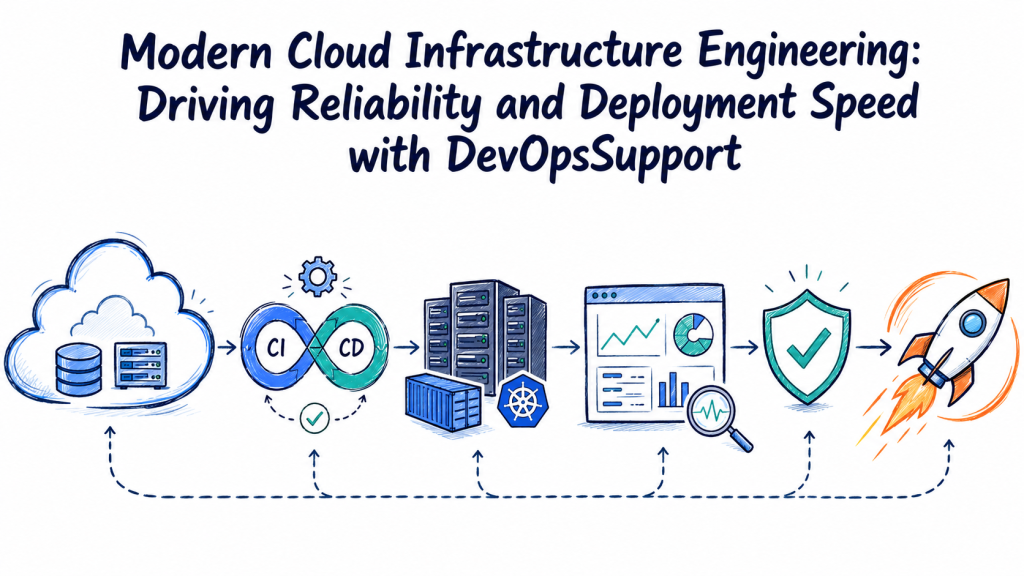
A robust cloud operational framework relies on five core technical pillars designed to maintain system health and accelerate release cycles:
- Automated CI/CD Pipelines: Reliable build workflows that eliminate human errors during code deployments.
- Full-Stack Observability: Proactive log collection, metric dashboards, and smart alert routing.
- Infrastructure as Code (IaC): Version-controlled cloud provisioning using tools like Terraform.
- Continuous Security Operations: Automated vulnerability scanning, patch management, and access controls.
- Disaster Recovery: Automated backup strategies paired with rapid failover protocols to protect business data.
Engineering surveys show that organizations implementing this complete model lower overall cloud operating costs by up to 45%.
DevOps Support Company India: What Should Businesses Evaluate?
Partnering with a specialized DevOps Support Company India gives organizations access to certified technical talent, round-the-clock coverage, and efficient operational execution. However, selecting the right partner requires thorough evaluation.
First, inspect their historical performance with complex multi-cloud migrations and container orchestration. Second, verify their contractual commitment to rapid response times for high-severity incidents.
Finally, confirm that the support team emphasizes clear documentation, transparent escalation channels, and smooth integration with your existing engineering processes.
Kubernetes Support Services
Containerized applications provide immense architectural flexibility, but managing production Kubernetes clusters demands deep domain knowledge. Configuration errors cause severe security gaps and cluster instability.
Through tailored Kubernetes Support Services, technical teams gain continuous cluster administration, smooth version upgrades, automated scaling policies, and network ingress management. Operations experts fine-tune resource requests so applications handle sudden traffic spikes without performance loss.
A fast-growing fintech platform recently used expert cluster tuning to reduce cloud compute costs by 35% while doubling application transaction capacity during peak usage hours.
AWS DevOps Support Services
Amazon Web Services offers an extensive cloud toolset, but constructing secure, cost-effective environments requires continuous maintenance. Unoptimized cloud resources cause unexpected cost spikes and security risks.
Comprehensive AWS DevOps Support Services keep core cloud infrastructure optimized across EKS, ECS, EC2, Lambda, and database clusters. Engineers build automated Terraform deployment pipelines while enforcing strict AWS security standards.
Continuous telemetry and automated patching ensure your Amazon Web Services footprint remains fast, secure, and cost-efficient.
Azure DevOps Support Services
Enterprise organizations operating within the Microsoft ecosystem require specialized technical management to maximize their cloud investment. Configuring Azure Pipelines, AKS clusters, and enterprise networking demands specialized skills.
Professional Azure DevOps Support Services optimize build pipelines, secure Azure Resource Manager templates, and manage containerized software. Specialists automate release strategies to guarantee smooth deployments across staging and production environments.
This consistent operational management enables enterprise teams to increase deployment frequency while fulfilling strict regulatory compliance standards.
DevSecOps Support Services
Modern software practices require embedding security directly into deployment pipelines rather than treating it as a final manual review. Early security integration prevents expensive post-production bug fixes.
Through specialized DevSecOps Support Services, engineers embed automated vulnerability scanners, code analysis, and container image auditing directly into your CI/CD pipelines. Security specialists configure centralized secrets management and strictly enforce zero-trust access policies.
This active security strategy stops code flaws from reaching production, protecting sensitive business assets and maintaining compliance standards.
SRE Support Services
Site Reliability Engineering combines software development techniques with operational management to create self-healing, highly resilient software systems. SRE specialists focus on building automation rather than manually fixing repetitive server alerts.
By utilizing SRE Support Services, organizations establish clear Service Level Indicators (SLIs) and Service Level Objectives (SLOs) to measure platform health accurately. Engineers manage error budgets, perform root-cause analysis, and build self-healing remediation routines.
Consequently, core software products deliver high availability, smooth deployment cycles, and stable end-user performance during heavy traffic loads.
MLOps Support Services
Deploying and managing machine learning models in production introduces unique operational challenges, including data drift, model retraining, and specialized hardware management.
Dedicated MLOps Support Services provide real-time monitoring for production machine learning models, automated retraining pipelines, and efficient GPU infrastructure scaling. Technical specialists bridge the operational gap between data science teams and cloud engineers.
This specialized operational pipeline ensures AI features maintain high prediction accuracy, fast response times, and exceptional production reliability.
A Practical Example of DevOps Support
A rapidly expanding logistics platform faced frequent deployment failures and database freezes during peak shipping hours. Emergency alerts constantly interrupted internal developers, halting core feature development for weeks.
After partnering with dedicated cloud operations specialists, the company implemented automated regression tests, zero-downtime deployment pipelines, and proactive database tuning. Average incident resolution time instantly dropped from several hours to under five minutes.
Consequently, the platform restored developer velocity, achieved 99.99% system availability, and doubled its monthly software release frequency.
How to Build a DevOps Support Strategy
Designing a high-impact operational strategy requires a clear step-by-step roadmap tailored to your business goals:
- Step 1: Perform System Audits: Map current pipeline bottlenecks, security risks, and unoptimized cloud resources.
- Step 2: Define Core Metrics: Establish clear targets for deployment speed, lead time for changes, and mean time to recovery (MTTR).
- Step 3: Establish Incident Workflows: Build clear escalation paths and automated alert routing for critical production outages.
- Step 4: Automate Infrastructure: Transition manual infrastructure configurations into version-controlled Infrastructure as Code templates.
- Step 5: Iterate Continuously: Conduct detailed post-incident reviews to continuously refine workflows and platform reliability.
How DevOps Support Can Reduce Operational Overhead
Maintaining internal operational capabilities requires heavy ongoing investments in technical recruitment, continuous training, and software licensing. Furthermore, platform outages create immediate financial losses and permanent brand damage.
External operational support dramatically reduces company overhead by offering flexible, highly scalable service models. Instead of hiring niche engineers for every distinct cloud technology, your company accesses a complete team of certified cloud experts immediately.
This shared services framework lowers monthly operational costs while raising system performance and enterprise security standards.
When Should You Consider External DevOps Support?
Recognizing operational bottlenecks early prevents infrastructure debt from slowing down your overall business expansion. Specific structural indicators signal the precise moment your company needs dedicated external assistance.
- Frequent Production Outages: System updates regularly crash core user features or trigger unexpected downtime.
- Engineer Fatigue: Developers spend more time managing cloud servers than building customer-facing software features.
- Slow Release Cycles: New software updates take months due to manual testing and manual approval gates.
- Uncontrolled Cloud Bills: Monthly cloud expenditures rise rapidly without clear usage tracking or resource optimization.
Why a Specialized Support Partner Can Help
Collaborating with a dedicated operational partner provides an immediate strategic edge. Specialized engineering teams bring extensive operational experience gathered from managing hundreds of complex cloud environments across global industries.
These experts introduce battle-tested automation templates, proven security baselines, and advanced monitoring frameworks directly into your company’s tech stack. Instead of wasting months troubleshooting obscure cloud bugs internally, your team adopts proven solutions right away.
This high-value technical alliance establishes long-term engineering operational excellence, allowing your core business to scale rapidly and securely.
Frequently Asked Questions About DevOpsSupport
What exact cloud maintenance tasks does DevOpsSupport manage for modern engineering teams?
DevOpsSupport manages round-the-clock cloud monitoring, CI/CD pipeline automation, Infrastructure as Code provisioning, security hardening, Kubernetes cluster management, and emergency incident response across all major cloud platforms.
How long does it take specialized operational engineers to onboard into an existing workflow?
Specialists complete full team integration within days by auditing your existing architecture, setting up secure access channels, configuring alert routes, and aligning with your team communication tools.
Does hiring an external operations team require replacing our current developers?
External support empowers your internal developers by removing heavy cloud maintenance, on-call burdens, and manual deployment tasks so your team stays focused on product development.
What specific steps do 24/7 DevOps Support Services take during a production outage?
Engineers use automated telemetry systems that trigger instant notifications, allowing on-call specialists to analyze root causes and restore systems within strict SLA guarantees.
How do engineers identify and eliminate unnecessary cloud infrastructure costs?
Engineers perform deep cost optimization audits, right-sizing underutilized cloud instances, eliminating orphaned storage assets, and reserving cloud capacity to cut monthly bills significantly.
Which cloud providers, container technologies, and CI/CD tools do your engineers support?
Specialists support AWS, Microsoft Azure, Google Cloud Platform, Kubernetes, Docker, Terraform, Ansible, Jenkins, GitHub Actions, Prometheus, and advanced DevSecOps security scanners.
How do automated CI/CD pipelines improve software release velocity for businesses?
Automating build, test, and release workflows removes manual deployment errors, empowering your software engineers to ship production updates multiple times each day safely.
What is the core structural difference between standard DevOps and DevSecOps support models?
DevSecOps embeds automated vulnerability scanners, code analysis, and compliance checks directly into deployment pipelines, whereas traditional DevOps prioritizes build automation and infrastructure delivery.
Why do global technology companies choose to work with a DevOps Support Company India?
Partnering with an established Indian support firm grants international organizations access to certified cloud talent, round-the-clock coverage, and exceptional operational cost efficiency.
What methods do SRE Support Services utilize to uphold maximum uptime SLAs?
SRE engineers define clear SLO targets, construct self-healing automated routines, and conduct chaos tests to ensure systems remain reliable during massive user traffic spikes.
Final Thoughts
Optimizing enterprise cloud management no longer requires internal software developers to delay feature updates or handle exhausting night shifts. Deploying automated delivery pipelines, continuous system observability, and proactive security checks converts cloud management into a distinct competitive advantage.
Partnering with experienced operational engineers ensures your application platforms remain fast, highly secure, and continuously accessible to global users. Upgrading your infrastructure strategy today establishes the scalable technical foundation your business needs to expand without limits.