Introduction
Space technology includes the machines, systems, software, materials, and scientific tools used to explore space and support activities beyond Earth.
It includes powerful launch rockets, communication satellites, astronaut spacecraft, planetary rovers, space telescopes, navigation systems, heat shields, spacesuits, and mission-control networks.
Space technology may appear highly complex, but most systems are designed to solve a few basic problems. A spacecraft must reach space, survive harsh conditions, communicate with Earth, receive power, control its direction, complete its mission, and sometimes return safely.
This beginner-friendly guide explains the most important areas of space technology in simple language. It also shows how these technologies support weather forecasting, navigation, communication, scientific research, human spaceflight, and future missions to the Moon and Mars.
What Is Space Technology?
Space technology refers to equipment and systems designed for use in space or for supporting space missions from Earth.
It covers technologies used to:
- Launch spacecraft
- Place satellites into orbit
- Explore planets and moons
- Observe Earth
- Communicate over long distances
- Support astronauts
- Navigate through space
- Collect scientific data
- Return spacecraft safely
- Monitor space weather
Some space technologies are used directly in orbit, while others operate from launch sites, tracking stations, laboratories, and mission-control centres.
Why Space Technology Is Important
Space technology supports many services used in everyday life.
Satellites help provide:
- Weather forecasts
- Television signals
- Internet connections
- Navigation services
- Emergency communication
- Climate monitoring
- Disaster tracking
- Agricultural information
- Aviation support
- Maritime navigation
Space technology also helps scientists study Earth, the solar system, distant stars, and the universe.
Without it, many modern communication, transportation, and scientific systems would be less accurate or unavailable.
Main Areas of Space Technology
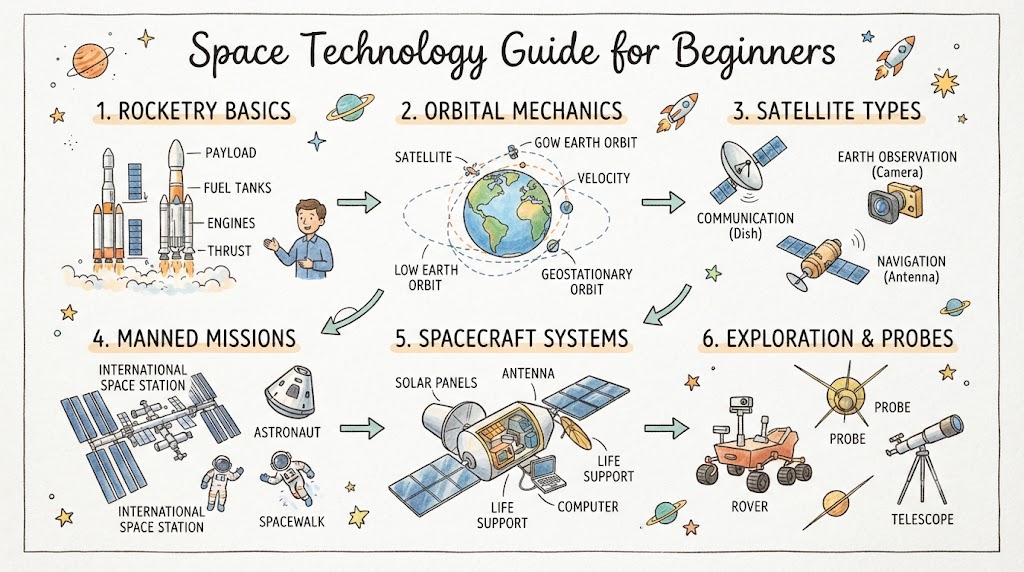
Space technology can be divided into several major areas:
- Rocket and launch technology
- Spacecraft technology
- Satellite technology
- Communication systems
- Navigation systems
- Power systems
- Life-support technology
- Robotics
- Scientific instruments
- Reentry and landing systems
- Ground-control technology
- Space manufacturing and future innovation
Each area supports a different part of a mission.
Rocket Technology
Rockets carry spacecraft beyond Earth’s atmosphere.
Unlike aircraft engines, rockets do not depend on oxygen from the atmosphere. They carry both fuel and an oxidiser.
When rocket fuel burns, hot gases move rapidly out of the engine nozzle. This creates thrust that pushes the rocket upward.
Main Parts of a Rocket
A launch rocket commonly includes:
- Engines
- Fuel tanks
- Oxidiser tanks
- Guidance computers
- Navigation sensors
- Structural sections
- Payload fairing
- Separation systems
- Communication equipment
- Safety systems
Every part must operate correctly during launch.
Rocket Stages
Many rockets use multiple stages.
Each stage contains fuel and engines. After a stage uses most of its fuel, it separates from the remaining vehicle.
Removing empty stages reduces weight and improves efficiency.
A typical launch may involve:
- First-stage ignition
- Lift-off
- First-stage separation
- Upper-stage ignition
- Payload fairing separation
- Spacecraft deployment
Reusable Rockets
Traditional rockets often use major sections only once.
Reusable rockets are designed so that parts of the launch vehicle can return and fly again.
Benefits may include:
- Lower launch costs
- Faster mission preparation
- Reduced hardware waste
- More frequent launches
- Improved commercial access to space
Reusable systems require accurate guidance, strong structures, reliable engines, and safe landing technology.
Spacecraft Technology
A spacecraft is a vehicle designed to operate beyond Earth’s atmosphere.
Spacecraft may carry astronauts, scientific instruments, cargo, communication equipment, or robotic systems.
Main spacecraft types include:
- Crew capsules
- Spaceplanes
- Satellites
- Space probes
- Orbiters
- Landers
- Rovers
- Cargo vehicles
- Space stations
Each spacecraft is designed around its mission.
Spacecraft Structure
The spacecraft structure supports all major components.
It must survive:
- Launch vibration
- High acceleration
- Extreme temperature
- Vacuum
- Radiation
- Micrometeoroid impacts
- Engine forces
- Landing impact
Engineers try to make spacecraft structures strong but lightweight.
Common materials may include aluminium alloys, titanium, carbon composites, ceramics, and specialised heat-resistant materials.
Satellite Technology
A satellite is an object that travels around a planet or another celestial body.
Artificial satellites are placed in orbit for communication, navigation, observation, science, or defence.
Communication Satellites
Communication satellites relay signals between different locations.
They support:
- Television broadcasting
- Internet services
- Telephone communication
- Military communication
- Aviation communication
- Ship communication
- Emergency response
The satellite receives a signal, processes or strengthens it, and sends it toward another location.
Weather Satellites
Weather satellites observe clouds, storms, oceans, temperatures, and atmospheric conditions.
They help experts:
- Track cyclones
- Predict rainfall
- Monitor cloud movement
- Observe wildfires
- Study climate
- Issue storm warnings
Weather forecasting depends heavily on satellite data.
Earth Observation Satellites
Earth observation satellites collect information about the planet’s surface and environment.
They may monitor:
- Forests
- Crops
- Rivers
- Oceans
- Ice
- Cities
- Pollution
- Natural disasters
- Land use
This data supports environmental protection, agriculture, urban planning, and disaster management.
Navigation Satellites
Navigation satellites provide timing and position information.
Receivers use signals from several satellites to calculate location.
Navigation systems support:
- Aircraft
- Ships
- Cars
- Smartphones
- Surveying
- Emergency services
- Scientific research
Accurate timing is one of the most important parts of satellite navigation.
Satellite Orbits
Different missions require different orbits.
Low Earth Orbit
Low Earth orbit is relatively close to Earth.
It is commonly used for:
- Earth observation
- Crewed missions
- Space stations
- Scientific satellites
- Communication constellations
Satellites in this orbit move around Earth quickly.
Medium Earth Orbit
Medium Earth orbit is often used by navigation satellites.
It provides broad coverage and stable positioning services.
Geostationary Orbit
A satellite in geostationary orbit appears to remain above the same region of Earth.
This orbit is useful for:
- Communication
- Television
- Weather monitoring
The satellite travels around Earth at the same rotational rate as the planet.
Polar Orbit
A polar-orbiting satellite travels near Earth’s poles.
As Earth rotates below it, the satellite can observe most of the planet over time.
Space Communication Technology
Communication systems connect spacecraft with Earth.
Mission teams use communication links to:
- Send commands
- Receive scientific data
- Monitor spacecraft health
- Speak with astronauts
- Update software
- Track position
- Respond to emergencies
Spacecraft Antennas
Spacecraft use antennas to send and receive radio signals.
Common antenna types include:
- High-gain antennas
- Low-gain antennas
- Dish antennas
- Phased-array antennas
High-gain antennas provide stronger, more focused communication but must usually point accurately toward Earth.
Ground Stations
Ground stations are facilities that communicate with spacecraft.
They may include:
- Large antennas
- Tracking equipment
- Computers
- Signal processors
- Communication networks
- Mission-support teams
Ground stations are placed in different regions so they can maintain contact as Earth rotates.
Communication Delay
Radio signals travel at the speed of light, but space distances are enormous.
Communication with nearby satellites may feel almost immediate.
Communication with distant planets may take several minutes or longer.
Because of this delay, deep-space spacecraft need some ability to operate independently.
Space Navigation Technology
Space navigation determines where a spacecraft is, how fast it is moving, and where it will travel next.
Navigation systems may use:
- Star trackers
- Sun sensors
- Gyroscopes
- Inertial measurement units
- Radio tracking
- Cameras
- Radar
- Satellite signals
- Ground calculations
- Onboard computers
Accurate navigation is essential for launch, orbit changes, docking, landing, and planetary travel.
Star Trackers
Star trackers use images of stars to determine spacecraft orientation.
Because star patterns are predictable, onboard computers can compare observed stars with stored maps.
This allows the spacecraft to understand which direction it is facing.
Gyroscopes
Gyroscopes measure rotation and movement.
They help spacecraft maintain stability and track changes in orientation.
Trajectory Correction
During a long journey, even a small error can cause a spacecraft to miss its destination.
Small engine burns are used to correct speed and direction.
These are called trajectory-correction manoeuvres.
Spacecraft Propulsion
Propulsion systems change spacecraft speed and direction.
They may be used for:
- Entering orbit
- Leaving orbit
- Adjusting altitude
- Docking
- Landing
- Deep-space travel
- Attitude control
Chemical Propulsion
Chemical rockets produce high thrust by burning propellant.
They are useful for launch and major manoeuvres.
However, they consume fuel quickly.
Electric Propulsion
Electric propulsion uses electrical energy to accelerate charged particles.
It produces lower thrust but can operate efficiently for long periods.
Electric propulsion is useful for:
- Satellite orbit adjustment
- Long deep-space missions
- Fuel-efficient travel
Small Control Thrusters
Small thrusters rotate and stabilise spacecraft.
They help control attitude, which means the direction the vehicle is facing.
Spacecraft Power Systems
Spacecraft require electricity for:
- Computers
- Communication
- Scientific instruments
- Heating
- Cooling
- Lighting
- Motors
- Navigation
- Life support
Different missions use different power sources.
Solar Panels
Solar panels convert sunlight into electricity.
They are widely used for satellites and spacecraft operating near the Sun.
Solar panels must be correctly pointed and kept as free from dust and damage as possible.
Batteries
Batteries store electrical energy.
They provide power during:
- Launch
- Darkness
- Peak demand
- Emergency conditions
- Short missions
Many spacecraft recharge their batteries using solar panels.
Radioisotope Power Systems
Some spacecraft travel too far from the Sun for solar panels to provide enough energy.
Radioisotope systems use heat from the natural decay of radioactive material to produce power.
They are useful for long missions in dark, cold, or distant environments.
Thermal-Control Technology
Spacecraft can experience extreme temperatures.
One side may face strong sunlight, while another side remains in darkness.
Thermal-control systems keep equipment and crews within safe limits.
They may include:
- Insulation
- Reflective coatings
- Radiators
- Heaters
- Cooling loops
- Ventilation fans
- Heat pipes
Without thermal control, electronics, batteries, instruments, and life-support systems could fail.
Life-Support Technology
Human spaceflight requires systems that maintain a safe living environment.
Life-support technology controls:
- Oxygen
- Carbon dioxide
- Pressure
- Temperature
- Water
- Humidity
- Waste
- Air quality
Oxygen Systems
Spacecraft may carry oxygen in tanks or produce it through onboard processes.
Sensors continuously monitor oxygen levels.
Carbon Dioxide Removal
Astronauts breathe out carbon dioxide.
Filters and chemical systems remove it from cabin air before it reaches dangerous levels.
Water Recycling
Water is heavy and expensive to launch.
Long-duration missions may recycle moisture from cabin air and other approved sources.
The water is filtered and treated before reuse.
Waste Management
Spacecraft require specialised toilets and waste-storage systems because liquids and solids behave differently in microgravity.
Waste systems must protect hygiene, air quality, and crew health.
Spacesuit Technology
A spacesuit acts like a small personal spacecraft.
It protects astronauts during spacewalks and emergency situations.
A spacesuit provides:
- Oxygen
- Pressure
- Cooling
- Communication
- Carbon dioxide removal
- Limited radiation protection
- Protection from small particles
- Mobility
Spacesuits are carefully designed to balance safety with movement.
Space Robotics
Robots perform tasks that may be too dangerous, distant, or repetitive for people.
Space robotics includes:
- Planetary rovers
- Robotic arms
- Autonomous spacecraft
- Inspection robots
- Flying vehicles
- Sample collectors
- Satellite-servicing robots
Planetary Rovers
Rovers travel across the surfaces of planets or moons.
They may use cameras, drills, robotic arms, weather sensors, and chemical instruments.
Rovers must avoid rocks, steep slopes, soft soil, and other hazards.
Robotic Arms
Robotic arms can:
- Move cargo
- Capture spacecraft
- Collect samples
- Repair equipment
- Support experiments
- Position instruments
They may be controlled by astronauts, mission teams, or automated software.
Autonomous Technology
Communication delay makes real-time control difficult on distant worlds.
Autonomous systems allow spacecraft to:
- Avoid obstacles
- Enter safe mode
- Manage power
- Select routes
- Protect instruments
- Respond to faults
Artificial intelligence may make future spacecraft even more independent.
Space Telescopes
Space telescopes observe the universe from outside Earth’s atmosphere.
They can study forms of light that may be blocked or distorted by the atmosphere.
Space telescopes may observe:
- Stars
- Galaxies
- Black holes
- Exoplanets
- Nebulae
- Cosmic radiation
- The early universe
Different instruments observe visible, infrared, ultraviolet, X-ray, or radio signals.
Scientific Instruments
Spacecraft carry instruments according to mission goals.
Common instruments include:
- Cameras
- Spectrometers
- Radar
- Seismometers
- Magnetometers
- Radiation detectors
- Thermometers
- Pressure sensors
- Microscopes
- Drills
- Weather sensors
Cameras
Cameras help with:
- Scientific imaging
- Navigation
- Mapping
- Landing
- Equipment inspection
- Earth observation
Some cameras are designed for measurement rather than ordinary photography.
Spectrometers
Spectrometers study how materials interact with light.
They help scientists identify gases, minerals, ice, and chemicals.
Radar
Radar sends signals toward a surface and analyses the reflected energy.
It can map terrain, measure altitude, detect buried features, and observe through clouds.
Spacecraft Computers and Software
Modern spacecraft depend heavily on computers.
Onboard computers manage:
- Navigation
- Communication
- Power
- Temperature
- Scientific instruments
- Engine control
- Fault detection
- Crew displays
- Landing systems
Spacecraft software must be reliable because repairs may be difficult or impossible.
Redundant Computer Systems
Important spacecraft may contain backup computers.
If one computer fails, another can take control.
This is called redundancy.
Redundancy is also used for sensors, communication systems, power supplies, and other critical equipment.
Safe Mode
Safe mode is a protective operating condition.
If a spacecraft detects a serious problem, it may:
- Stop scientific work
- Reduce power use
- Protect sensitive equipment
- Point antennas toward Earth
- Wait for instructions
Safe mode prevents a small problem from becoming a complete mission failure.
Heat-Shield Technology
Spacecraft returning to Earth enter the atmosphere at high speed.
Air is compressed and heated around the vehicle.
Heat shields protect spacecraft from extreme temperatures.
Ablative Heat Shields
Ablative heat shields slowly burn or wear away during reentry.
As material is removed, it carries heat away from the spacecraft.
Reusable Thermal Protection
Some reusable spacecraft use heat-resistant tiles, blankets, or other materials that survive multiple flights.
These systems require detailed inspection after landing.
Landing Technology
Spacecraft use different landing methods depending on their design and destination.
Common landing systems include:
- Parachutes
- Engines
- Airbags
- Landing legs
- Wings
- Shock absorbers
- Flotation systems
- Sky-crane systems
Parachute Landing
Parachutes slow capsules and planetary probes.
Smaller drogue parachutes may stabilise the vehicle before larger main parachutes deploy.
Powered Landing
Powered landing uses engines to reduce speed before touchdown.
It provides greater control but requires accurate sensors, reliable engines, and enough fuel.
Splashdown
A capsule may descend under parachutes and land in the ocean.
Recovery ships, divers, helicopters, and medical teams then retrieve the crew and spacecraft.
Runway Landing
Spaceplanes use wings and landing gear to return like aircraft.
They require accurate reentry control and a suitable runway.
Space Mission Control Technology
Mission control monitors and supports spacecraft from Earth.
Teams use large computer systems, communication networks, simulations, and tracking data.
Mission-control specialists may manage:
- Navigation
- Propulsion
- Electrical power
- Communication
- Crew health
- Scientific tasks
- Life support
- Emergency response
- Landing
- Recovery
Spacecraft Testing
Spacecraft must survive conditions that are difficult to reproduce.
Engineers use specialised tests before launch.
Vibration Testing
Vibration tests simulate the shaking experienced during launch.
Thermal Vacuum Testing
Thermal vacuum chambers reproduce the low pressure and temperature changes of space.
Radiation Testing
Electronic components are tested to determine how they respond to radiation.
Drop Testing
Capsules, parachutes, landing legs, and airbags may be dropped to test landing performance.
Software Simulation
Computer simulations test navigation, failures, communication, and mission procedures.
Common Risks in Space Technology
Space systems face many hazards.
Launch Failure
Rocket engines, guidance systems, fuel tanks, or structures may fail.
Radiation Damage
Radiation can affect electronics, materials, and human health.
Space Debris
Small objects moving at high speed can damage spacecraft.
Communication Loss
Antenna, software, power, or orientation problems may interrupt signals.
Power Failure
Damaged solar panels or batteries can end a mission.
Extreme Temperatures
Too much heat or cold can damage equipment.
Software Errors
A small programming error can affect navigation or spacecraft control.
Landing Failure
Sensors, engines, parachutes, or navigation systems may fail during descent.
How Engineers Improve Reliability
Engineers improve spacecraft reliability through:
- Redundant systems
- Extensive testing
- Fault-detection software
- Backup communication
- Strong quality control
- Protective shielding
- Emergency procedures
- Design reviews
- Simulations
- Continuous monitoring
Spacecraft must be reliable because sending a repair team is usually impossible.
Space Technology and Aviation
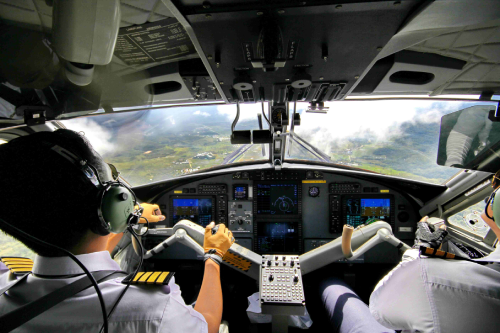
Space technology and aviation share many systems and principles.
Both fields use:
- Navigation
- Communication
- Flight computers
- Weather data
- Crew training
- Checklists
- Automation
- Emergency procedures
- Human-factors research
- Safety management
Future pilots may work with reusable spaceplanes, high-altitude vehicles, commercial spacecraft, or advanced aerospace systems.
Everyday Uses of Space Technology
Space technology affects daily life in many ways.
Examples include:
- Navigation apps
- Weather forecasts
- Satellite television
- International communication
- Disaster warnings
- Online mapping
- Aircraft tracking
- Precision farming
- Environmental monitoring
- Emergency search and rescue
Many people use space-based services without realising it.
Careers in Space Technology
Space technology requires professionals from many fields.
Possible careers include:
- Aerospace engineer
- Satellite engineer
- Rocket engineer
- Spacecraft software developer
- Mission controller
- Robotics engineer
- Astronaut
- Space doctor
- Planetary scientist
- Remote-sensing expert
- Communication engineer
- Materials scientist
- Space lawyer
- Launch operations specialist
Students interested in space careers can build skills in mathematics, physics, engineering, programming, electronics, biology, and communication.
Future Space Technologies
Future space systems may become more reusable, autonomous, and capable.
Possible developments include:
- Reusable launch vehicles
- Commercial space stations
- Lunar habitats
- Space-based manufacturing
- Autonomous planetary robots
- Advanced propulsion
- In-space refuelling
- Satellite repair systems
- Asteroid-resource missions
- Mars transport systems
In-Space Manufacturing
Producing equipment in space could reduce the need to launch every item from Earth.
Future systems may manufacture:
- Tools
- Spare parts
- Structural components
- Medical equipment
- Habitat sections
Space-Based Solar Power
Large solar-power systems in orbit could collect sunlight and transmit energy to Earth or other spacecraft.
This idea requires major advances in construction, safety, and energy transmission.
Advanced Propulsion
Future propulsion systems may allow spacecraft to travel farther using less fuel.
Research areas may include:
- Improved electric propulsion
- Nuclear thermal propulsion
- Solar sails
- High-efficiency ion engines
- Advanced chemical engines
Lunar and Martian Habitats
Long-term human missions will need habitats that provide:
- Radiation protection
- Air
- Water
- Power
- Food storage
- Waste treatment
- Temperature control
- Medical support
Local materials may eventually be used for construction.
Common Misunderstandings About Space Technology
Spacecraft Do Not Operate Without Human Support
Even robotic spacecraft depend on engineers, scientists, and mission controllers.
Satellites Do Not Remain Motionless
They continuously travel around Earth, even when they appear fixed above one region.
Space Is Not Completely Empty
It contains radiation, particles, dust, and debris.
Rockets Do Not Push Against the Air
They move by pushing exhaust gases in the opposite direction.
Automation Does Not Remove Every Risk
Automated systems must still be tested, monitored, and supported by people.
Best Practices in Space Technology
Successful space missions depend on several important practices:
- Clear mission goals
- Reliable engineering
- Strong testing
- Backup systems
- Accurate navigation
- Continuous communication
- Fault monitoring
- Crew training
- Careful risk management
- Post-mission analysis
Key Takeaways
- Space technology includes rockets, satellites, spacecraft, robots, and ground systems.
- Rockets carry spacecraft beyond Earth’s atmosphere.
- Satellites support communication, navigation, weather, and Earth observation.
- Spacecraft require power, navigation, communication, and thermal control.
- Human missions also require life-support systems.
- Robotic spacecraft explore dangerous and distant environments.
- Heat shields and landing systems protect returning vehicles.
- Computers and software control most spacecraft operations.
- Testing and redundancy improve mission reliability.
- Future space technology may support Moon bases, Mars missions, and commercial space travel.
Frequently Asked Questions
What is space technology?
Space technology includes the equipment and systems used to launch, operate, communicate with, and recover spacecraft.
What are the main types of space technology?
Major types include rockets, satellites, crewed spacecraft, robotic probes, communication systems, navigation systems, power systems, and scientific instruments.
How do rockets work?
Rockets burn fuel and push hot gases through an engine nozzle. The opposite force pushes the rocket forward.
How do satellites stay in orbit?
Satellites travel forward fast enough that they continuously fall around Earth instead of reaching the surface.
How do spacecraft communicate with Earth?
They use radio signals, antennas, ground stations, and communication networks.
What powers spacecraft?
Spacecraft may use solar panels, batteries, fuel cells, or radioisotope power systems.
Why do spacecraft need heat shields?
Heat shields protect vehicles from extreme temperatures during atmospheric reentry.
What is the role of robots in space?
Robots explore distant environments, collect scientific data, repair equipment, and prepare for future human missions.
How does space technology help people on Earth?
It supports navigation, weather forecasting, communication, disaster response, environmental monitoring, and scientific research.
What should students study for a space-technology career?
Useful subjects include mathematics, physics, engineering, computer science, electronics, robotics, biology, and communication.
Conclusion
Space technology combines rockets, satellites, spacecraft, computers, communication networks, life-support systems, robots, and scientific instruments. Each technology solves an important challenge, from escaping Earth’s gravity to operating safely in a harsh environment. Understanding these basic systems gives beginners a strong foundation for learning about human spaceflight, robotic exploration, satellite services, and future missions to the Moon and Mars.